
Astrotech Corporation: Platform Diversification, Commercialization Friction, and the Search for Scalable Mass Spectrometry Economics
Astrotech’s proprietary mass spectrometry technology underpins a suite of specialized subsidiaries targeting security, agriculture, industrial, and environmental markets. Despite product certifications and a reported liquidity position snapshot, recurring net losses, modest revenues, and early-stage moonshot projects raise questions about the path to sustainable scale.
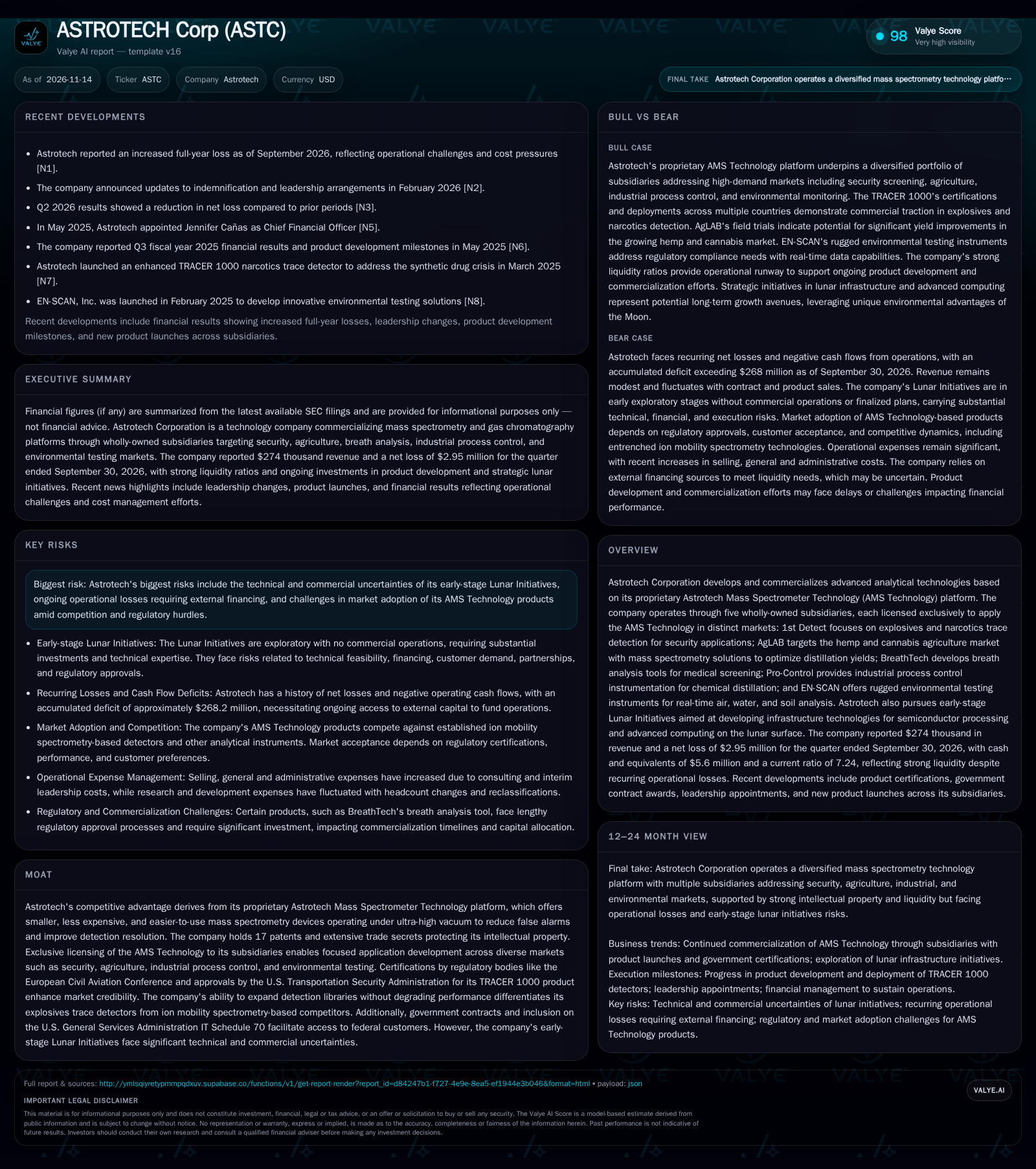
Astrotech commercializes a proprietary mass spectrometry platform through five subsidiaries, with flagship deployments in security and promising field results in agriculture. However, the company continues to report recurring losses, low revenues, and negative cash flows, and it is investing in speculative lunar infrastructure projects. [S2]
Astrotech Corporation sits at the intersection of advanced analytical instrumentation and niche application markets, leveraging its proprietary mass spectrometry platform across a portfolio of specialized subsidiaries. While its TRACER 1000 security product boasts regulatory certifications and international deployments, and AgLAB’s field results suggest potential in cannabis processing, the company’s financials reveal persistent losses and modest revenue traction. Meanwhile, ambitious lunar infrastructure initiatives add speculative upside but increase risk. The central question is whether Astrotech can convert technical credentials and early market entries into sustainable, scalable economics before liquidity pressures mount. [S2]
Where Astrotech Stands: Certifications, Deployments, and Financial Realities
Astrotech’s diversified approach is anchored by its proprietary Astrotech Mass Spectrometer Technology (AMS Technology), commercialized through five wholly-owned subsidiaries targeting security, agriculture, breath analysis, industrial, and environmental markets. The flagship 1st Detect TRACER 1000 is the world’s first mass spectrometry-based explosives trace detector certified by the European Civil Aviation Conference and approved by the TSA for air cargo security, with deployments in approximately 37 locations across 16 countries as of June 2026. [S2]
Despite these technical and commercial milestones, the company reported revenue of $274,000 and a net loss of $2.95 million for the quarter ended September 30, 2026. The company reported cash and liquidity metrics for the period; these figures do not by themselves establish operating runway, investment capacity, financial flexibility, or financing capacity. [S2]
Recent developments include product launches (e.g., enhanced TRACER 1000 narcotics detector, EN-SCAN environmental solutions), new leadership (appointment of a new CFO in May 2025), and the launch of exploratory lunar infrastructure initiatives, which remain pre-commercial and highly speculative at this stage. [N7] [N8] [N5]
How the Subsidiary Model and AMS Technology Could Drive (or Limit) Profitable Scale
Astrotech’s business model is predicated on leveraging a core mass spectrometry platform to serve distinct verticals via subsidiaries—each with its own regulatory and commercial dynamics. The economics hinge on the ability to scale hardware sales (such as TRACER 1000 or AgLAB’s 1000-D2), possibly augmented by recurring revenue from consumables, service contracts, or software updates if these models are adopted. However, the report does not specify the mix of one-time versus recurring revenue, nor the margin profile for each segment. As such, recurring revenue and high-margin service layers remain potential rather than proven mechanisms.
Gross margin for the latest quarter was 37%, indicating moderate hardware margin for a specialized instrumentation business, but not yet at a level that would offset SG&A and R&D requirements. Operating expenses have decreased year-over-year due to headcount reduction and R&D reclassification, but SG&A has increased due to consulting and interim leadership costs. The result is continued negative operating leverage: incremental revenues are not yet sufficient to absorb fixed costs, and cash used in operating activities was $3.2 million for the quarter. [S2]
The capital structure is heavily reliant on equity financing and periodic capital raises, with cash burn partially offset by proceeds from equity programs. Without a step change in gross profit or a shift to higher-margin, recurring revenue streams, the path to self-sustaining operations remains uncertain and capital-intensive. [S2]
AMS Technology’s Differentiation and the Challenge of Displacing Incumbents
Astrotech’s AMS Technology claims key technical advantages: smaller footprint, lower cost, ease of use, and the ability to operate under ultra-high vacuum, which can reduce false alarms and improve resolution. TRACER 1000’s regulatory certifications and U.S. government procurement eligibility (GSA Schedule 70) provide critical market validation, particularly in the security segment. [S2]
However, the main competitive headwind is the entrenched presence of ion mobility spectrometry (IMS) devices, which are widely adopted in security and industrial markets due to their reliability, speed, and regulatory familiarity. For AgLAB and EN-SCAN, the challenge is to convert field trial advantages (such as 20% yield improvements in cannabis processing) into broad market adoption, which often requires both demonstrated ROI and customer willingness to switch from legacy or manual processes.
The breadth of addressable markets—security, agriculture, industrial process control, and environmental testing—offers optionality, but each market is characterized by long sales cycles, regulatory gating, and risk-averse procurement behaviors. Intellectual property protection (17 patents, trade secrets) and the ability to expand detection libraries are durable assets, but these must translate into commercial traction and customer lock-in to create a true moat.
What If Commercial Traction Accelerates Across Verticals?
In the most favorable scenario, Astrotech’s subsidiaries achieve accelerated adoption in their target verticals, driven by regulatory wins, compelling field data, and expansion of product certifications. For example, if TRACER 1000 sees expanded mandates for air cargo security or narcotics detection in additional jurisdictions, or if AgLAB’s yield improvements become an industry standard in cannabis processing, hardware sales and potential recurring service revenue could scale rapidly.
Confirmation would come from a material jump in quarterly revenues (well above current levels), new or expanded government contracts, and evidence of recurring revenue (e.g., service agreements or software upgrades). Gross margin expansion and positive operating leverage—where incremental sales outpace fixed cost growth—would further support the upside case.
A positive surprise could also come from the successful commercialization of EN-SCAN’s environmental solutions, especially if regulatory requirements for real-time monitoring tighten, or if the company signs multi-year contracts with large industrial or governmental customers.
Falsification would be indicated by stagnant or declining revenue, continued reliance on small, one-off product sales, or the inability to convert pilot deployments into broader adoption.
Subsidiary Progress, Slow Revenue Growth, and Ongoing Cash Burn Remain the Most Likely Outcome
The most plausible trajectory is that Astrotech continues to make incremental progress in its core markets—securing additional certifications, deploying more units, and refining its products—but revenue growth remains modest and lumpy, tied to the timing of contract wins and regulatory approvals. Operating expenses may be managed more tightly, but negative cash flow persists absent a step change in scale.
This scenario would be confirmed by quarterly revenues growing at a slow pace, ongoing net losses, and continued cash burn partially offset by financing activities. New product launches or upgrades may generate headlines but do not immediately translate into substantial commercial traction.
If the company can demonstrate a shift toward higher-margin or recurring revenue streams—such as service contracts or consumables—this could improve long-term viability. However, without evidence of such a transition, the base case remains ongoing operational losses and periodic capital raises to maintain liquidity.
When Commercial Adoption Stalls and Liquidity Deteriorates
The primary downside risk is that Astrotech’s products fail to achieve broader market adoption, either due to entrenched competition, regulatory setbacks, or insufficient customer ROI. If pilot programs do not convert to repeat or scaled orders, and if no meaningful recurring revenue emerges, quarterly revenues could stagnate or decline.
Given the company’s historical pattern of negative cash flow and recurring losses, persistent shortfalls could quickly erode the current liquidity buffer. If access to external capital becomes constrained—due to market conditions or dilution concerns—Astrotech could face severe operational cutbacks, delayed R&D, or even restructuring.
This scenario would be confirmed by a shrinking cash balance, rising payables, missed product development milestones, or the announcement of layoffs or business divestitures. Further, the speculative Lunar Initiatives could become a distraction if they consume resources without clear commercial path or progress.
Milestones That Will Reveal Whether Astrotech Can Scale Its Platform
Quarterly revenue growth and its composition—hardware sales versus any disclosed recurring or service revenue streams—will clarify whether the business is scaling or remaining project-based.
Gross margin trends: Sustained improvement would indicate better pricing power or cost discipline, while compression would raise questions about competitive pressure or input costs.
Customer concentration and repeat order rates, if disclosed, would help assess whether deployments are one-off pilots or the beginning of scalable, sticky relationships.
Operating cash flow and quarterly cash burn: Tracking whether operational losses are narrowing or widening will be critical as the company’s liquidity buffer is drawn down.
Progress on regulatory certifications and government contract wins, especially for the TRACER 1000 and EN-SCAN platforms, will signal commercial validation and open larger addressable markets.
Updates on the Lunar Initiatives—including any disclosed commercial partnerships, funding rounds, or pilot projects—would provide clarity on whether this moonshot is an asset or a distraction.
Leadership stability and execution: Changes in executive team or board composition, if frequent, could indicate internal challenges or shifting strategic priorities.
Any announced shift toward recurring revenue models (e.g., service contracts, software subscriptions, or consumables) would materially alter the economics and resilience of the business.
Disclaimer: This is research-only, informational analysis and not investment advice. It may include AI-generated interpretation and general industry context. Always verify important details using primary sources.

Comments