
Cheetah Net’s Post-Transformation Test: Logistics, Trading, and the Realities of Integration
Fresh from a strategic overhaul, Cheetah Net Supply Chain Service Inc. is betting on logistics, international trading, and recent acquisitions to deliver scale and stability. The company’s rapid business mix shift, capital raises, and operational pivots offer new opportunities but leave open questions about integration, profitability, and resilience to sector headwinds.
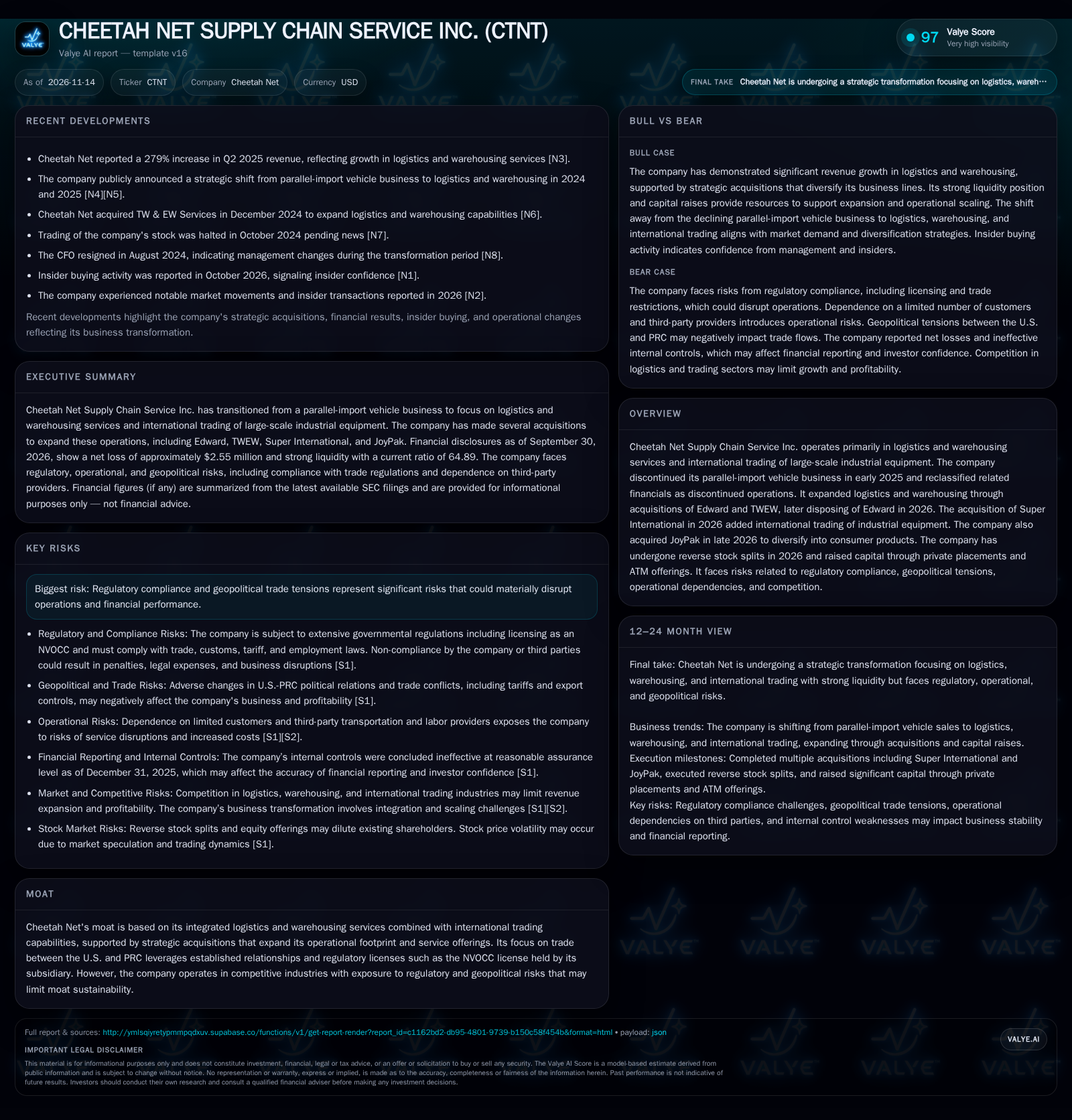
Cheetah Net has exited its legacy vehicle import business to focus on logistics, warehousing, and international trading—an evolution marked by multiple acquisitions, substantial revenue growth, and heavy investments in transformation. The next phase will test whether Cheetah Net can convert its broadened footprint and capital base into sustainable margins and operational coherence. [S2] [N1] [N3]
Cheetah Net Supply Chain Service Inc. is at a pivotal juncture, having exited its legacy parallel-import vehicle business and redirected its focus to logistics, warehousing, and international trading. This transformation, underpinned by a series of acquisitions and a reported liquidity position, has delivered a surge in revenue but not yet profitability. The company’s ability to integrate diverse operations, manage regulatory and geopolitical risks, and realize the potential of its new business lines will determine whether its reinvention delivers durable value or exposes it to new operational and financial vulnerabilities. [S2]
Strategic Pivot and Financial Snapshot: Where Cheetah Net Stands Now
Cheetah Net’s most material recent development is its completed exit from the parallel-import vehicle business in early 2025, with all related financials reclassified as discontinued operations. The company’s current operations are anchored in logistics and warehousing (mainly via TWEW after Edward’s disposal in April 2026) and international trading of large-scale industrial equipment through Super International, acquired in May 2026. In October 2026, Cheetah Net added JoyPak Supply LLC, moving into consumer and personal care products, which will be consolidated from Q4 2026. [S2]
Financially, Cheetah Net reported $4.52 million in revenue and a $2.55 million net loss for the nine months ended September 30, 2026, with a gross profit of $320,774. The company’s liquidity is notable, with $14.5 million in cash and a current ratio of 64.89, following $54 million raised via a private placement and ATM offering in 2026. Insider buying activity was reported in October 2026. [S2] [N1]
How the New Business Lines Could Convert Scale into Profits
Cheetah Net’s pivot to logistics, warehousing, and international equipment trading fundamentally changes its unit economics. Logistics and warehousing typically generate revenue through a mix of contract logistics (multi-year, volume-based agreements), transactional shipping, and value-added services such as labor support and inventory management. Margins in these sectors are often thin but can improve with scale, operational efficiency, and effective asset utilization.
With the acquisition of Super International, Cheetah Net enters the international trading of high-value industrial equipment, a business that can offer higher ticket sizes but is exposed to cyclical demand, working capital intensity, and counterparty risk. The gross profit of $320,774 on $4.52 million in revenue for the first nine months of 2026 suggests a blended margin profile still in flux, likely reflecting ramp-up costs, integration friction, and an evolving customer mix. [S2]
Operating leverage could improve if Cheetah Net can drive higher throughput through its logistics assets and secure recurring or longer-term trading relationships. The company reported cash and liquidity metrics for the period; these figures do not by themselves establish operating runway, investment capacity, financial flexibility, or financing capacity.
Integration, Differentiation, and the Sector’s Competitive Pressures
Cheetah Net operates in highly competitive logistics, warehousing, and international trading sectors. The logistics market is characterized by price-sensitive customers, commoditized core offerings, and intense competition from both global logistics giants and specialized regional providers. Differentiation typically comes from reliability, integrated service offerings, network reach, and technology adoption (e.g., real-time tracking, automation).
The company’s expansion into international trading of industrial equipment positions it against established trading houses and specialized equipment brokers, where success often hinges on supplier relationships, credit management, and the ability to navigate cross-border regulatory and customs complexities.
Cheetah Net’s strategic acquisitions could, in theory, create an integrated service platform for U.S.-PRC trade flows—a potential advantage if the company can deliver reliability and scale. However, integration risks, dependence on third-party providers, and exposure to regulatory and geopolitical disruptions remain significant counterforces. The lack of evidence for durable switching costs or proprietary technology means any competitive advantage is likely to be narrow and execution-dependent at this stage.
If Integration Succeeds and Trade Flows Stabilize, Margin Expansion Is Plausible
The most favorable scenario for Cheetah Net is one in which its recent acquisitions are successfully integrated, allowing the company to deliver a seamless, multi-service logistics and trading platform that attracts new customers and increases wallet share from existing ones. In this scenario, operational synergies could drive margin expansion, and the capital raised in 2026 would fund further automation or selective expansion. Recurring logistics contracts or repeat trading relationships could improve revenue visibility and reduce volatility.
This scenario would be confirmed by sequential revenue growth outpacing increases in operating expenses, steady or improving gross margins, and evidence of recurring customer relationships (such as disclosed contract wins or customer retention rates). Additional insider buying or the ability to secure new logistics or trading licenses in key markets would further validate this pathway.
Integration Drags and Competitive Pressures Temper Growth Ambitions
The most plausible middle path is that Cheetah Net achieves moderate revenue growth as it integrates its new business lines, but profitability remains elusive in the near term due to ongoing integration costs, elevated administrative expenses, and the need to invest in customer acquisition and compliance. The logistics and trading markets remain competitive, keeping pricing power low and gross margins under pressure. [S2]
This scenario would be confirmed by continued net losses, stable or only modestly improving gross margins, and ongoing reliance on capital raises to fund operations. Evidence of customer concentration, persistent internal control weaknesses, or further management turnover would reinforce this ‘work in progress’ trajectory. If the company can demonstrate operational stability and a path to positive operating cash flow, sentiment could improve—but absent that, the risk of further dilution or strategic retrenchment remains.
Integration Stalls, Geopolitics Bite, and Cash Burn Accelerates
In the adverse scenario, Cheetah Net faces major friction in integrating its acquisitions, leading to operational inefficiencies, customer losses, or service disruptions. Heightened regulatory scrutiny, trade restrictions, or renewed U.S.-PRC tensions could disrupt trade flows, erode revenue, or increase compliance costs. Heavy dependence on third-party providers could amplify risks if service quality or labor availability deteriorates.
This scenario would be confirmed by declining or volatile revenues, widening net losses, further increases in general and administrative costs, or evidence of customer attrition. Signs of working capital stress, inability to renew key licenses, or negative findings from internal control reviews would also support the downside thesis. If cash burn accelerates and access to capital tightens, Cheetah Net could be forced to divest assets, retrench, or seek strategic alternatives.
Milestones That Will Reveal Whether Cheetah Net’s Reinvention Is Working
Sequential revenue growth from logistics, warehousing, and international trading lines, with breakdowns by segment if disclosed, to assess whether new acquisitions are driving scale.
Gross margin trends over the next several quarters, as margin expansion would indicate successful integration and improved operating efficiency.
General and administrative expenses as a percentage of revenue; stabilization or decline would suggest integration costs are subsiding.
Evidence of customer diversification or reduced concentration, such as the addition of new major clients or industry segments.
Disclosure of recurring contracts, long-term agreements, or renewal rates in logistics and trading, which would improve revenue visibility and test for stickiness.
Updates on the status of key regulatory licenses, especially NVOCC renewals and any new trade-related approvals.
Progress on remediation of internal control weaknesses, as confirmed by future audit opinions or management disclosures.
Signs of further insider buying or management alignment, which could reinforce confidence if supported by operational progress.
Disclaimer: This is research-only, informational analysis and not investment advice. It may include AI-generated interpretation and general industry context. Always verify important details using primary sources.

Comments