
Calidi Biotherapeutics: Clinical Momentum, Capital Demands, and the Road to Oncology Differentiation
Calidi Biotherapeutics is advancing a focused pipeline in cancer immunotherapy and antitumor virotherapy, with recent progress in clinical development, regulatory milestones, and capital raising. The company’s trajectory now hinges on translating early-stage innovation into clinical proof and funding sustainability in a crowded biotech landscape.
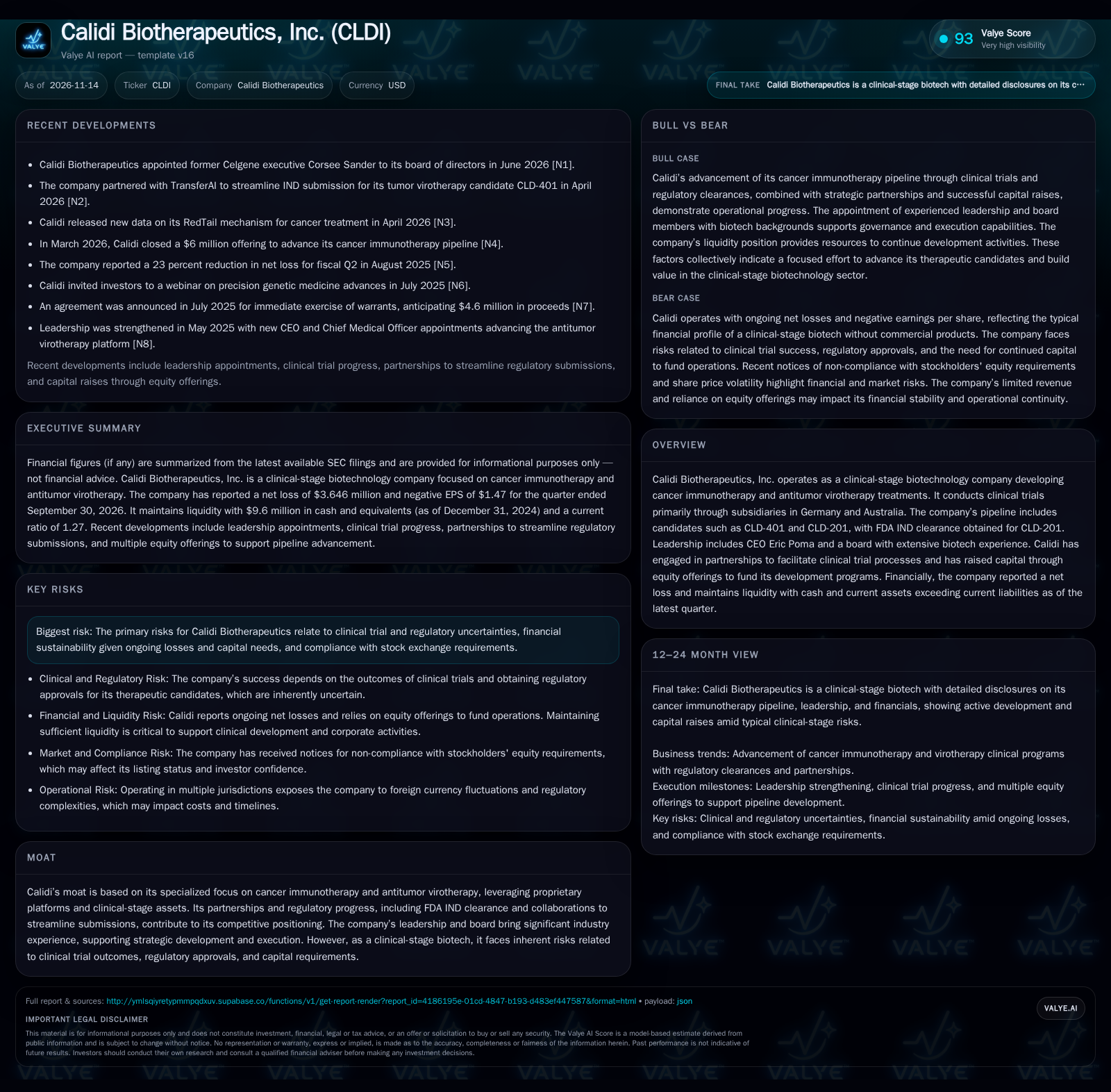
Calidi Biotherapeutics is a clinical-stage biotech pursuing cancer immunotherapy and virotherapy solutions, highlighted by recent FDA IND clearance, new clinical data, and ongoing leadership upgrades. Key factors going forward include trial outcomes, regulatory progress, financial runway, and the ability to distinguish its technology in a competitive oncology field. [S1] [S2] [N2] [N3] [N4]
Calidi Biotherapeutics is navigating the pivotal early years of clinical-stage biotechnology, marked by advances in its cancer immunotherapy and virotherapy pipeline, recent cash infusions, and leadership upgrades. The company’s clinical assets, including the recently FDA-cleared CLD-201 and ongoing trials for CLD-401, underscore operational momentum. However, persistent net losses, reliance on equity financing, and the inherent risks of drug development pose ongoing challenges. The next phase of value creation will depend on Calidi’s ability to generate compelling clinical data, secure additional capital, and carve out a differentiated position in a crowded oncology market.
Recent Pipeline Progress and Capital Raises Set the Stage for Clinical Execution
Calidi Biotherapeutics’ recent operational highlights include FDA IND clearance for its solid tumor candidate CLD-201 and new clinical data on its RedTail mechanism for cancer therapy. The company also advanced its lead virotherapy candidate, CLD-401, through a streamlined IND submission in partnership with TransferAI. On the financial front, Calidi closed a $6 million equity offering in March 2026 and anticipates an additional $4.6 million from warrant exercises, supporting ongoing R&D activities. Leadership was reinforced by the appointment of a new CEO, Eric Poma, and the addition of experienced biotech executives to its board. Together, these developments provide both the operational and financial foundation for the next phase of clinical development, but underscore the capital intensity and execution risks typical of a clinical-stage biotech. [S1] [S2] [N1] [N2] [N3] [N4] [N7] [N8]
The Economics of Oncology Innovation: Cash Burn, Milestone Triggers, and Capital Needs
As a clinical-stage biotechnology company, Calidi generates no product revenue and operates at a net loss, reporting a $3.646 million loss and negative EPS in the most recent quarter. Its business model relies on raising capital—primarily through equity offerings—to fund R&D, clinical trials, and regulatory submissions. The cost structure is dominated by R&D expenses, clinical trial costs, and overhead, with limited variable costs at this stage but significant fixed costs tied to ongoing development. Operating leverage remains negative until a product reaches commercialization.
The company reported cash and liquidity metrics for the period; these figures do not by themselves establish operating runway, investment capacity, financial flexibility, or financing capacity. If Calidi achieves positive clinical milestones—such as favorable Phase 1/2 data—this could unlock further financing at less dilutive terms or enable partnerships with larger pharma companies. Conversely, trial setbacks or delays could accelerate cash burn, increase dilution risk, or force program reprioritization. The economics hinge on the ability to efficiently convert R&D spend into clinical proof, regulatory progress, and ultimately, a path to revenue through licensing, partnership, or commercialization. [S2]
The timing and sequencing of clinical milestones are critical economic inflection points for clinical-stage biotechs like Calidi. Achieving early proof-of-concept can substantially de-risk the pipeline, enabling more favorable financing terms or strategic partnerships. However, the inherent unpredictability of clinical development means that capital planning must incorporate contingencies for delays or negative outcomes. Moreover, the company's capital structure and investor base influence its ability to raise funds without excessive dilution. A concentrated shareholder base or strong institutional support can provide stability, whereas a fragmented ownership may increase volatility during financing rounds.
Differentiation Challenges in a Crowded Oncology and Virotherapy Landscape
Calidi operates in an intensely competitive field, with numerous biotech and pharmaceutical companies pursuing immunotherapies and virotherapy platforms for cancer. Its proprietary candidates, CLD-401 and CLD-201, target areas of high unmet need—solid tumors and recurrent glioma—but must demonstrate clear advantages in efficacy, safety, or delivery to stand out. The company’s competitive positioning is bolstered by recent regulatory progress and the addition of leadership with deep biotech experience, including alumni from Celgene.
However, the oncology space is characterized by rapid innovation, frequent clinical trial failures, and significant capital requirements. Potential competitors range from large pharma with extensive resources to nimble biotechs with differentiated platforms. Substitutes include other immunotherapies (such as checkpoint inhibitors), cell therapies, and next-generation targeted agents. A sustainable edge may depend on demonstrating unique mechanisms of action (such as the RedTail platform), achieving regulatory milestones ahead of peers, or securing strategic partnerships that validate technology and provide access to commercial infrastructure.
In addition to scientific differentiation, Calidi’s competitive positioning depends on its ability to navigate intellectual property landscapes and regulatory exclusivities. Securing robust patent protection around its RedTail platform and product candidates can create barriers to entry and enhance negotiation leverage with partners or acquirers. Furthermore, the company’s development strategy must consider the evolving standards of care and emerging biomarkers that influence patient selection and trial design. Adaptive trial designs or biomarker-driven approaches may improve the probability of clinical success and market adoption. Finally, geographic expansion strategies, including regulatory approvals in multiple jurisdictions, could provide incremental competitive advantages but also require additional resources and regulatory expertise.
The dynamics of the oncology and virotherapy markets also necessitate consideration of reimbursement and market access challenges. Even with positive clinical data, translating efficacy into commercial success requires alignment with payer expectations and health technology assessments. Calidi’s ability to demonstrate cost-effectiveness, quality-of-life improvements, or survival benefits relative to existing therapies will influence its market penetration. Strategic collaborations with commercial partners experienced in oncology reimbursement landscapes can facilitate market entry and scaling. Additionally, ongoing innovation in combination therapies and personalized medicine may open opportunities for Calidi to position its candidates as part of multi-agent regimens, thereby expanding potential indications and revenue streams.
Early Clinical Proof Unlocks Partnering and Funding Opportunities
If Calidi’s clinical programs—particularly CLD-201 and CLD-401—generate compelling early efficacy and safety data, the company could attract interest from larger pharmaceutical partners or investors, enabling non-dilutive funding through licensing or collaboration deals. Positive results could also support additional equity raises at higher valuations, reducing dilution for existing shareholders. The recent FDA IND clearance and new RedTail data suggest that Calidi is making progress toward these inflection points.
Evidence that would confirm the upside scenario includes: strong Phase 1/2 clinical data, new partnership or licensing announcements, accelerated regulatory pathways (such as orphan drug or fast track designations), and successful, less dilutive capital raises. Conversely, the absence of clinical progress or muted investor/pharma interest would challenge this thesis.
Steady Advancement Amid Capital Constraints and Development Risk
The most plausible near-term scenario is that Calidi continues to advance its lead programs through early-stage trials, supported by periodic capital raises via equity or warrant exercises. Incremental clinical progress is likely, but transformative data or major partnerships may remain elusive until later-stage results are available. The company will likely face continued net losses, with cash burn necessitating further fundraising within the next 12-18 months.
Confirmation of this scenario would come from ongoing trial enrollment and data readouts, regular capital raises, and gradual expansion of the pipeline or regulatory filings. Falsification would involve material clinical setbacks, inability to raise new capital, or loss of key personnel.
Clinical or Financing Setbacks Force Retrenchment or Restructuring
The risk scenario centers on negative or inconclusive clinical trial results, regulatory delays, or an inhospitable capital market that limits Calidi’s ability to raise funds. Such setbacks could force the company to halt or reprioritize programs, cut operating expenses, or pursue strategic alternatives such as asset sales or partnerships on unfavorable terms. Prolonged net losses and dilution from distressed financings could erode shareholder value.
Indicators for this downside include missed clinical milestones, failed or delayed trials, unsuccessful fundraising efforts, non-compliance with listing requirements, or abrupt changes in leadership. Confirming evidence would be public announcements of program discontinuations, layoffs, or material going concern warnings.
Milestones That Will Shape Calidi’s Next Chapter in Oncology
Progression status, enrollment rates, and data readouts from ongoing Phase 1/2 trials for CLD-201 and CLD-401 would help test the company’s ability to generate clinical proof-of-concept.
Updates on RedTail mechanism research and whether it demonstrates a material advantage over competing virotherapy or immunotherapy platforms.
Frequency, size, and terms of new capital raises, including whether Calidi can secure less dilutive funding or attract strategic partners.
Regulatory milestones such as orphan drug, fast track, or breakthrough therapy designations that could accelerate timelines or enhance commercial prospects.
Board or management turnover, especially among recently appointed executives and directors with key industry experience.
Announcements of licensing, collaboration, or partnership deals with larger biopharma companies.
If disclosed, cash burn rate and projected runway under current operating plans, especially in relation to clinical milestone timelines.
Disclaimer: This is research-only, informational analysis and not investment advice. It may include AI-generated interpretation and general industry context. Always verify important details using primary sources.

Comments