
Keen Vision Acquisition Corp.: SPAC Execution Hinge and the Stakes of the Medera Merger Pathway
The company's future now depends on deal consummation, integration, and the commercial viability of the target’s pre-clinical drug discovery platform.
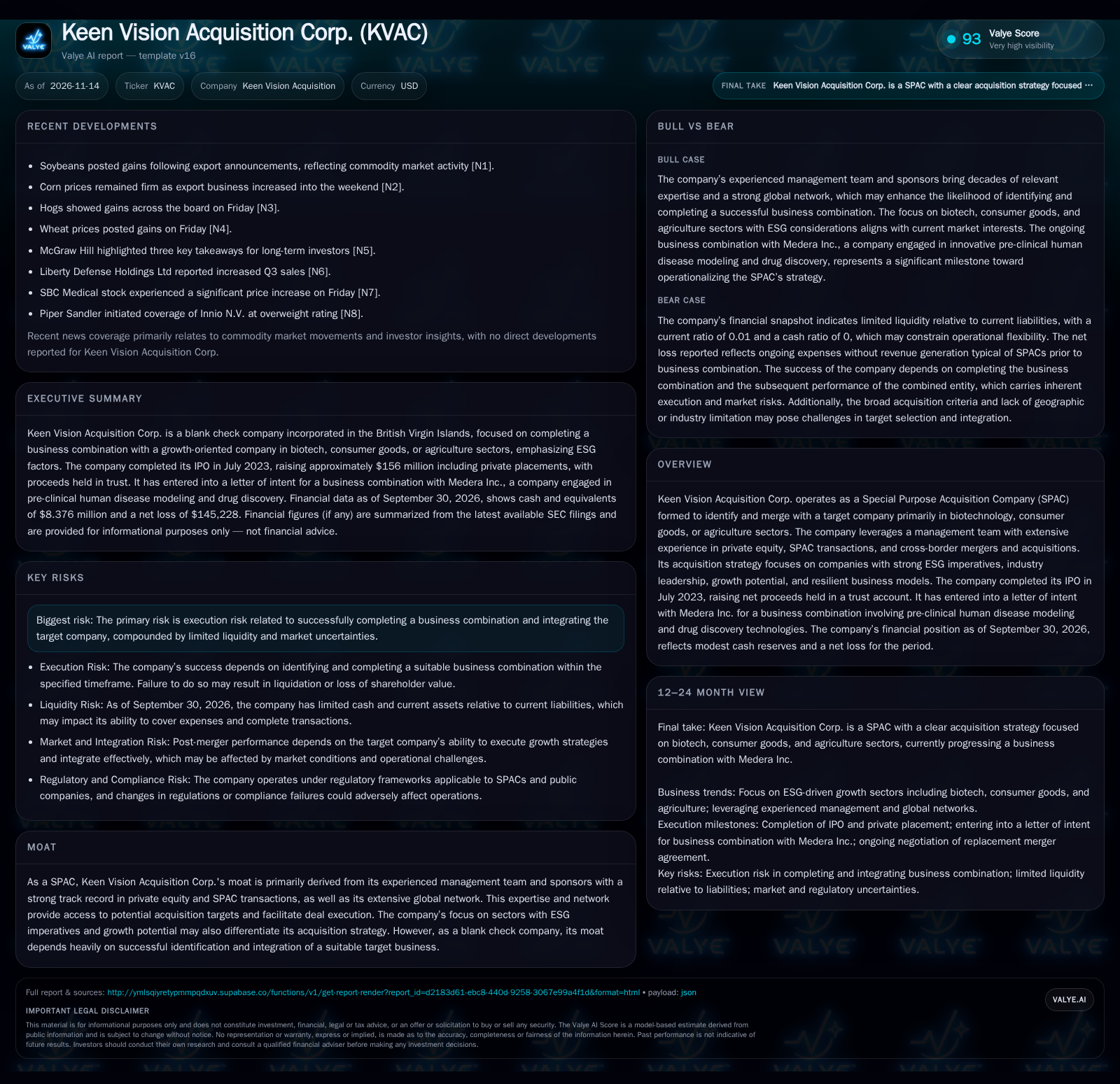
Keen Vision Acquisition Corp. (KVAC), a SPAC with a seasoned management team, is in advanced negotiations for a merger with Medera Inc., a pre-clinical biotech innovator. With scant liquidity and no revenue pre-combination, KVAC’s fate rests on executing this deal and realizing value from Medera’s disease modeling and drug discovery technologies. The outcome will test the SPAC’s ability to deliver on its growth- and ESG-driven mandate in a volatile capital markets environment.
Keen Vision Acquisition Corp. stands on the threshold of a defining transaction: its proposed merger with Medera Inc. signals a shift from capital-raising and target-hunting to operational execution in the high-stakes world of biotech SPACs. The next phase will test not only the management team’s dealmaking acumen but also the commercial promise of Medera’s pre-clinical drug discovery platform—against a backdrop of volatile market sentiment and rising scrutiny of SPAC outcomes.
Medera Merger Negotiations Define Immediate Trajectory
The most material current fact is Keen Vision Acquisition Corp.’s (KVAC) signed letter of intent (LOI) with Medera Inc. and its subsidiary Novoheart Group Limited for a business combination focused on pre-clinical human disease modeling and drug discovery technologies [S1]. This prospective deal, with an aggregate consideration of approximately $622.6 million in newly issued shares, represents KVAC’s transition from capital pool to operating company. As of September 30, 2026, KVAC’s cash and equivalents stood at $8.376 million, with a current ratio of 0.01 and a net loss of $145,228, underscoring the urgency of completing a transaction to avoid protracted value erosion or forced liquidation [S2]. The management team’s 55+ years of M&A and private equity experience provides a potential edge in navigating the complexities of cross-border biotech dealmaking [S1].
SPAC Value Creation: From Trust Capital to Target Integration
As a SPAC, KVAC’s business model is predicated on raising capital via IPO and private placements, depositing proceeds in a trust, and then identifying and merging with a high-growth target. Until a business combination closes, the company generates no operating revenue and incurs expenses related to deal sourcing, diligence, and compliance. The economics turn on the successful completion and subsequent performance of the acquired business.
In KVAC’s case, the Medera transaction—if completed—would convert static trust capital into an equity stake in a biotech platform with pre-clinical disease modeling and drug discovery assets. The economic upside depends on Medera’s ability to advance drug candidates, secure partnerships, or generate licensing revenue. Biotech platforms can carry high operating leverage: R&D and regulatory milestones drive value, but costs are front-loaded and success is binary. The all-share merger structure preserves cash but dilutes existing shareholders and ties value to post-merger execution. Should the deal fail or drag, KVAC’s limited cash and negative operating margin would quickly become existential.
The structural dynamics of SPAC value creation also imply that the timing of the merger and subsequent integration is critical. Delays in closing can erode investor confidence and increase the risk of redemption waves, which in turn reduce the capital base available for the combined entity’s operations. Moreover, the post-merger valuation is highly sensitive to the biotech sector’s broader funding environment; a tightening in venture or public capital markets can constrain Medera’s ability to raise follow-on financing, thereby impeding R&D progress. Consequently, the SPAC’s economic model hinges not only on closing the transaction but also on navigating sector cyclicality and maintaining investor support through early-stage operational milestones.
SPACs Compete on Target Access, Sector Focus, and Sponsor Credibility
KVAC operates in a crowded SPAC landscape, where sponsor reputation, sector focus, and access to quality targets are crucial differentiators. The management team’s 55+ years of experience in private equity and cross-border M&A may help secure and negotiate complex biotech deals, which often require nuanced understanding of IP, regulatory, and partnership dynamics. The focus on biotech, consumer goods, and agriculture—filtered through ESG criteria—could attract quality targets that align with current institutional investor preferences.
However, KVAC faces counterforces common to late-cycle SPACs: heightened regulatory scrutiny, SPAC fatigue among investors, and a shrinking pool of high-quality, willing targets. Within biotech, competition comes not only from other SPACs but also from traditional IPOs, private equity, and strategic acquirers. The question is whether KVAC’s network and deal discipline can secure a target with both credible science and commercial promise—while avoiding overpayment or adverse selection risk.
In addition to sponsor credibility and sector focus, the competitive positioning of KVAC is influenced by the quality and uniqueness of its target pipeline. In biotech, differentiation often depends on proprietary technology platforms, patent portfolios, and the ability to demonstrate translational relevance from pre-clinical models to human disease. KVAC’s ability to secure a target like Medera may be enhanced if the target possesses defensible intellectual property and a clear regulatory strategy. However, this also raises the bar for due diligence and integration complexity, as cross-border biotech deals often involve navigating diverse regulatory regimes and potential cultural differences in R&D approaches, which can affect time-to-market and cost structures.
Deal Consummation Unlocks Biotech Platform Value
The favorable scenario for KVAC is the successful closing and integration of the Medera merger. In this chain, Medera’s pre-clinical disease modeling and drug discovery technologies attract investor interest, strategic partnerships, or licensing deals—validating the platform’s commercial potential. This outcome could be confirmed by post-merger announcements of R&D milestones, pipeline progress (such as FDA IND approvals), or significant third-party collaborations.
Evidence that would support the upside includes timely closing of the transaction, rapid progress on Medera’s experimental therapies, and market recognition in the form of analyst coverage or follow-on capital raises at favorable terms.
A successful merger could also create strategic optionality beyond immediate R&D progress. For example, if Medera’s platform proves scalable and adaptable, it might attract multiple partnership opportunities across different therapeutic areas, enabling diversified revenue streams and de-risking the business model. Additionally, a well-executed integration could position the combined entity to leverage emerging trends such as AI-driven drug discovery or personalized medicine, thereby enhancing long-term competitive advantage. These factors would not only support valuation appreciation but also improve access to capital by demonstrating a credible growth trajectory and innovation pipeline.
Execution Drag and Dilution Shape the Most Likely Outcome
The most plausible path is that KVAC completes the Medera merger after some delays, with moderate dilution and integration friction. The combined entity may face the typical challenges of post-SPAC biotech platforms: high cash burn, uncertain clinical timelines, and the need for further capital. In this scenario, value realization is slow and tied to incremental R&D milestones rather than immediate commercial revenue. The share price may underperform until clear validation of Medera’s pipeline is achieved.
Evidence supporting this scenario would include protracted negotiations, modest post-merger operational progress, and recurring capital raises or warrant exercises to fund ongoing development. Falsification would come from failure to close the deal, SPAC redemption waves, or regulatory setbacks for Medera’s assets.
Execution challenges in the post-merger phase often stem from the inherent uncertainties of biotech development timelines and regulatory pathways. Delays in clinical milestones or unexpected trial results can lead to increased capital requirements and downward valuation pressure. Furthermore, integration risks include aligning organizational cultures, retaining key scientific talent, and streamlining operational processes without disrupting ongoing R&D activities. In this context, moderate dilution through additional financing rounds may be necessary but could weigh on shareholder value. The combined entity’s ability to communicate a clear development roadmap and manage investor expectations will be critical in mitigating these execution risks.
Deal Failure or Target Underperformance Triggers Value Erosion
The adverse scenario is that the Medera deal fails to close—due to regulatory, commercial, or diligence issues—or that the acquired platform materially underperforms post-merger. In this outcome, KVAC’s reported liquidity position and lack of operating revenue become acute: the company could face forced liquidation, returning trust proceeds to shareholders, typically at a loss relative to initial capital after expenses. Alternatively, if the merger closes but Medera fails to deliver clinical progress or attract capital, the combined entity could rapidly deplete cash and see its valuation collapse.
Confirmation of this scenario would include announcement of deal termination, mass SPAC redemptions, or early post-merger disclosures of operational or regulatory setbacks at Medera. A useful watchpoint would be the trend in trust redemptions and the company’s ability to secure PIPE (private investment in public equity) financing, if disclosed.
Milestones That Will Determine KVAC’s Post-SPAC Value Creation
Definitive merger agreement signing and subsequent closing timeline for the Medera transaction.
Shareholder redemption rates ahead of and at the time of the business combination—if disclosed.
Progress updates on Medera’s clinical or pre-clinical pipeline, including new FDA IND approvals or major R&D milestones.
Disclosure of PIPE financing or other capital raises to support post-merger operations.
Post-merger operating cash burn and available liquidity in the combined entity.
Announcements of third-party partnerships, licensing deals, or collaborations involving Medera’s platform.
Changes in board composition or management roles following the closing of the business combination.
If disclosed, the breakdown of pro forma ownership and dilution impact for public shareholders after the merger.
Disclaimer: This is research-only, informational analysis and not investment advice. It may include AI-generated interpretation and general industry context. Always verify important details using primary sources.

Comments