
Mobiquity Technologies: Integrated Ad Tech Ambitions Meet Financial and Execution Headwinds
Mobiquity Technologies operates proprietary platforms for digital advertising, data intelligence, and publisher monetization, with a unique push into casino and gaming ad inventory.
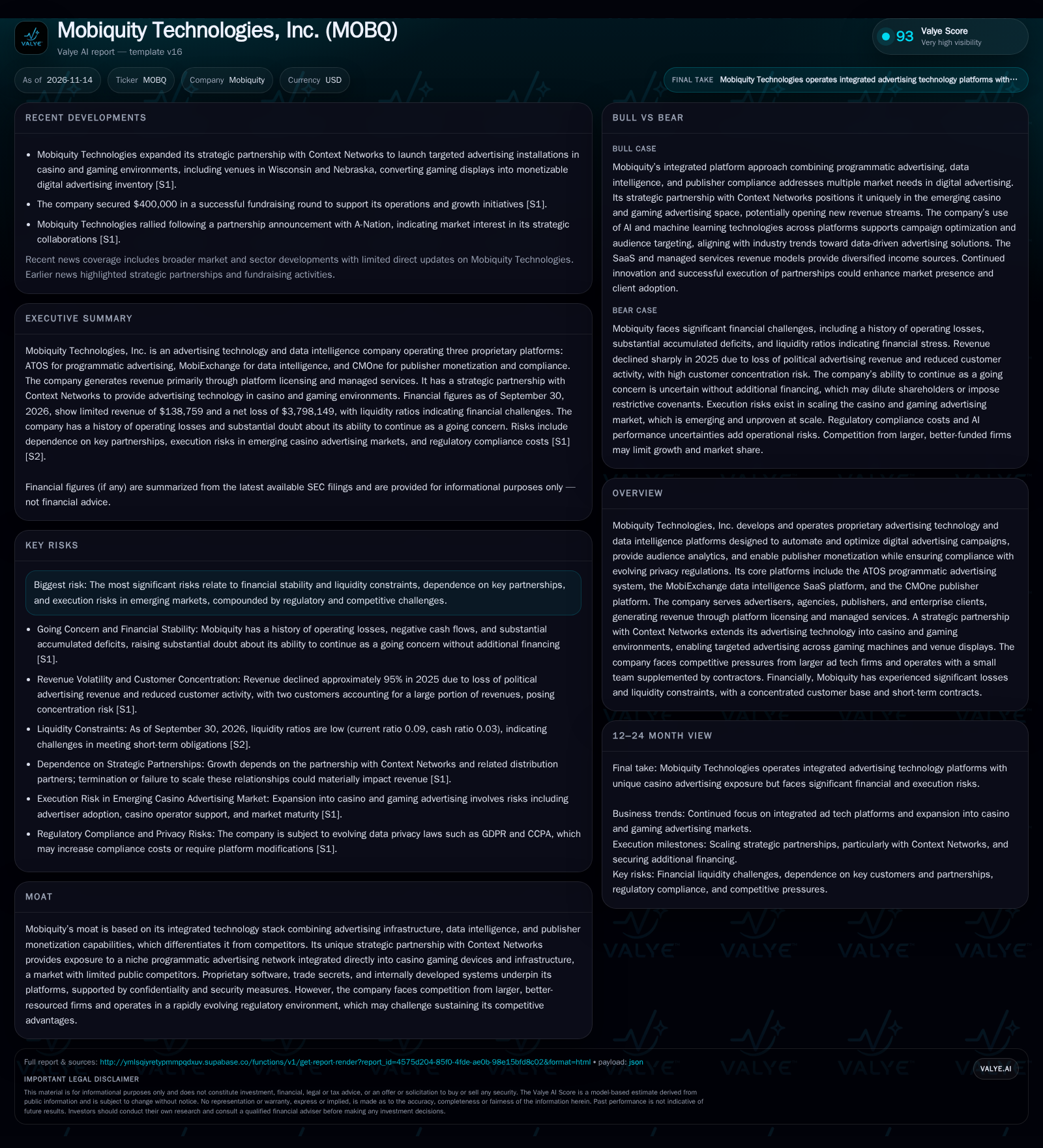
Mobiquity Technologies operates proprietary platforms for digital advertising, data intelligence, and publisher monetization, with a unique push into casino and gaming ad inventory. Its future hinges on demonstrating that its integrated stack can unlock new markets and achieve sustainable revenue amid persistent financial and operational pressures. [S1] [S2]
Mobiquity Technologies, Inc. stands at a strategic crossroads. Its integrated suite of advertising technology platforms aims to address the multifaceted needs of digital advertisers, publishers, and agencies—automating campaign execution, optimizing audience targeting, and ensuring privacy compliance. The company’s unique foray into casino and gaming advertising through a partnership with Context Networks sets it apart in a crowded ad tech landscape. The next chapter for Mobiquity will depend on its ability to convert technical integration and niche positioning into sustainable, diversified revenues before financial pressures force strategic retrenchment or restructuring.
Liquidity Pressures and Revenue Volatility Define Near-Term Reality
Mobiquity Technologies is navigating a period marked by acute financial stress and operational uncertainty. As of September 30, 2026, the company reported cash and equivalents of $123,340, current assets of $407,360, and current liabilities of $4,414,712, resulting in a current ratio of 0.09 and a cash ratio of 0.03. These metrics underscore significant short-term liquidity challenges. Revenue for the period was just $138,759, a stark decline of approximately 95% compared to the prior year, primarily attributed to the absence of nonrecurring political advertising revenue that had previously buoyed results. Net loss for the period totaled $3,798,149. Customer concentration remains high, with two customers accounting for 85% of revenues in 2025, and contracts are generally short-term and terminable with limited notice. The company’s auditor has raised substantial doubt about its ability to continue as a going concern, highlighting the urgent need for additional financing or a fundamental turnaround in revenue generation. [S1] [S2]
Monetization Mechanics: Platform Licensing, Usage Fees, and Managed Services
Mobiquity’s business is built around three proprietary platforms: ATOS (a programmatic advertising operating system), MobiExchange (data intelligence SaaS), and CMOne (publisher monetization and compliance). Revenue is generated through two primary channels: platform licensing—typically structured as SaaS or white-label agreements based on usage or a percentage of advertising spend—and managed services, where Mobiquity operates campaigns or provides platform support directly for clients. This model can, in theory, offer high incremental margins if the platforms achieve scale, as software and data operations have significant fixed cost components but relatively low variable costs per additional customer or campaign. However, the company’s limited revenue base and high customer concentration suggest that it has not yet achieved the kind of scale needed to unlock operating leverage. Short-term, easily terminable contracts further limit revenue visibility and make it difficult to forecast cash flows with confidence. The acute liquidity pressures and history of negative cash flows may force Mobiquity to seek external financing, which could entail dilution or restrictive covenants, or to cut investments in product development and business development—potentially limiting its ability to compete and innovate. [S1] [S2]
Capital requirements in ad tech are typically moderate, focused on software development, cloud hosting (notably, MobiExchange is hosted on AWS), and sales/customer acquisition. However, Mobiquity’s current financial state raises questions about its ability to invest meaningfully in platform enhancements or sales expansion without near-term revenue growth or outside capital.
Integrated Stack and Casino Niche Offer Differentiation—But Not Immunity from Larger Rivals
Mobiquity’s principal competitive differentiator is its integrated technology stack—offering end-to-end automation, audience analytics, and publisher monetization with built-in privacy compliance. The ability for customers to use these platforms separately or as an integrated suite may create switching frictions, particularly if workflows become embedded in client operations. Its partnership with Context Networks enables targeted, programmatic advertising on casino gaming devices and infrastructure, a niche where Mobiquity claims to be the only publicly traded ad tech player with such integration. This could provide early-mover advantages in a market with unique audience demographics and relatively untapped inventory.
However, these advantages are not absolute. The broader ad tech landscape includes formidable competitors such as LiveRamp, The Trade Desk, and OneTrust, all of which have greater financial and engineering resources and deeper relationships with agencies and enterprise clients. These incumbents can rapidly replicate features, invest in privacy compliance, and undercut pricing if the casino and gaming advertising segment proves attractive. Additionally, Mobiquity’s IP portfolio is relatively modest (two patents related to legacy location-based technologies), suggesting that differentiation is primarily operational and ecosystem-based rather than protected by strong barriers to entry. The company’s small team and reliance on contractors may also constrain its ability to execute on multiple fronts simultaneously.
Casino Advertising Proves Scalable and Recurring, Unlocking Margin Leverage
A favorable outcome for Mobiquity would see its programmatic advertising solutions gain meaningful adoption across casino and gaming environments, with the Context Networks partnership expanding into more venues and geographies. If casino operators and advertisers recognize the incremental value of targeted digital inventory on gaming devices, Mobiquity could secure multi-year, recurring licensing or revenue-share agreements, reducing customer concentration and improving revenue visibility. As the installed base grows, operating leverage could emerge, with incremental platform revenue dropping to the bottom line after covering fixed development and hosting costs.
Confirmation of this scenario would require evidence such as significant new deployments in additional casinos, the signing of longer-term or multi-property contracts with casino operators, and visible adoption by a broader array of advertisers (including non-gaming brands seeking to reach casino audiences). Improved revenue diversification, positive operating cash flow, and reduced reliance on one-off political advertising would also validate the thesis. Conversely, failure to land meaningful new contracts or expand beyond pilot deployments would undermine the upside case.
Customer Concentration and Short-Term Contracts Keep Results Volatile
The most plausible near-term trajectory is one of continued revenue volatility, with Mobiquity reliant on a small number of customers and short-duration contracts—leaving revenues susceptible to abrupt swings if any major client reduces or terminates their engagement. The company may secure incremental wins in the casino and gaming niche, but these are likely to be small-scale or pilot projects rather than transformational deals until the market matures and advertisers demonstrate sustained demand for this channel.
In this scenario, Mobiquity scrambles to stabilize its financial position through cost containment, opportunistic fundraising, or selective business development, but lacks the resources or runway to invest aggressively in product or market expansion. Revenue may recover modestly from 2025 lows if nonrecurring factors (like political advertising) return, but the fundamental risks of customer concentration, liquidity, and limited scale persist. Evidence confirming this scenario would include continued high revenue concentration, lack of multi-year contracts, and ongoing concerns about going concern status in regulatory filings. A shift toward broader customer adoption, multi-year deals, or a meaningful improvement in cash flow would falsify the base scenario.
Liquidity Shortfall or Partnership Loss Forces Strategic Retrenchment
The bear case centers on Mobiquity exhausting its reported liquidity position before it can meaningfully scale its business or secure new financing. If one or both of its major customers reduce spend or terminate their relationship, or if the Context Networks partnership fails to deliver additional deployments or is itself disrupted, revenue could fall below the level needed to sustain even minimal operations. The company’s acute current ratio and cash ratio suggest little margin for error; failure to rapidly secure capital could result in layoffs, asset sales, or a strategic review including possible sale, merger, or bankruptcy.
Confirmation of this scenario would include further revenue declines, a shrinking customer list, unsuccessful fundraising attempts, or explicit disclosures of potential restructuring or liquidation in SEC filings. A material deterioration in the company’s ability to pay obligations as they come due would also be a warning signal. Falsification would require a clear demonstration of new financing, a rebound in revenue diversity, or a major new partnership that substantially improves revenue visibility and liquidity.
Milestones and Data Points That Will Shape Mobiquity’s Casino Ad Tech Thesis
New or expanded deployments of Mobiquity’s platforms in additional casino or gaming venues, especially those outside initial pilot states, would be a material sign of adoption momentum.
Disclosure of multi-year, recurring contracts with casino operators or major advertisers would help test whether Mobiquity can convert pilots into sustainable revenue streams.
Revenue diversification away from the top two customers—if disclosed—would signal reduced concentration risk and improved business durability.
Quarterly changes in operating cash flow and net working capital would provide early warnings of either stabilization or further liquidity stress.
Evidence of successful capital raises, including terms and dilution impact, would clarify the company’s near-term viability.
Customer churn rates or retention statistics (if disclosed) would offer insight into the stickiness of Mobiquity’s platform relationships.
Any regulatory developments or compliance costs related to privacy laws (GDPR, CCPA) could materially affect cost structure and customer willingness to adopt the platform.
Performance data on the AI/ML components of the platform—such as campaign optimization effectiveness or uptime—would help gauge whether technical differentiation is being realized in practice.
Disclaimer: This is research-only, informational analysis and not investment advice. It may include AI-generated interpretation and general industry context. Always verify important details using primary sources.

Comments