
Perpetua Resources: Advancing Stibnite Gold Project from Permitting to Construction Amid Legal and Execution Risks
However, ongoing legal challenges, persistent net losses, and the need for further capital highlight the execution and regulatory risks that will shape the project’s trajectory toward production.
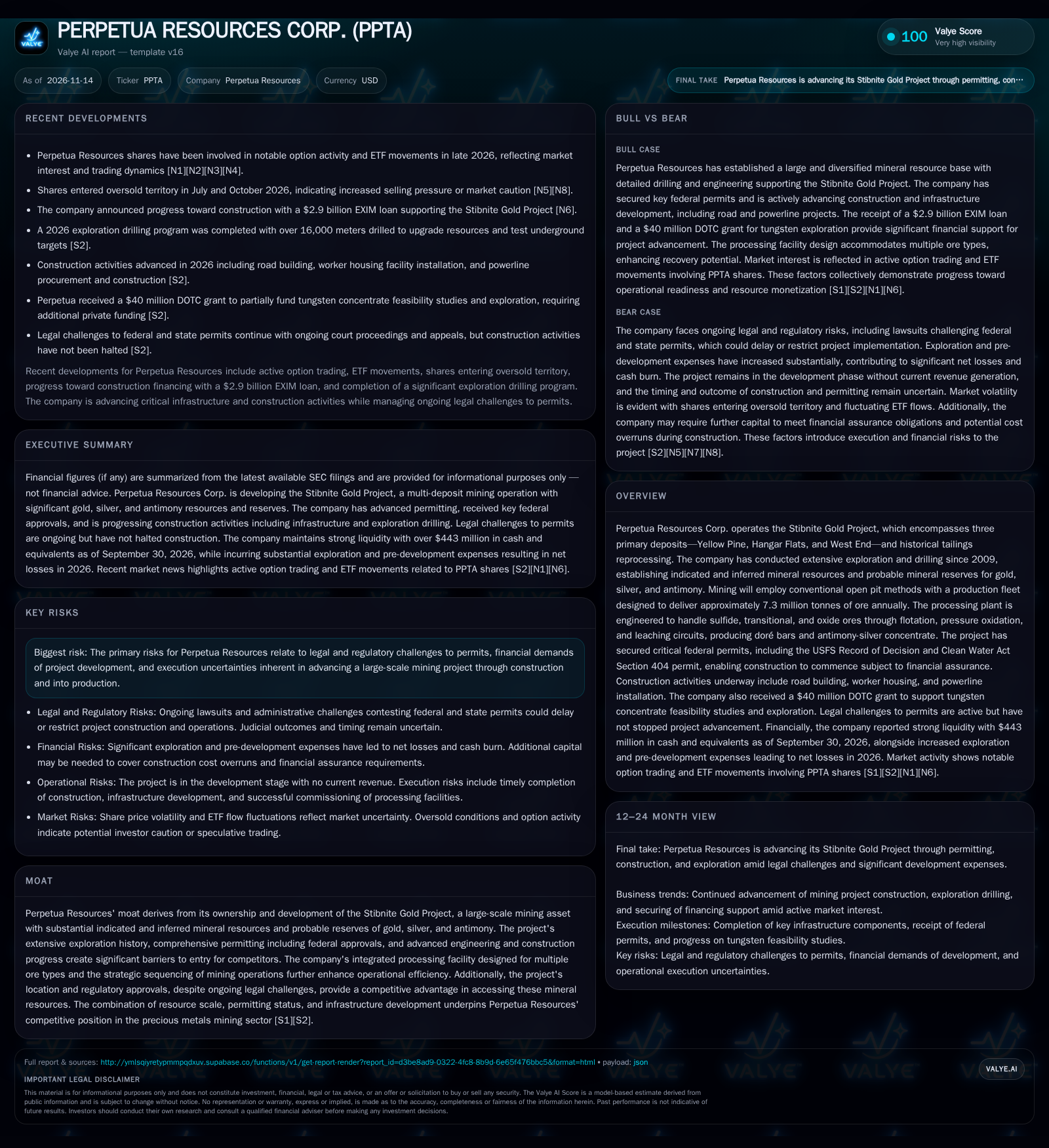
Perpetua Resources has secured key federal permits and begun construction at its Stibnite Gold Project, supported by a $2.9 billion EXIM loan and a $40 million DOTC grant. The company reports reported liquidity position but continues to incur significant net losses due to pre-development spending. Ongoing legal challenges and uncertain project economics make future outcomes highly sensitive to regulatory, financial, and operational milestones. [S1] [S2] [N6]
Perpetua Resources is at a pivotal moment, transitioning its Stibnite Gold Project from a decade-plus of exploration and permitting into the initial phases of construction. Backed by a $2.9 billion EXIM loan and a $40 million government grant for tungsten exploration, the company is building infrastructure and upgrading resource estimates in a bid to monetize substantial gold, silver, and antimony reserves. Despite reported liquidity position, the company is burning cash at a rapid pace and faces persistent legal and regulatory uncertainty. The ultimate outcome will depend on Perpetua’s ability to execute construction, secure additional funding, and defend its permits through ongoing litigation.
Federal Permits, Major Grants, and Construction Progress Define 2026 Milestones
Perpetua Resources’ operational status at the close of 2026 is shaped by several high-impact developments. The company has secured key federal permits, including the USFS Record of Decision and Clean Water Act Section 404, which are prerequisites for major mining operations. Construction activities are advancing, with road building, worker housing, and powerline procurement underway, and a 16,000-meter drilling program completed to upgrade resources and test underground targets. Financially, Perpetua’s $443.4 million in cash and equivalents reflects a reported balance sheet position, bolstered by a $2.9 billion EXIM loan commitment and a $40 million DOTC grant to support tungsten feasibility studies. However, the project is operating at a net loss—$79.2 million in Q3 2026 alone—driven by heavy exploration and pre-development expenses. Ongoing legal challenges to permits remain unresolved, introducing continued regulatory risk even as physical construction advances. [S2] [N6]
Mining Economics: Capex, Ramp-Up, and Multi-Metal Revenue Potential
Perpetua’s business model is capital-intensive and front-loaded, typical of large-scale mining projects. The company must invest heavily in infrastructure, equipment, and environmental management before generating any revenue. The planned mining operation targets 7.3 million tonnes of ore per year across three deposits, using conventional open-pit methods and a processing facility designed to handle sulfide, transitional, and oxide ores. Revenue will eventually derive from doré bars (gold and silver) and antimony-silver concentrate, with potential upside from tungsten if feasibility studies succeed.
The economics hinge on high fixed costs—construction, permitting, engineering, and environmental compliance—followed by operating leverage if the plant ramps up to nameplate capacity. Variable costs are tied to labor, reagents, maintenance, and energy, while commodity price volatility will drive top-line swings. Pre-revenue losses are currently funded by equity and government-backed debt; future cash flows depend on successful commissioning and ramp-up. The need for additional private funding, especially for tungsten development and unforeseen overruns, remains an open question. If gold, silver, or antimony prices fall or if capex overruns materialize, economic viability could be threatened.
Resource Scale, Permitting Status, and Processing Flexibility as Barriers to Entry
Perpetua’s competitive position rests on its control of the Stibnite Gold Project, which has substantial indicated and inferred resources and probable reserves across multiple metals. The project’s integrated processing facility is engineered for flexibility, capable of handling multiple ore types and producing both doré bars and concentrate, potentially allowing for operational resilience to changes in ore mix or commodity prices.
Barriers to entry are high: few undeveloped projects in the U.S. combine this scale of resource, advanced permitting, and multi-metal output. Federal permit approvals and ongoing infrastructure buildout represent a significant moat, as new entrants would face a decade or more of exploration, permitting, and community engagement. However, legal challenges to Stibnite’s permits expose a vulnerability: if litigation leads to delays, restrictions, or revocations, the project’s competitive advantage could erode. Substitutes include other global gold producers, but Stibnite’s antimony and potential tungsten output could differentiate it as supply security becomes a strategic priority, especially for the U.S. and allied governments.
If Legal Hurdles Clear and Construction Stays on Track, Stibnite Could Become a Multi-Metal Producer
The most favorable scenario for Perpetua involves successful defense of its permits, timely construction progress, and resource upgrades translating into robust reserves. If legal appeals are resolved in Perpetua’s favor and construction milestones are met on schedule—enabled by the EXIM loan and additional funding—the company could move into production in the next several years. This would unlock revenue from gold, silver, and antimony, with tungsten feasibility potentially adding a fourth revenue stream.
Confirmation of this scenario would come from final resolution of major lawsuits, continued on-budget construction progress, and positive results from tungsten studies. Early commissioning of the processing plant and demonstration of operational throughput at or above design rates would provide further validation. Market recognition might manifest as improved share price stability, reduced option volatility, and increased institutional ownership.
Stibnite Advances Incrementally: Construction Progress, But Delays and Cost Creep Remain Likely
The most plausible outcome is a gradual advance toward production, punctuated by delays and cost overruns typical of large, complex mining projects. Construction will likely proceed but face bottlenecks—legal appeals may not halt operations outright, but could delay certain activities or increase compliance costs. The need for further funding, especially if tungsten development proceeds or if environmental mitigation expenses rise, could prompt additional equity or debt issuance, diluting existing shareholders.
Evidence supporting this scenario would include ongoing but slower-than-anticipated progress updates, budget revisions, and incremental permit clarifications. If disclosed, changes in project capital cost estimates, workforce expansion, or procurement contracts would signal steady but not breakout momentum. Share price could remain volatile, with investor sentiment tracking both litigation news and commodity price swings.
Litigation, Regulatory Setbacks, or Cost Blowouts Could Derail Project Economics
The most adverse scenario would be a major legal setback—such as permit revocation or adverse court rulings—that halts or materially delays construction. Regulatory uncertainty could dissuade lenders or partners, making it difficult to secure required additional funding. Simultaneously, significant capex overruns, environmental incidents, or negative feasibility results for tungsten could further erode confidence and drain liquidity.
Confirmation of this scenario would come from court decisions against Perpetua, public agency reversals, or publicized construction stoppages. If disclosed, rapid cash burn, missed construction milestones, or failed financing rounds would compound the risk. Prolonged share price weakness, persistent oversold conditions, and sharp ETF outflows would signal rising investor pessimism.
Milestones and Metrics That Will Decide Perpetua’s Stibnite Trajectory
Resolution and timing of outstanding legal challenges to federal and state permits. Court rulings or administrative decisions will directly affect construction continuity and project timelines.
Actual construction progress versus planned milestones, including road, powerline, and processing plant development. Delays or cost overruns disclosed in periodic updates would be telling.
Updates on the use and drawdown of the $2.9 billion EXIM loan, including any additional funding requirements or conditions attached to disbursements.
Results from tungsten feasibility studies and decisions regarding project scope expansion—if these are positive and fully funded, they could materially alter project economics.
Trends in quarterly cash burn and updated capital expenditure forecasts. If disclosed, tracking the pace and allocation of spending would illuminate funding needs and runway.
Production start date guidance and commissioning progress for the processing facility—early, on-time, or delayed startup will signal execution risk or momentum.
Commodity price movements for gold, silver, antimony, and tungsten, as realized prices will determine ultimate project cash flow and valuation sensitivity.
ETF flows, option activity, and share price volatility, which may reflect shifting market confidence or speculative pressure in response to project news.
Disclaimer: This is research-only, informational analysis and not investment advice. It may include AI-generated interpretation and general industry context. Always verify important details using primary sources.

Comments