
Healthcare Triangle’s AI Expansion: Strategic Ambition Meets Funding and Execution Headwinds
Healthcare Triangle, Inc.
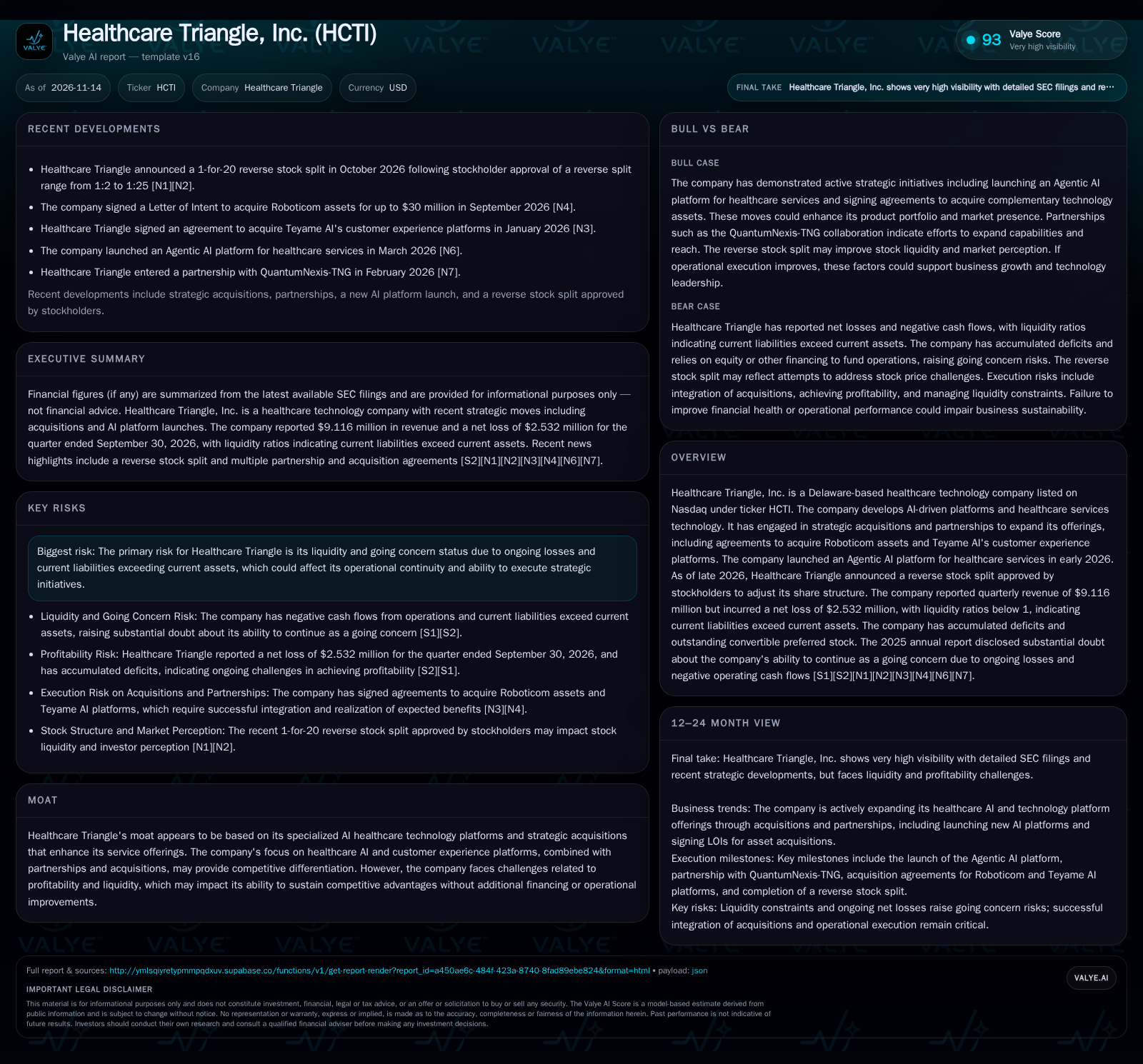
Healthcare Triangle, Inc. is making bold moves to expand its healthcare AI and technology platform footprint, including launching an Agentic AI platform and signing agreements to acquire Roboticom and Teyame AI assets. Execution on integration, revenue growth, and cost control will be critical in determining whether Healthcare Triangle can transition from survival to scalable growth. [S2] [N3] [N4] [N6] [N7]
Healthcare Triangle, Inc. is pursuing a high-stakes transformation in healthcare technology, betting on AI-driven platforms and strategic acquisitions to carve out a differentiated market position. The company’s recent launch of an Agentic AI platform, agreements to acquire complementary technology assets, and new partnerships showcase an aggressive growth agenda. Yet, these ambitions are unfolding against a backdrop of persistent net losses, acute liquidity shortfalls, and explicit going concern warnings—raising the stakes for execution and integration. Whether Healthcare Triangle can convert its technological and strategic moves into sustainable business momentum remains the central question for investors and stakeholders. [S2] [N3] [N4] [N6] [N7]
Liquidity Squeeze and Growth Ambitions Define the Current Landscape
Healthcare Triangle reported quarterly revenue of $9.116 million and a net loss of $2.532 million for the period ended September 30, 2026. The company's current assets ($8.862 million) remain well below current liabilities ($14.383 million), resulting in a current ratio of 0.62 and a cash ratio of just 0.13. These metrics signal a significant liquidity gap and near-term funding pressure, corroborated by explicit going concern disclosures in recent filings. [S2]
Despite these financial constraints, Healthcare Triangle has moved to expand its healthcare AI platform offerings. It launched an Agentic AI platform in March 2026 and entered agreements to acquire Roboticom assets (up to $30 million) and Teyame AI's customer experience platforms, while forging a partnership with QuantumNexis-TNG. These actions indicate a dual track of offensive strategic expansion amid defensive financial positioning. [N3] [N4] [N6] [N7]
Revenue Model and Cost Structure: Scaling Ambitions Confront Margin and Funding Realities
Healthcare Triangle’s core business model appears to hinge on providing AI-driven platforms and technology-enabled services to healthcare clients. This likely involves a mix of software subscriptions, platform fees, and possibly consulting or integration services. However, the commercial mechanics—such as contract lengths, pricing tiers, or the split between recurring and project-based revenue—are not clearly disclosed, introducing uncertainty about revenue visibility and margin structure.
The company’s recent acquisitions and platform launches suggest a capital-intensive approach, requiring upfront investment in product development, integration, and potential customer onboarding. Fixed costs likely include engineering, platform maintenance, and R&D, while variable costs may scale with service delivery and customer support. The ongoing net losses and negative cash flows signal that current revenue levels are insufficient to cover fixed costs, and the company is not yet achieving operating leverage.
Given the acute liquidity constraints, any delay in realizing revenue synergies from acquisitions or in scaling new platforms could exacerbate funding needs. The need to finance acquisitions (such as the $30 million Roboticom asset deal) may require external capital or creative deal structuring, which could further dilute equity holders or add debt service burdens.
Strategic Moves in a Crowded Healthcare AI Landscape
Healthcare Triangle operates in a highly competitive sector where technology vendors, consulting firms, and healthcare IT incumbents all vie for healthcare organizations seeking digital transformation and AI integration. The company's focus on AI-driven platforms, combined with customer experience technologies, could provide differentiation if execution is strong and integration is seamless.
However, barriers to entry in healthcare technology are moderate: while specialized AI capabilities and regulatory familiarity matter, switching costs for healthcare providers depend heavily on workflow integration, data migration, and vendor lock-in. The company reported cash and liquidity metrics for the period; these figures do not by themselves establish operating runway, investment capacity, financial flexibility, or financing capacity.
Partnerships—such as the QuantumNexis-TNG collaboration—may extend reach or accelerate product development, but their commercial impact will depend on the depth of integration and the ability to convert technical synergies into paying customers. The success of recent acquisitions will hinge on both the uniqueness of the acquired technology and Healthcare Triangle’s capacity to integrate and monetize these assets given its constrained resources.
From Survival to Scale: How Successful Integration Could Unlock Value
A favorable trajectory for Healthcare Triangle would require rapid and effective integration of the Roboticom and Teyame AI assets, resulting in a broadened product suite and cross-selling opportunities for existing healthcare clients. If the Agentic AI platform demonstrates measurable improvements in customer outcomes or operational efficiency, the company could position itself as a differentiated provider in healthcare AI, potentially commanding premium pricing or longer-term contracts.
The upside scenario would be confirmed by evidence of accelerating top-line growth (quarter-over-quarter revenue increases), improved gross margins (suggesting higher-value or more scalable software revenues), and clear customer wins attributable to the new platforms. Additional signs would include successful completion of the announced acquisitions without material dilution or distress financing, and positive operating cash flow trends indicating the onset of operating leverage.
If the company can secure non-dilutive funding or monetize acquired assets quickly, it could extend its runway and reduce going concern risk, supporting a virtuous cycle of investment and growth.
Integration Challenges and Funding Constraints Shape a Uncertain Transition
The most plausible near-term outcome is a period of operational turbulence as Healthcare Triangle attempts to integrate new acquisitions, roll out the Agentic AI platform, and manage acute liquidity stress. Revenue may grow incrementally, but cost pressures from acquisition integration, platform development, and customer support could keep the company in a loss-making position.
Confirmation of this scenario would include continued negative operating cash flow, high SG&A and R&D expenses relative to revenue, and delays or complications in integrating acquired technologies. If the company is forced to raise capital through dilutive equity offerings or high-cost debt to fund acquisitions or operations, existing shareholders could see further erosion of value.
On the other hand, steady customer adoption of new platforms, even if not explosive, could demonstrate product-market fit and buy time for operational improvements.
Liquidity Crunch and Execution Slippage: When Expansion Outpaces Resources
In an adverse scenario, Healthcare Triangle’s liquidity position deteriorates faster than anticipated, either due to slower-than-expected customer adoption, integration setbacks, or unforeseen costs related to acquisitions. If revenue growth stalls and cost containment proves elusive, the company may be compelled to seek emergency financing under unfavorable terms or even face restructuring.
Signs confirming this scenario would be a further decline in the current ratio, missed acquisition milestones, delayed product launches, or material increases in short-term liabilities. If the company’s going concern warnings intensify or if independent auditors raise additional red flags, counterparties and customers may lose confidence, further pressuring revenue and strategic options.
Failure to integrate acquired assets or realize synergies could force the company to divest assets at distressed prices, potentially resulting in permanent impairment of shareholder value.
Signals That Will Determine Whether Healthcare Triangle Can Bridge Ambition and Viability
Quarterly revenue growth rates and the breakdown of revenue by product or service line, if disclosed, to assess the commercial impact of new platforms and acquisitions.
Gross margin trends and operating cash flow, which would indicate whether the business is moving toward scalable, profitable growth.
Updates on the completion and integration progress of the Roboticom and Teyame AI acquisitions, including any disclosed synergies, cost savings, or cross-selling wins.
Trends in current and cash ratios, and any new debt or equity financing events, to monitor short-term liquidity risk and dilution.
Customer win announcements, contract renewals, or case studies demonstrating real-world adoption and value of the Agentic AI platform or acquired technologies.
Management commentary or auditor notes on going concern status and capital plans in future filings.
Any evidence of non-dilutive funding, strategic investments, or government grants that could extend runway without eroding shareholder value.
Attrition or turnover among key technical and sales staff, which could signal internal stress or integration difficulties.
Disclaimer: This is research-only, informational analysis and not investment advice. It may include AI-generated interpretation and general industry context. Always verify important details using primary sources.

Comments