
Vendome Acquisition Corp I: SPAC Strategy, Competitive Dynamics, and the Countdown to a Consumer Sector Deal
Vendome Acquisition Corp I enters the critical phase of its SPAC lifecycle with $200 million in trust and a mandate to secure a consumer-sector target. With no operational revenues and a 24-month deal deadline, success hinges on sourcing, structuring, and closing a business combination amid intensifying competition and evolving SPAC market dynamics.
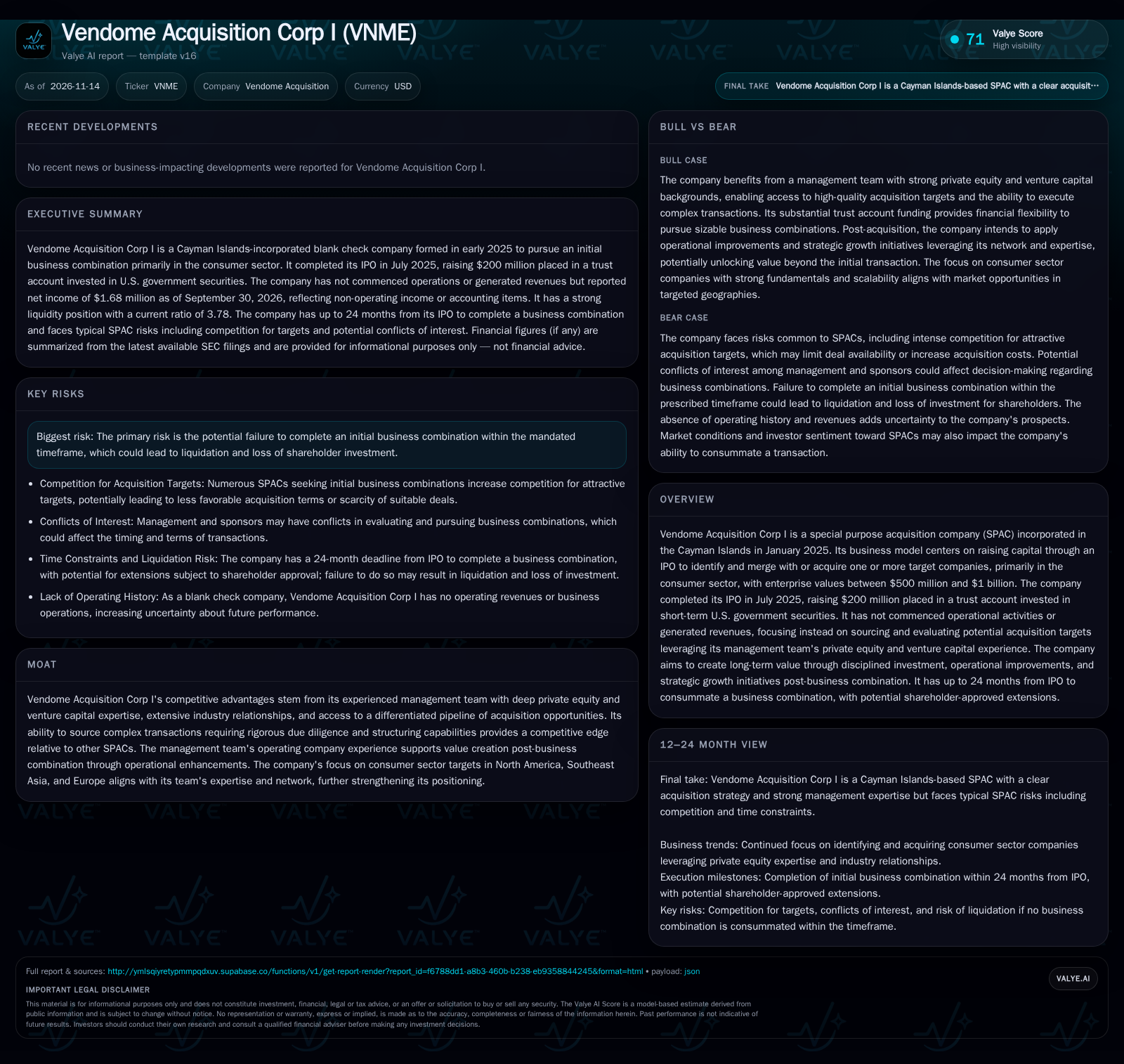
Vendome Acquisition Corp I is a Cayman Islands-incorporated SPAC with $200 million in trust from its July 2025 IPO, seeking a consumer-sector business combination valued between $500 million and $1 billion. As of September 30, 2026, it has not consummated a deal or generated operating revenue, and faces a 24-month window to complete a transaction or risk liquidation. Execution now depends on the management team’s ability to identify and close a high-quality target in a crowded SPAC environment. [S2]
Vendome Acquisition Corp I stands at a pivotal juncture typical for late-stage SPACs: flush with $200 million in trust from its 2025 IPO but with the clock ticking on its 24-month window to secure a business combination. With a stated focus on consumer-sector targets valued between $500 million and $1 billion and a management team rooted in private equity and venture capital, the company’s near-term fate hinges on its ability to source, negotiate, and close a deal in a competitive and evolving SPAC landscape. The absence of operating revenue and the risk of forced liquidation add urgency, making Vendome’s next move decisive for shareholders. [S2]
Deal Clock Ticking: Vendome’s Financial Position and Strategic Deadline
Vendome Acquisition Corp I completed its $200 million IPO in July 2025 and, as of September 30, 2026, has not consummated a business combination or generated operating revenues. All reported income is derived from interest on the trust account, not from operations. The company faces a fixed 24-month window from IPO to close an acquisition, with possible extensions subject to shareholder approval. If no deal is completed, the SPAC must liquidate and return trust funds to shareholders. This structure creates a hard deadline and elevates the importance of sourcing and closing an attractive transaction within the remaining months. [S2]
As of the most recent filing, the company’s current assets (excluding the trust) are $596,273 against current liabilities of $157,729, resulting in a current ratio of 3.78. The company reported cash and liquidity metrics for the period; these figures do not by themselves establish operating runway, investment capacity, financial flexibility, or financing capacity. [S2]
SPAC Economics: Trust Structure, Fee Leakage, and Value Creation Levers
Vendome’s economic model is typical of SPACs: the $200 million IPO capital is sequestered in a trust, earning modest interest, and cannot be deployed for operational or deal-related expenses until a business combination closes. All pre-deal expenses are covered by sponsor loans, small working capital balances, or private placement proceeds, with sponsors bearing the risk if the SPAC fails to close a deal.
Upon a successful business combination, the economics pivot to the operating company: Vendome’s value will hinge on the growth, profitability, and capital efficiency of the acquired target. The SPAC structure typically involves significant dilution from sponsor promote shares and warrants, which can erode value for public shareholders if the post-merger company underperforms. The selection of a business with recurring revenue, scalability, and healthy margins—as Vendome’s criteria specify—would be critical for generating operating leverage and supporting a premium valuation post-merger.
If an acquisition is not completed, trust funds are returned to shareholders (minus modest permitted expenses), and sponsors lose their investment—a structure that aligns incentives for deal completion but can also encourage riskier or less accretive transactions as deadlines approach.
Sourcing Advantage or Commodity Capital? Vendome’s Place in the SPAC Crowd
Vendome operates in an intensely competitive SPAC landscape, with dozens of blank-check companies vying for a finite pool of attractive targets—particularly in the consumer sector. The primary differentiator is the management team’s private equity and venture capital pedigree, which may provide access to proprietary deal flow and the ability to execute complex transactions. However, many SPACs tout similar credentials, and target companies now have greater bargaining power, often extracting higher valuations or more favorable terms.
Vendome’s focus on consumer businesses in North America, Southeast Asia, and Europe reflects a broad mandate, which could increase its addressable universe but also dilutes sectoral expertise relative to more narrowly focused SPACs. The company’s ability to source targets with recurring revenue and operational improvement potential is theoretically attractive, but execution will depend on both network strength and willingness to compete on price and structure.
Alternative routes for high-quality consumer businesses—such as direct listings, traditional IPOs, or private equity sales—serve as strong substitutes, forcing SPACs like Vendome to offer compelling value-add or speed to close. The question for Vendome is whether its sourcing and execution capabilities can translate into a differentiated outcome for shareholders.
Unlocking Value: How a High-Quality Consumer Deal Could Catalyze Returns
The most favorable scenario for Vendome is the identification and successful acquisition of a consumer-sector business with strong recurring revenue, scalability, and margin expansion potential. In this case, Vendome’s management leverages its network to secure a proprietary or semi-proprietary deal at a reasonable valuation, and post-merger, applies operational improvements to accelerate growth or profitability.
Confirmation of this scenario would come from the announcement of a definitive agreement with a target that fits the stated criteria—ideally with a diversified customer base, clear growth levers, and evidence of operational improvements post-close. Strong PIPE (private investment in public equity) participation or low SPAC redemption rates at merger close would further validate market confidence in the transaction.
Falsification would occur if Vendome announces a deal outside its stated focus, at an inflated valuation, or with weak fundamentals, or if the deal is met with high redemption rates and tepid PIPE interest. Lack of post-merger operating improvement would also undermine the upside thesis.
Navigating the Middle Ground: Probable Outcomes Given Market Realities
The most plausible outcome is that Vendome, like many SPACs in a crowded market, secures a business combination close to the end of its 24-month window. The acquired business may meet some but not all of Vendome’s ideal criteria, with valuation and deal terms reflecting current market dynamics and competition.
In this scenario, shareholders may face significant dilution from the SPAC structure (sponsor promote, warrants), and the post-merger company may experience modest public market traction. Confirmation would include a timely deal announcement, completion of the merger, and a post-close operating company with a credible growth plan, even if near-term performance is unremarkable. Falsification would be delayed or failed deal execution, high redemption rates, or a post-merger company with subpar growth and profitability metrics.
Deal Slippage and Liquidation: When the SPAC Clock Runs Out
The principal risk is failure to secure an acceptable business combination before the 24-month deadline, resulting in forced liquidation and return of trust proceeds to shareholders. In this case, sponsors lose their investment, public shareholders receive only their pro rata share of the trust (minus expenses), and no value is created from the SPAC process.
This scenario could be confirmed by a lack of deal announcements as the deadline approaches, unsuccessful negotiations with targets, or adverse changes in SPAC market sentiment leading to an unwillingness of targets to transact. High redemption rates at merger announcement or shareholder rejection of a proposed deal would also trigger this downside outcome.
Milestones That Will Determine Vendome’s SPAC Outcome
Announcement of a definitive merger agreement with a consumer-sector target—timing, sector fit, and deal terms.
PIPE (private investment in public equity) commitments or other external financing participation at deal announcement.
SPAC shareholder redemption rates at the completion of the business combination—if disclosed.
Valuation and growth profile of the target relative to original investment criteria and comparable public companies.
Evidence of management’s operational improvement plan for the acquired business—if detailed in deal materials.
Shareholder vote outcome and timing of deal close versus the SPAC’s liquidation deadline.
Post-merger trading performance and analyst/investor reception of the new operating company—if available.
Disclaimer: This is research-only, informational analysis and not investment advice. It may include AI-generated interpretation and general industry context. Always verify important details using primary sources.

Comments