
Positron Corporation: Cardiac PET-CT Ambition Meets Financial and Adoption Barriers
With specialized focus in cardiac PET imaging and a pipeline targeting broader clinical applications, Positron Corporation seeks to carve out share in a capital-intensive market dominated by major OEMs. The company’s current financial pressures and adoption hurdles highlight a delicate balance between differentiated technology and the realities of scale, cash flow, and customer inertia.
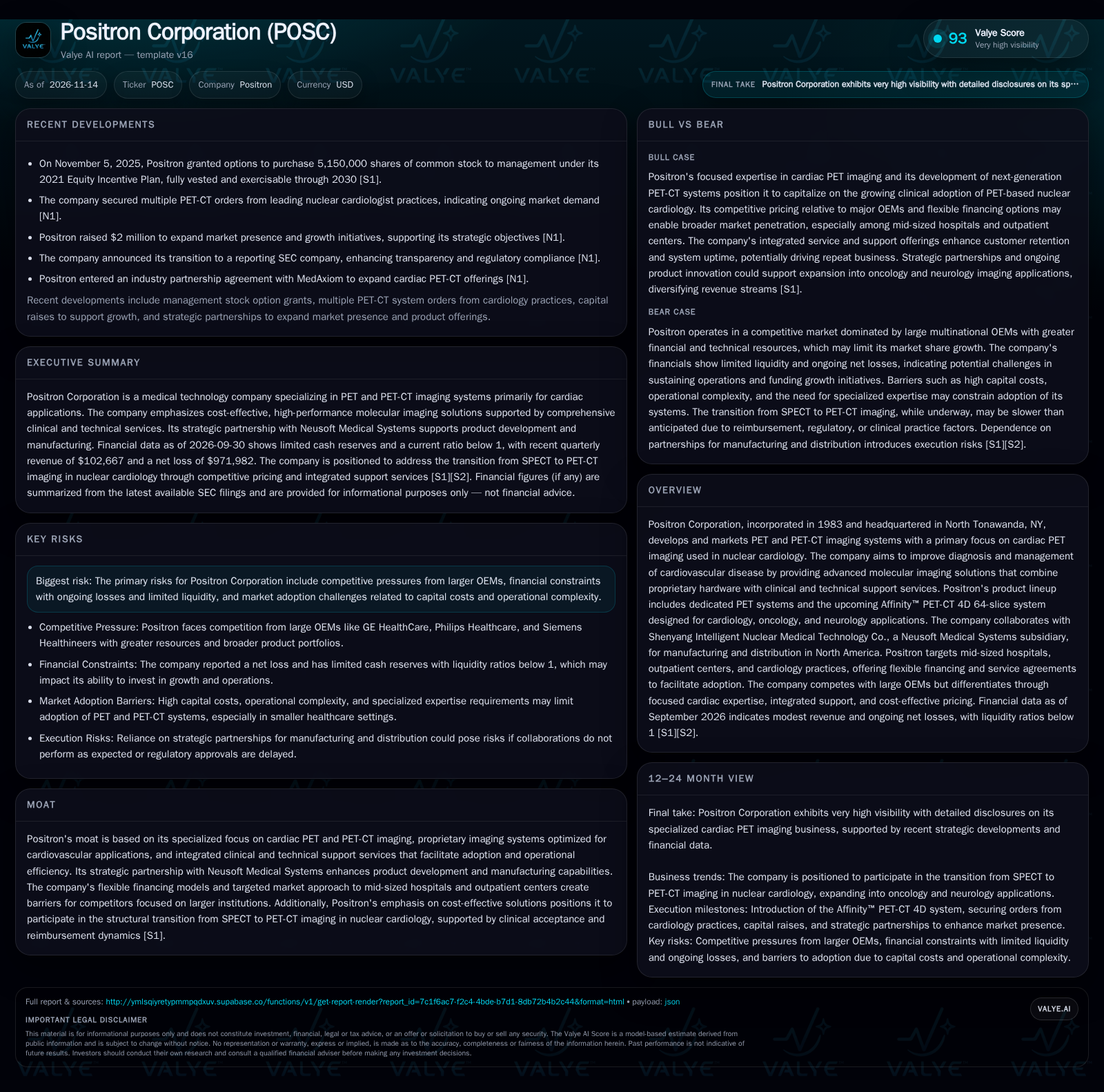
Positron Corporation develops and sells PET and PET-CT imaging systems for nuclear cardiology, targeting mid-sized healthcare providers with cost-effective, high-performance solutions. Execution on new platform launches, successful customer adoption, and access to capital are critical variables for the next phase of the business. [S1] [S2]
Positron Corporation is attempting to disrupt the nuclear cardiology imaging landscape by delivering specialized PET and PET-CT solutions to mid-sized healthcare providers. Its focus on cost-effective, high-performance imaging—backed by clinical support and flexible financing—positions it as a differentiated challenger to industry giants. The next twelve to twenty-four months will test whether Positron’s technological focus and partnership-driven model can translate into sustainable commercial traction.
Recent Financial Results and Strategic Moves Define the Near-Term Landscape
The company reported cash and liquidity metrics for the period; these figures do not by themselves establish operating runway, investment capacity, financial flexibility, or financing capacity. The company’s financials reflect the high fixed costs and long sales cycles typical of advanced medical imaging businesses, especially those targeting slower-to-adopt mid-market providers. Recent developments include the granting of 5,150,000 stock options to management and a series of PET-CT system orders from leading cardiology practices, alongside capital raises and new partnerships to support growth and product development. These moves highlight both the urgency to secure operational runway and the intent to strengthen market presence through innovation and customer engagement. [S1] [S2]
Unit Economics in Cardiac Imaging: Margin Potential and Capital Intensity
Positron’s revenue model is anchored in the sale and leasing of PET and PET-CT imaging systems, supplemented by service agreements, training, and maintenance contracts. The economics of PET-CT systems are defined by high upfront capital costs, with potential for attractive gross margins on hardware and recurring revenue from services if scaled. However, the company’s modest revenue base and persistent net losses suggest it has not yet achieved sufficient volume to benefit from operating leverage or to cover fixed R&D, manufacturing, and support costs. The introduction of flexible financing (rental and lease-to-own programs) may accelerate adoption by lowering upfront barriers for mid-sized hospitals and outpatient centers, but could also delay cash inflows and compress near-term margins. The capital-intensive nature of medical device manufacturing, combined with slow procurement cycles and regulatory hurdles, means Positron’s path to profitability likely hinges on scaling placements, expanding service attach rates, and maintaining cost discipline. [S1] [S2]
The interplay between capital intensity and margin potential in cardiac imaging devices necessitates a nuanced approach to scaling. While high upfront costs can deter initial buyers, especially in budget-constrained mid-market settings, the recurring revenue from service contracts and consumables often forms a critical backbone for sustained profitability. This dynamic implies that Positron’s long-term success depends not only on system placements but also on the effective cultivation of a service ecosystem that locks in customers and generates predictable cash flows. Moreover, the amortization of R&D investments over a growing installed base is essential to improving unit economics, highlighting the importance of reaching a critical mass of deployments to dilute fixed overheads.
Additionally, the adoption of flexible financing models introduces complex trade-offs between accelerating market penetration and managing near-term liquidity. While lease-to-own or rental options can lower barriers for customers hesitant to commit large capital expenditures, these arrangements may extend the time horizon for cash recovery and increase the company’s credit exposure. Therefore, Positron’s financial strategy must carefully balance growth ambitions with prudent risk management, ensuring that financing terms do not undermine the company’s working capital position. Monitoring the evolution of customer payment patterns and default rates would provide valuable insight into the sustainability of these financing approaches.
Specialization Versus Scale: Competing with Industry Incumbents
Positron operates in a market dominated by multinational OEMs such as GE HealthCare, Philips Healthcare, and Siemens Healthineers, which possess greater financial resources, brand recognition, and established distribution networks. The company’s competitive differentiation rests on its cardiac PET expertise, proprietary imaging systems tailored for cardiovascular diagnostics, and an integrated service model designed to maximize uptime and customer support. Exclusive North American rights for PET and PET-CT scanners through the Neusoft Medical partnership provide a channel advantage, but the durability of this edge depends on execution and sustained technological innovation. The shift from SPECT to PET-CT in nuclear cardiology represents a structural tailwind, but adoption is gated by customer inertia, reimbursement dynamics, and the readiness of mid-market providers to invest in new modalities. Substitutes include continued SPECT use, as well as competing PET-CT platforms from larger OEMs that may bundle broader product suites or offer aggressive financing. [S1]
If PET-CT Adoption Accelerates, Positron’s Niche Focus Could Drive Market Share Gains
The most favorable scenario for Positron is one where clinical guidelines, reimbursement policies, and growing evidence of PET-CT’s diagnostic superiority accelerate the replacement of SPECT in nuclear cardiology. In this environment, mid-sized hospitals and outpatient imaging centers would actively seek cost-effective, high-performance PET-CT solutions, and Positron’s targeted approach, flexible financing, and integrated support would resonate. Successful launch and adoption of the Affinity™ PET-CT 4D 64-slice system—coupled with expanding service contracts and reference wins in leading cardiology practices—could drive significant revenue growth and operating leverage. Confirmation of this scenario would come from a rising order backlog, increasing system placements, visible expansion of the installed base, and improving gross margins as fixed costs are absorbed. Additional capital raises or strategic investments that extend operational runway would further support this trajectory. [S1] [S2]
Incremental Gains Amid Financial Constraints and Gradual Market Transition
The most plausible trajectory is a gradual increase in PET-CT adoption as mid-market providers cautiously evaluate capital investments and as reimbursement and clinical acceptance evolve. In this scenario, Positron captures incremental share through its differentiated focus and service orientation, but faces elongated sales cycles and ongoing pricing pressure from larger OEMs. Progress would be evidenced by steady, though not rapid, order flow, stable or slightly improving gross margins, and measured expansion of the installed base. Falsification would be indicated by stagnant or declining revenue, inability to secure new contracts, or persistent operating losses without evidence of scale benefits. [S1] [S2]
Financial Pressure and Adoption Delays Could Constrain Viability
A less favorable outcome materializes if PET-CT adoption in nuclear cardiology stalls due to reimbursement headwinds, slow clinical guideline changes, or customer reluctance to invest in new capital equipment. In this scenario, Positron’s sales pipeline slows, order flow weakens, and competitive pricing from larger OEMs erodes margins. Execution risks associated with manufacturing partnerships or supply chain disruptions could further undermine performance. Downside confirmation would come from declining order intake, rising operating losses, missed debt or payables obligations, or negative developments in key partnership agreements. [S1] [S2]
Testing the Thesis: Adoption, Cash Flow, and Execution Milestones for Positron
Quarterly order volume and system placements: Monitoring the rate of new PET-CT system orders and installations will signal commercial traction and adoption velocity.
Gross margin trends: Sustained improvement in gross margins would suggest operating leverage and better absorption of fixed costs.
Expansion of service/maintenance contract base: Growth in recurring service revenue would validate the integrated support model and improve revenue visibility.
Cash burn rate and capital raising activity: Tracking cash outflows relative to available liquidity and the frequency, size, and terms of capital raises will clarify financial runway.
Progress on Affinity™ PET-CT 4D system launch: Milestones in regulatory approval, commercial deployment, and customer feedback will be pivotal for growth aspirations.
Customer mix and reference wins: Securing flagship accounts or multi-site deals with leading cardiology practices would enhance credibility and facilitate further adoption.
Execution of Neusoft Medical partnership: Performance in manufacturing, supply chain stability, and exclusivity terms will shape long-term competitiveness.
A useful metric would be system uptime and customer satisfaction scores, as high operational reliability is a stated differentiator but would benefit from quantitative disclosure.
Disclaimer: This is research-only, informational analysis and not investment advice. It may include AI-generated interpretation and general industry context. Always verify important details using primary sources.

Comments