
Scientific Industries After Genie: Bioprocessing Ambition, Funding Strain, and the Search for Profitable Scale
Following the sale of its Genie product line, Scientific Industries pivots toward advanced bioprocessing systems and core benchtop equipment.
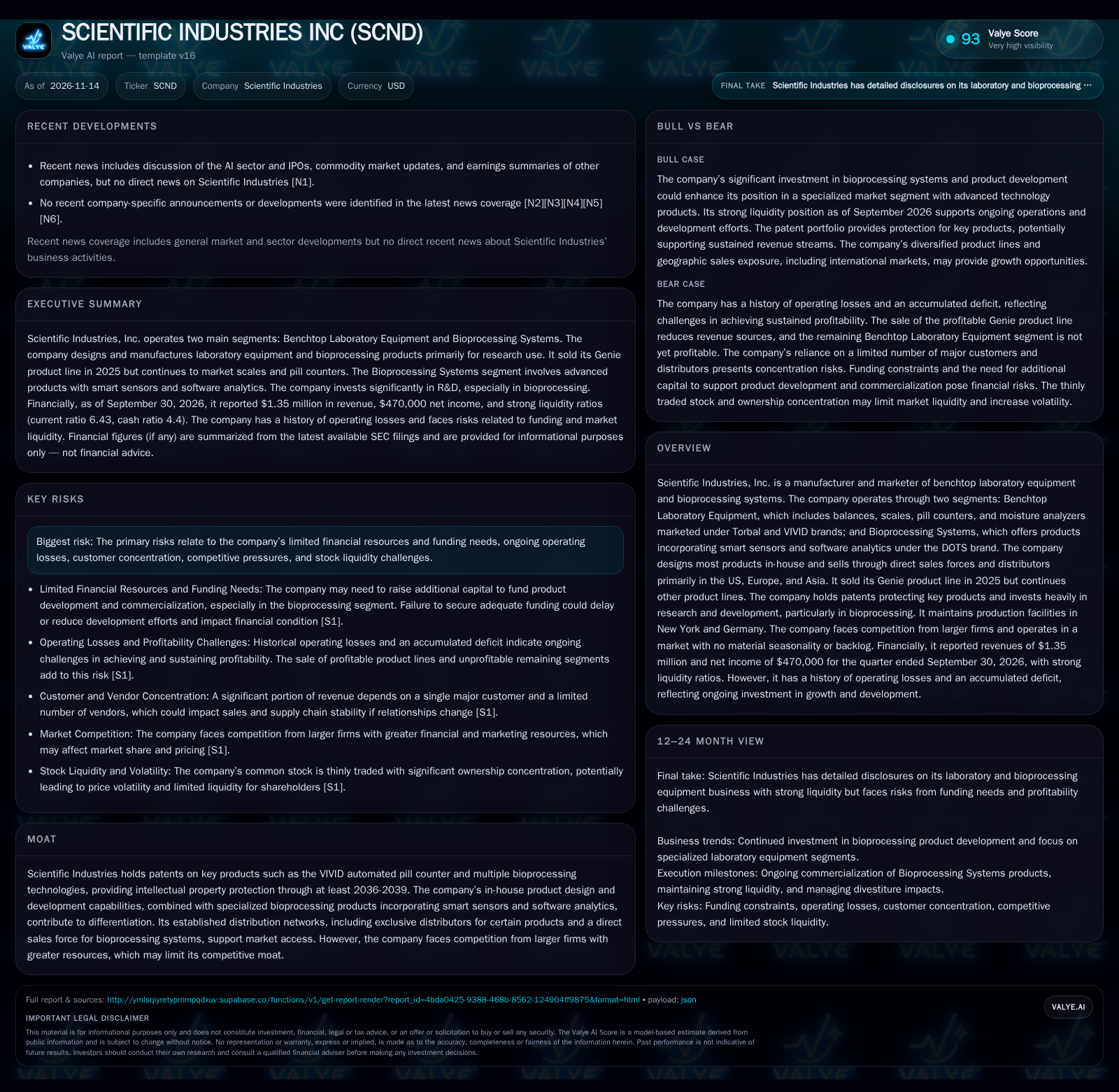
Scientific Industries, Inc. is refocusing on its Benchtop Laboratory Equipment and Bioprocessing Systems segments after divesting its profitable Genie product line in 2025. While recent reported liquidity position and patented bioprocessing technologies offer differentiation, the company faces ongoing operating losses, heavy R&D commitments, and significant customer concentration. Achieving scale and sustainable profitability—especially in bioprocessing—will require successful commercialization, careful capital management, and diversification of both customer base and product revenue streams. [S1] [S2]
Scientific Industries stands at a strategic crossroads following the sale of its Genie product line—a decision that has reshaped its revenue base and sharpened its focus on bioprocessing and core benchtop laboratory equipment. Yet, a history of operating losses, customer concentration, and the need for external funding underscore the execution risks ahead. The real test will be whether Scientific Industries can translate its technology investments into profitable and defensible market positions before capital constraints or competitive pressures force a different outcome.
Strategic Reset Post-Genie Sale: Where Scientific Industries Stands Now
The August 2025 sale of the Genie product line for $9.6 million plus an earn-out marked a pivotal transition for Scientific Industries, removing a historically profitable segment and leaving the company reliant on its Torbal and VIVID benchtop products and a growing but unprofitable Bioprocessing Systems division [S1]. The latest financial snapshot as of September 30, 2026, shows $1.35 million in revenue and $470,000 in net income for the quarter, with cash and equivalents at $515,400 and a current ratio of 6.43 [S2]. However, this short-term profitability is set against a backdrop of chronic operating losses—$1.22 million in 2025 and $6.45 million in 2024—and a $35.15 million accumulated deficit [S1] [S2]. The Bioprocessing Systems segment, which absorbs the majority of R&D spending ($2.49 million in 2025), is expected to remain a drag on bottom-line results for the foreseeable future [S1]. Additionally, customer concentration is pronounced: one buyer accounted for 31% of 2025 revenues, mainly through VIVID pill counters [S1].
Economics of a Niche Lab Equipment and Bioprocessing Play
Scientific Industries’ business model is split between two distinct economic engines: the mature, relatively commoditized Benchtop Laboratory Equipment business and the higher-potential but riskier Bioprocessing Systems segment. Benchtop products—scales, balances, pill counters—are typically sold through distributors and online, with pricing pressure from larger competitors and limited room for margin expansion absent unique features or strong brand pull. The VIVID pill counter, protected by patents through 2039, offers some insulation, but the segment's profitability is not yet established following the Genie divestiture [S1].
The Bioprocessing Systems division targets a specialized market with smart sensors and software analytics for cell growth and process monitoring. These products are likely to command higher gross margins if adoption scales, given their proprietary technology and integration into customer workflows. However, this segment is capital-intensive: high R&D outlays are required for continuous innovation, and long sales cycles or customer validation periods are common in laboratory and bioprocessing equipment markets. The company’s lack of material backlog and short lead times suggest a transactional revenue model, with little built-in visibility or recurring revenue unless software analytics or consumables become a larger mix [S1].
Operating leverage could improve meaningfully if bioprocessing revenues ramp, as much of the development and fixed cost base is already in place. However, the need for additional funding to support commercialization, particularly for bioprocessing, remains a structural concern [S1].
Competitive Dynamics: Intellectual Property and Scale Versus Sector Giants
Scientific Industries operates in markets dominated by larger players with deeper pockets and broader distribution—Ohaus, A&D Company, and Illinois Tool Works in benchtop equipment; Sartorius, Eppendorf, and Hamilton Bonaduz in bioprocessing [S1]. The company’s patent portfolio (VIVID pill counter through 2039, multiple bioprocessing patents through 2036–2038) provides some defensibility, especially in niche applications where proprietary features matter. However, these protections are time-limited, and larger competitors can often outspend smaller firms on both product development and commercial reach.
Switching costs for benchtop equipment are typically low unless embedded in validated workflows, while bioprocessing systems offer greater potential for customer lock-in if software analytics or proprietary sensors become integral to lab processes. The company’s strategy of direct sales in bioprocessing and exclusive distribution in benchtop equipment may help target high-value segments, but the thinly traded OTC stock and ownership concentration could limit access to growth capital needed to scale or defend share.
Differentiation will likely hinge on the adoption of its smart, sensor-enabled bioprocessing products and the company’s ability to convert technical features into must-have solutions for research and biomanufacturing customers.
If Bioprocessing Innovation Drives Adoption and Margins
The most favorable scenario for Scientific Industries is one in which its bioprocessing product line—anchored by smart sensors, software analytics, and proprietary consumables—secures significant adoption among research labs and biomanufacturers. If the company can establish its DOTS and MPS product families as industry standards, this would increase switching costs and enable premium pricing, especially if data integration and workflow automation become critical to customers.
Confirmation would come from accelerating bioprocessing revenue growth, a rising proportion of sales from software or recurring-consumable contracts, and an expanding distributor and customer base outside the current concentration. Operating leverage would be visible in improving segment gross margins and narrowing losses, even as R&D remains elevated. Additional evidence would include new patent issuances, strategic partnerships with larger industry players, or successful penetration of international markets beyond the current 17% foreign sales mix [S1].
Falsification would occur if bioprocessing revenue remains stagnant, customer wins are limited, or if the company is unable to command premium pricing due to competitive encroachment or lack of differentiation.
Steady State: Incremental Progress, Capital Constraints, and Customer Dependence
The most plausible trajectory over the next 12–24 months is one of incremental growth in both segments, with Benchtop Laboratory Equipment providing stability but little margin expansion, and Bioprocessing Systems showing gradual revenue increases offset by continued R&D investment. The company leverages its patent-protected products to defend share in core niches, but customer concentration—especially in pill counters—remains a vulnerability [S1].
The absence of material backlog and short production cycles mean revenue visibility is limited, even as the company tries to diversify its sales base through new distributors and international channels.
Evidence supporting this scenario would include modest sequential revenue growth, continued operating losses (albeit at a reduced rate), and no major changes in customer or distributor concentration. It would be challenged if the company secures major new customers, achieves a step-change in bioprocessing sales, or conversely, if it is forced to curtail R&D or seek emergency financing.
Funding Shortfalls and Revenue Shocks Could Force Retrenchment
The negative case is driven by two intertwined risks: the inability to secure additional capital and adverse shifts in customer concentration. If the company’s primary VIVID pill counter customer reduces purchases or switches to a competitor, the revenue base could contract sharply, exacerbating operating losses. Should bioprocessing commercialization fall short or timelines extend further, ongoing R&D and overhead costs could outpace available liquidity, forcing layoffs, asset sales, or a halt in development efforts.
Further, the thinly traded OTC stock and ownership concentration could make capital-raising expensive or dilutive, limiting strategic flexibility. Confirmation of this scenario would come from sharp revenue declines, a spike in net losses, urgent capital raises at unfavorable terms, or a sudden drop in R&D outlays signaling retrenchment. Falsification would require evidence of diversified revenue streams, successful capital raising on favorable terms, or stabilization in both benchtop and bioprocessing segments.
Milestones That Will Define Scientific Industries’ Next Chapter
Bioprocessing Systems segment revenue growth, especially as a percentage of total sales, would help gauge traction and potential for scale.
The mix of recurring versus transactional revenue—such as software subscriptions or consumable sensor sales—if disclosed, would clarify the durability of the company’s business model.
Gross margin trends by segment, particularly any expansion in bioprocessing, would signal improved pricing power or operational leverage.
Customer concentration levels—especially reliance on the single largest buyer—should be monitored for signs of diversification or further dependence.
R&D expenditure as a share of revenue: continued investment is necessary, but any forced reduction could indicate capital strain or a strategic pivot.
Cash burn and working capital trends will be critical, especially if bioprocessing remains unprofitable and external funding is required.
New patent grants or IP litigation outcomes could expand or erode the company’s defensibility in core product lines.
Distribution network expansion—new agreements or entry into additional geographies—would help test the company’s ability to broaden its customer base.
Disclaimer: This is research-only, informational analysis and not investment advice. It may include AI-generated interpretation and general industry context. Always verify important details using primary sources.

Comments