
Stardust Power: Refining Ambition Meets Capital Constraints in the U.S. Lithium Race
Stardust Power targets a critical choke point in the U.S. battery supply chain with its planned Oklahoma refinery, but acute liquidity pressure, a major convertible note default, and market delisting now threaten its ability to execute before competitors and macro headwinds reset the opportunity.
Stardust Power is developing a major lithium refinery in Oklahoma designed to supply battery-grade lithium carbonate to the U.S. EV and energy storage markets. The ability to secure new capital and demonstrate construction progress will determine whether Stardust can capitalize on the U.S. lithium supply gap or be sidelined by execution and funding setbacks.
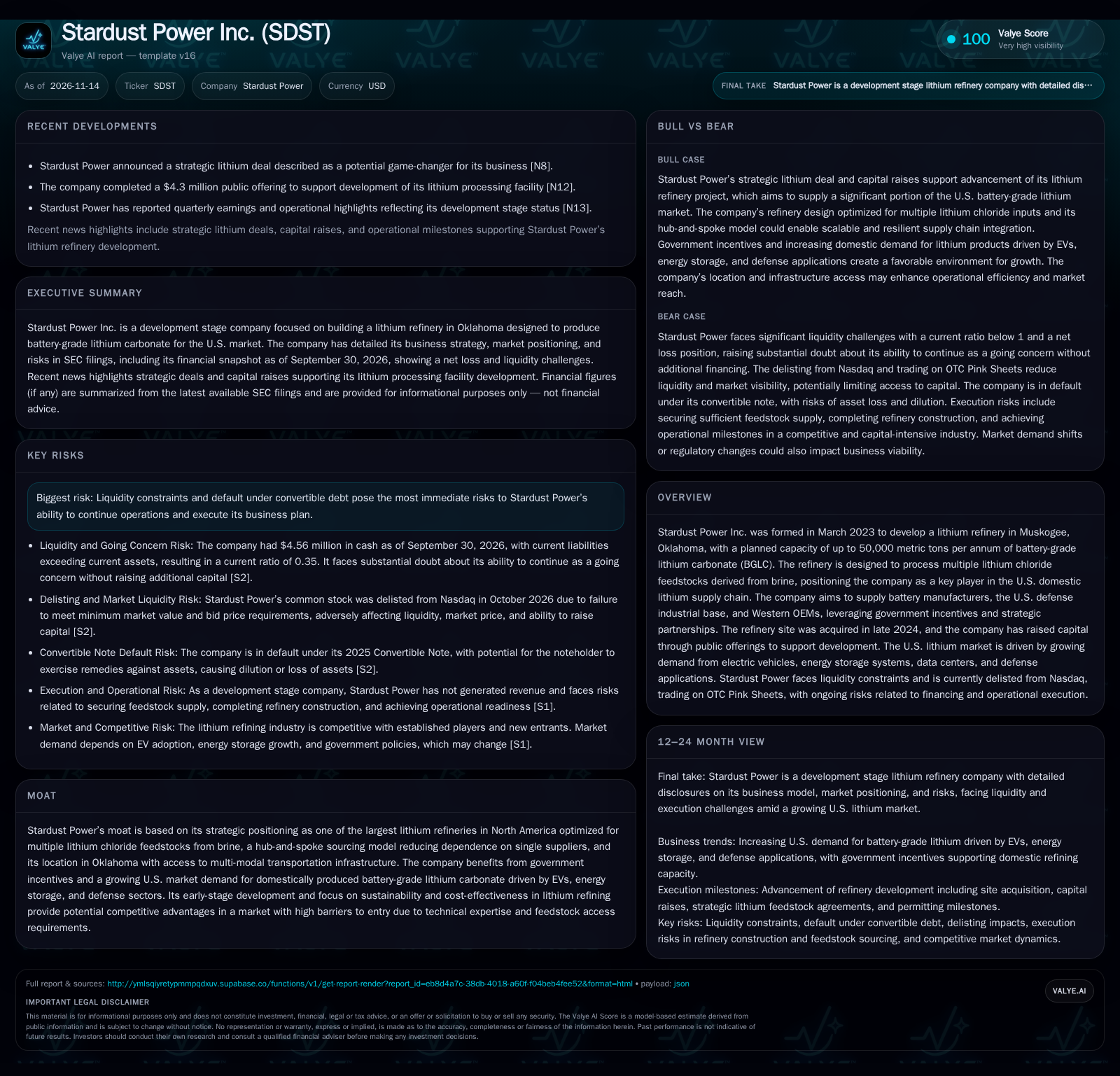
Stardust Power Inc. seeks to bridge a vital gap in the U.S. battery supply chain by developing a large-scale lithium refinery in Oklahoma, promising to supply enough battery-grade lithium carbonate for approximately one million electric vehicles annually. The company’s ambition is underpinned by a flexible, multi-source feedstock strategy and the lure of substantial state and federal incentives. However, acute funding strain, a recent default on its convertible note, and delisting from Nasdaq have shifted the focus from long-term market opportunity to short-term survival. The next several quarters will be decisive: either Stardust secures the capital and execution momentum needed to advance construction, or it risks falling behind as larger, better-funded players and shifting policy priorities reshape the North American lithium landscape.
Liquidity Stress and Default Define Stardust’s Immediate Outlook
As of September 30, 2026, Stardust Power reported $4.56 million in cash and cash equivalents, with current liabilities of $14.63 million, resulting in a current ratio of 0.35 and a cash ratio of 0.31 [S2]. This acute liquidity shortfall, well below typical going-concern thresholds, is compounded by a net loss of $2.77 million in the quarter and negative earnings per share. The company’s common stock was delisted from Nasdaq in October 2026 after failing to meet market value and bid price requirements, reducing market visibility and access to institutional capital [S2]. Most critically, Stardust is in default under its 2025 Convertible Note, with default events triggered by the delisting and market cap shortfall, raising the risk of forced asset sales or significant shareholder dilution if not promptly resolved [S2]. These facts place the company’s ability to continue operations and execute its refinery project in immediate jeopardy.
Refinery Economics: High-Capex, High-Stakes, and the Leverage of Scale
Stardust Power’s core economic proposition is to develop a refinery capable of producing up to 50,000 metric tons per year of battery-grade lithium carbonate (BGLC), targeting battery manufacturers, the U.S. defense base, and Western OEMs [S1]. Lithium refining is capital-intensive: upfront investment in land, permitting, construction, and processing equipment typically runs into the hundreds of millions of dollars. The company has acquired its site and secured illustrative incentives—up to $257 million in performance-based state and potential federal support—but actual realization of these funds likely depends on meeting construction and operational milestones [S1].
Revenue logic rests on both volume and pricing: the refinery’s potential output could supply lithium for approximately one million EVs per year, about 8% of the projected U.S. EV market by 2035 [S1]. The ability to process multiple lithium chloride feedstocks from brine gives Stardust flexibility to source from various suppliers, potentially reducing input price volatility and supply disruption risk. However, without an established cost structure, the ultimate margin profile will hinge on feedstock costs, conversion yields, energy inputs, labor, and the ability to secure offtake agreements with premium buyers. Operating leverage could be significant once fixed costs are absorbed, but the path to positive cash flow is long and fraught with construction, ramp-up, and market risks.
Positioning Against Incumbents and New Entrants in Domestic Lithium
Stardust Power’s planned refinery would be among the largest in North America, aiming to fill a critical gap in the U.S. lithium supply chain, which currently relies heavily on imports and has few battery-grade refining facilities [S1]. Its hub-and-spoke sourcing model, optimized for multiple lithium chloride feedstocks, could offer a resilience edge over competitors dependent on single-source or hard-rock supply chains. The Oklahoma location provides access to road, rail, and river transport, facilitating both inbound feedstock and outbound product distribution [S1].
However, the U.S. lithium refining market is quickly evolving. Incumbent chemical producers, mining companies integrating downstream, and new specialist entrants are all vying for a share of the anticipated EV and grid storage boom. Government incentives are significant but not exclusive, and technical barriers to entry remain high. The most immediate competitive threat may come from larger, better-capitalized rivals who can move faster to secure feedstock, talent, and offtake contracts. Stardust’s recent strategic lithium deal [N8] could improve its competitive position, but without clarity on scale or enforceability, its impact remains to be seen.
Unlocking Incentives and Securing Feedstock: A Route to Relevance
If Stardust Power can raise the capital required to resolve its default, fund construction, and hit key milestones, the company could access the up to $257 million in incentives from Oklahoma and potential federal programs [S1]. This would materially reduce net capital requirements and improve project economics. The recently announced lithium deal [N8] could lock in a portion of the required feedstock, reducing input risk and enhancing credibility with lenders and prospective customers.
A favorable scenario would see the company progressing through permitting, breaking ground on the refinery, and signing initial offtake agreements with battery manufacturers or OEMs, possibly at premium prices for domestic, traceable supply. Confirmation would come from new equity or debt financings, construction contract awards, and regulatory milestone achievements. Falsification would be evident if capital remains unavailable, milestones slip, or the lithium deal fails to move from announcement to binding agreement.
Facing the Funding Gauntlet: Survival Before Scale
The most plausible scenario is one of near-term triage: Stardust must urgently secure bridge financing or a strategic investor to address the convertible note default and restore minimal operational runway. The company may need to accept punitive terms or significant dilution, given its OTC Pink Sheets status and acute liquidity position [S2]. Even if lifeline capital is raised, major construction and operational milestones are likely to face delays as the company rebuilds credibility and negotiates with suppliers, contractors, and potential customers.
Progress would be confirmed by announcements of new funding, renegotiation or cure of the convertible note default, and incremental permitting or pre-construction activity. Falsification would be a lack of material capital inflows, continued default status, or asset sales under creditor pressure.
Asset Loss and Project Stall if Funding Remains Out of Reach
Should Stardust Power fail to secure new financing promptly, creditors under the defaulted convertible note could exercise remedies against company assets, potentially forcing liquidation or asset fire sales [S2]. In this scenario, the refinery project could stall indefinitely, with the Muskogee site and any intellectual property or contracts transferred to creditors or sold at distressed values. Existing shareholders would likely face severe dilution or total loss.
Further, ongoing liquidity shortfalls could lead to staff departures, regulatory setbacks, and the loss of any tentative feedstock or customer relationships. Confirmation of this scenario would come from asset sale announcements, bankruptcy filings, or ongoing SEC disclosures indicating inability to meet obligations. Falsification would require evidence of a successful capital raise or forbearance agreement with creditors.
Testing Stardust’s Refinery Ambition: Milestones That Will Prove the Thesis
Resolution or renegotiation of the 2025 Convertible Note default, including any waivers, forbearance, or recapitalization events.
Disclosure of new equity or debt financing sufficient to fund operations through at least the next major project milestone.
Binding feedstock supply agreements, with volume, tenor, and price terms if disclosed, as opposed to non-binding MOUs.
Award of construction contracts or commencement of site development at the Muskogee refinery location.
Permitting progress, including state and federal regulatory approvals for refinery construction and operation.
Announced offtake agreements with battery manufacturers, OEMs, or defense customers, with contract structure and duration if disclosed.
Evidence of performance-based incentive disbursement from Oklahoma or federal sources, contingent on meeting development milestones.
A useful metric would be projected or actual refinery EBITDA margins and capital intensity benchmarks compared to established industry peers, if disclosed.
Disclaimer: This is research-only, informational analysis and not investment advice. It may include AI-generated interpretation and general industry context. Always verify important details using primary sources.

Comments