
Twelve Seas Investment Co III: SPAC Clock Ticks as Global Acquisition Ambitions Meet Execution Risk
With $172.5 million in trust and a management team versed in international SPACs, Twelve Seas Investment Co III/Cayman faces a narrowing window to secure a cross-border deal. Its success will hinge on sourcing a compelling target in the Pan-Eurasian or African markets—and on overcoming the structural dilution and execution risks inherent to the SPAC model.
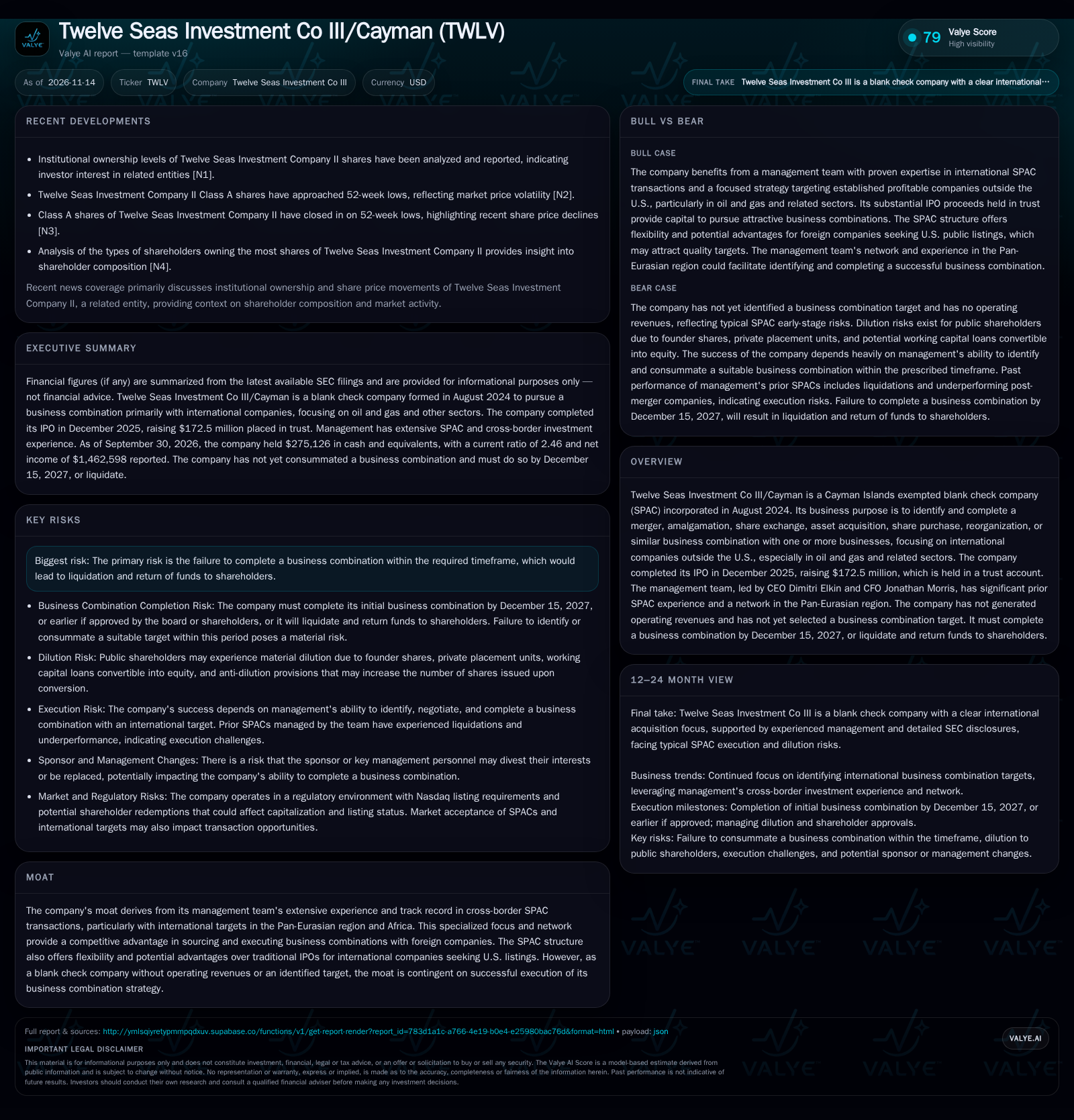
Twelve Seas Investment Co III/Cayman is a blank check company with $172.5 million in trust from its December 2025 IPO, led by experienced SPAC operators targeting international companies, especially in oil and gas. No acquisition target has been announced, and the company must complete a business combination by December 15, 2027, or liquidate. The main risks are execution, dilution, and the challenge of finding a quality target in a competitive global SPAC environment. The next twelve months are critical for deal sourcing and shareholder alignment.[S2]
Twelve Seas Investment Co III/Cayman stands at a critical juncture typical of newly listed SPACs: flush with $172.5 million in trust and led by a management team with a history of international deal-making, but with the clock ticking toward a mandatory 2027 deadline to secure a merger. The company’s explicit focus on established, profitable businesses outside the U.S.—particularly in oil and gas—reflects both its leadership’s cross-border expertise and the competitive realities of the current SPAC market. Yet, with no target identified and dilution risks looming, the next phase will test whether its network and deal discipline can deliver a value-accretive transaction before time runs out.[S2]
IPO Proceeds, Deal Deadline, and Management Track Record Define the Opportunity and Risk
Twelve Seas Investment Co III completed its IPO in December 2025, raising gross proceeds of $172.5 million, which are currently held in a U.S. trust account pending the identification and completion of a business combination.[S2] This capital pool is the company’s primary asset and serves as both its main attraction for potential targets and a safeguard for public shareholders should no deal materialize.
The company has not yet identified a target, and per its charter, it must consummate an initial business combination by December 15, 2027, or liquidate and return the trust proceeds to shareholders.[S2] This creates a fixed, non-negotiable timeline that compresses the opportunity set and heightens execution pressure as the deadline approaches.
Led by CEO Dimitri Elkin and CFO Jonathan Morris, the management team brings prior SPAC and cross-border M&A experience, including a notable merger with Brooge Holdings, a UAE oil storage operator. This track record positions the team to access non-U.S. deal flow, especially in the Pan-Eurasian and African regions, but does not guarantee the selection or successful execution of a suitable transaction.[S2]
How SPAC Economics and Structural Incentives Shape Outcomes
Twelve Seas Investment Co III’s economics are classic for a SPAC: its only asset is the $172.5 million in trust, which accrues minimal yield and is earmarked for acquisition, redemptions, or liquidation. The company currently generates no operating revenue, and its reported net income stems from SPAC accounting conventions (such as changes in warrant liabilities), not from commercial activity.[S2]
The company reported cash and liquidity metrics for the period; these figures do not by themselves establish operating runway, investment capacity, financial flexibility, or financing capacity. However, founder shares and private placement units entitle sponsors to a significant equity stake (typically 20% pre-dilution), creating potential misalignment: sponsors are incentivized to close almost any deal, while public shareholders bear the dilution and downside risk if the target underperforms.
Operating leverage is not relevant pre-merger, but post-combination, economics will depend entirely on the chosen target’s sector, margin profile, and capital intensity. If the merger candidate is in oil and gas, for example, capital requirements and commodity price sensitivity would dominate the financial model.
The structure also enables working capital loans convertible to equity, amplifying dilution risk if additional funding is needed before a deal closes. The trust account provides a hard cap on deployable equity unless PIPE (private investment in public equity) financing is secured alongside the merger.
Where Twelve Seas Could Find an Edge—and Where It Competes on a Level Playing Field
Twelve Seas Investment Co III’s competitive edge lies in its management’s international deal network, especially in regions—such as the Middle East, Central Asia, and Africa—that are less saturated with U.S.-centric SPAC activity. The team’s prior success in bringing Brooge Holdings public suggests access to established, profitable enterprises that may prefer a SPAC merger over a traditional IPO for reasons of speed, certainty, or sponsor alignment.
However, the competitive field is crowded: other SPACs, private equity firms, and regional investors are also seeking quality international assets, particularly in oil and gas, infrastructure, and industrials. Many attractive targets have already been approached or have become wary of U.S. capital markets due to increased regulatory scrutiny and the mixed performance of post-merger SPACs.
The company’s willingness to consider U.S.-based firms owned by non-U.S. shareholders marginally expands its pool, but this is unlikely to be a unique advantage. Ultimately, the moat is not structural but depends on the team’s ability to source, negotiate, and close a transaction that can withstand both public market scrutiny and the increasingly cautious stance of institutional investors.
If a High-Quality Cross-Border Target Is Secured, Value Creation Could Be Significant
The company reported profitability for the period.
A favorable scenario would involve minimal redemptions, a PIPE financing that supports valuation, and a target with strong cash generation and clear reporting. This could create a liquid, investable public company with the scale to attract long-term holders.
Confirmation of this scenario would come from a merger announcement with a known, credible operator, accompanied by PIPE participation from respected investors and limited redemption pressure at the shareholder vote. Early positive signals would include management commentary about advanced negotiations, LOIs (letters of intent), or regulatory filings indicating a definitive agreement.
Most Likely: Prolonged Search, Shareholder Redemptions, and a Conventional Target
The most plausible path is that Twelve Seas spends much of 2026 and early 2027 in active target search and negotiation, ultimately announcing a deal with a mid-sized international company—possibly in oil and gas or industrial services—that is willing to accept SPAC terms and valuation.
Shareholder redemptions are likely, given the mixed track record of recent SPACs and the structural dilution embedded in the model. The final business combination could require PIPE or bridge financing to maintain deal economics and Nasdaq listing compliance.
Evidence supporting this scenario would be public milestones such as the announcement of a non-binding LOI, followed by months of due diligence and negotiations. Falsification would be the absence of deal progress or shareholder votes to extend the SPAC’s life, signaling difficulty in finding a willing or viable target.
Failure to Find a Target or Close a Deal Triggers Liquidation and Capital Return
The adverse scenario is that management is unable to identify or close on a suitable business combination before the December 15, 2027 deadline. This could result from a lack of willing targets, regulatory or market headwinds, or shareholder resistance to proposed deals.
In this case, the trust account is returned to public shareholders (minus limited permitted expenses), with founder shares and warrants becoming worthless. This is a common outcome for SPACs that overestimate their access to quality assets or face unfavorable market conditions during the search window.
Confirmation of this scenario would be repeated extensions, failed shareholder votes, or an explicit announcement that no business combination will proceed. Falsification would require a material, credible deal announcement and progress toward closing.
Milestones That Will Determine Whether Twelve Seas Delivers Shareholder Value
Announcement of a letter of intent or definitive agreement with an international target, especially in the oil and gas sector, would be a clear inflection point.
Disclosure of PIPE financing commitments or other external capital support alongside a merger announcement would help test market appetite and deal credibility.
Shareholder redemption rates at the time of the merger vote—high redemption would signal low confidence in the transaction.
SEC or Nasdaq feedback on the proposed transaction, including any regulatory or listing compliance hurdles.
If disclosed, details on the valuation, historical profitability, and governance of the chosen target would clarify the deal’s risk/reward profile.
Any changes in sponsor or management composition, as this could disrupt deal execution and erode market confidence.
Indications of material dilution from the conversion of founder shares, private placement units, or working capital loans into equity.
Disclaimer: This is research-only, informational analysis and not investment advice. It may include AI-generated interpretation and general industry context. Always verify important details using primary sources.

Comments