
Canary XRP ETF: Navigating Regulatory Flux and the Mechanics of Crypto-Asset Exposure
The Canary XRP ETF offers investors direct access to XRP through a transparent, exchange-traded structure, but its future hinges on evolving U.S. digital asset regulation, operational integrity, and the adoption trajectory of XRP itself.
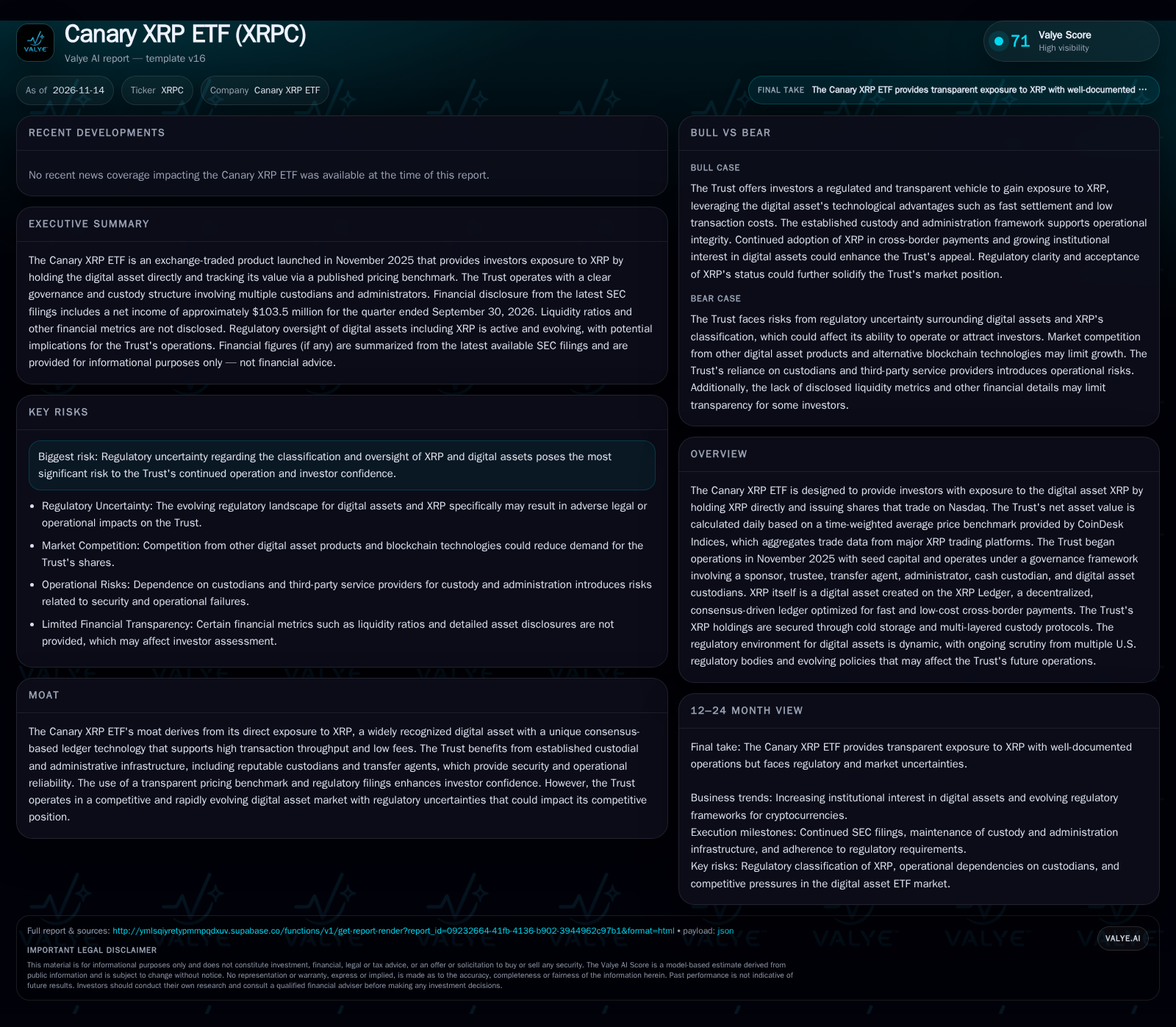
Canary XRP ETF enables exchange-traded exposure to XRP, reporting $103.5M in net income for Q3 2026, but faces material uncertainty from U.S. regulatory developments and the underlying XRP ecosystem. Its operational resilience and value proposition depend on custody security, competitive ETF alternatives, and the regulatory classification of XRP. Investors must weigh the structural transparency against the opacity of undisclosed liquidity metrics and the rapidly shifting digital asset landscape. [S2]
The Canary XRP ETF represents a new breed of exchange-traded products offering direct exposure to digital assets, in this case, XRP. With a transparent governance and custody framework, and a reported net income of over $103 million for Q3 2026, the ETF appeals to investors seeking regulated access to crypto markets. However, the product's long-term viability and growth prospects remain tightly linked to ongoing regulatory developments in the U.S., the operational soundness of its custody arrangements, and the ultimate adoption and utility trajectory of XRP itself. These factors, along with incomplete financial disclosures, create a landscape of both opportunity and uncertainty for investors. [S2]
Material Developments: Income, Structure, and Regulatory Backdrop
The Canary XRP ETF reported a net income of $103,507,551 for the quarter ended September 30, 2026, according to its latest SEC filing. The company reported cash and liquidity metrics for the period; these figures do not by themselves establish operating runway, investment capacity, financial flexibility, or financing capacity. [S2]
Operationally, the ETF maintains a multi-layer custody and governance setup: the Sponsor is Canary Capital Group LLC, with U.S. Bancorp Fund Services and U.S. Bank, N.A. handling transfer and cash custody, and Gemini Trust Company, LLC and BitGo Trust Company Inc. providing digital asset custody. These institutional arrangements are designed to enhance security and investor trust. [S1]
The ETF’s investment objective is to track the value of XRP, referencing the CoinDesk CCIXber 60m New York Rate, and all XRP holdings are managed via cold storage with strict security protocols. [S1]
Most critically, the regulatory environment for digital assets, especially XRP, is in flux. The SEC Crypto Task Force and recent executive orders underscore the uncertain classification and future treatment of XRP, creating a persistent risk to the ETF’s operations and investor appeal. [S2]
How the ETF Converts XRP Exposure Into Shareholder Value
The Canary XRP ETF generates value by holding XRP and issuing shares that represent fractional ownership of the Trust’s XRP holdings, minus expenses. Shares are created and redeemed in blocks of 10,000 (Baskets), facilitating efficient arbitrage and keeping share prices close to net asset value. [S1]
The ETF’s revenue model is fundamentally tied to the appreciation of XRP and the volume of assets under management. As with other commodity-backed ETFs, ongoing expenses—custody, administration, insurance, and regulatory filings—are deducted from the asset pool, reducing the XRP per share over time. This creates a built-in drag on performance relative to spot XRP prices, but offers investors exchange liquidity and access without self-custody risks.
Operating leverage is generally limited, as most costs scale with assets under management, but fixed expenses (compliance, administration) could decrease as a percentage of assets if the Trust grows. The largest capital need is maintaining secure custody and meeting regulatory compliance, rather than traditional operating investment.
The absence of disclosed liquidity metrics or fee schedules makes it difficult to analyze short-term cash dynamics or the impact of share creation/redemption on Trust operations. If disclosed, redemption activity and fee rates would provide valuable insight into the ETF’s ongoing economics.
ETF Structure, Custody Integrity, and the Race for Crypto-Asset Market Share
The Canary XRP ETF’s primary competitive advantage lies in its direct, regulated exposure to XRP—a digital asset with fast, low-cost settlement and a unique consensus-based ledger that differentiates it from proof-of-work cryptocurrencies. The use of established custodians and transparent NAV calculations supports institutional trust and operational reliability. [S1]
However, the ETF operates in a rapidly evolving and crowded marketplace. Competing products include other digital asset ETFs, closed-end trusts, and structured notes, as well as direct holdings via crypto exchanges or wallets. The ETF’s value proposition depends on its ability to offer greater security, compliance, and transparency than self-custody or less-regulated vehicles.
A key counterforce is regulatory uncertainty. Should U.S. regulators take an adverse stance on XRP, this could undermine the ETF’s legitimacy, reduce institutional participation, or force operational changes. Additionally, alternative blockchain technologies and digital assets with different risk/reward profiles compete for investor attention and capital.
The ETF’s moat is further challenged by the lack of disclosed granular financials; investors seeking full transparency may gravitate toward products with more robust reporting or lower fee structures if available.
What Drives Outperformance: Regulatory Clarity and XRP Adoption
A favorable scenario for the Canary XRP ETF would be triggered by decisive regulatory clarity—such as the SEC or other federal agencies confirming XRP as a non-security or otherwise permitting continued ETF operation without material restrictions. This would significantly reduce the ETF’s existential risk and open the door for greater institutional and retail inflows.
Simultaneously, if XRP sees meaningful adoption in cross-border payments—driven by partnerships, remittance corridors, or integration with financial institutions—demand for XRP could increase, potentially boosting its price and, by extension, the ETF’s NAV and trading volumes.
Operationally, continued evidence of secure custody, no major incidents, and robust share creation/redemption activity would reinforce market confidence.
Confirmation of this scenario would come from regulatory filings clarifying XRP’s status, rising AUM, expanded trading volumes, and positive developments in XRP’s utility or corporate adoption.
Status Quo: Regulatory Overhang and Incremental Growth
The most plausible near-term trajectory for the Canary XRP ETF is a continuation of the current environment: regulatory uncertainty persists, but no immediate adverse actions force the ETF to suspend operations. The product maintains its operational integrity, and investors seeking diversified digital asset exposure continue to use it as a vehicle for XRP.
Growth in assets under management is moderate, reflecting the broader crypto market sentiment and the ETF’s ability to attract capital despite incomplete financial disclosures. Expenses are managed, but the lack of detailed reporting may limit appeal among institutional allocators.
Share trading tracks underlying XRP price movements, with the ETF’s NAV closely following the CoinDesk CCIXber benchmark. The ETF retains its competitive position among regulated crypto products, but does not achieve breakout growth or market share without a resolution to the regulatory question.
This scenario would be confirmed by a steady pace of SEC filings, flat to modestly rising AUM, and continued absence of regulatory or operational disruptions.
Regulatory Disruption or Custody Failure: Triggers for Material Value Erosion
The principal adverse scenario stems from a negative regulatory event—such as the SEC classifying XRP as a security or imposing restrictions on digital asset ETFs. This could force the ETF to halt share creations/redemptions, delist from Nasdaq, or liquidate XRP holdings, potentially at unfavorable prices and with significant friction for shareholders.
A secondary risk is operational: a breach or failure at the custodian level could compromise the ETF’s XRP holdings, leading to loss of assets and erosion of investor confidence. Dependence on third-party providers amplifies this risk, as any incident could have cascading effects on market trust.
Finally, if XRP adoption stagnates or declines—due to technology obsolescence, competitive displacement, or reputational issues—the ETF’s value proposition weakens, and its assets under management could shrink, increasing the per-share drag from fixed expenses.
Evidence for this scenario would include adverse regulatory announcements, suspension notices, abnormal redemption activity, or disclosures of custody or operational incidents.
Testing the Canary XRP ETF Thesis: Concrete Developments to Track
If disclosed, these metrics would clarify operational sustainability.
Any updates on the regulatory classification of XRP or digital asset ETFs from the SEC or other federal agencies would directly affect the ETF’s business model and investor confidence.
Announcements or filings indicating changes in custody arrangements, security protocols, or incidents at Gemini Trust Company or BitGo Trust Company would materially impact perceived asset safety.
Tracking the ETF’s assets under management (AUM) and share creation/redemption volumes would provide insight into investor demand and product traction. If disclosed, these would be critical leading indicators.
Developments in XRP adoption—such as new payment corridors, institutional partnerships, or technology upgrades—would influence the underlying asset’s value and, by extension, the ETF’s appeal.
Changes in expense ratios, management fees, or new competitor ETF launches could shift the relative attractiveness of the product.
SEC filings or press releases indicating any operational disruptions, delistings, or forced liquidations would signal thesis-breaking risk events.
If available, investor composition (institutional vs. retail participation) would help gauge the ETF’s addressable market and resilience to sentiment shifts.
Disclaimer: This is research-only, informational analysis and not investment advice. It may include AI-generated interpretation and general industry context. Always verify important details using primary sources.

Comments