
Tempest Therapeutics: Dual-Targeting CAR-T Ambition Meets Funding and Execution Crossroads
The company's near-term trajectory hinges on its ability to secure external partnerships, advance pivotal trials, and stabilize governance amid a volatile funding environment.
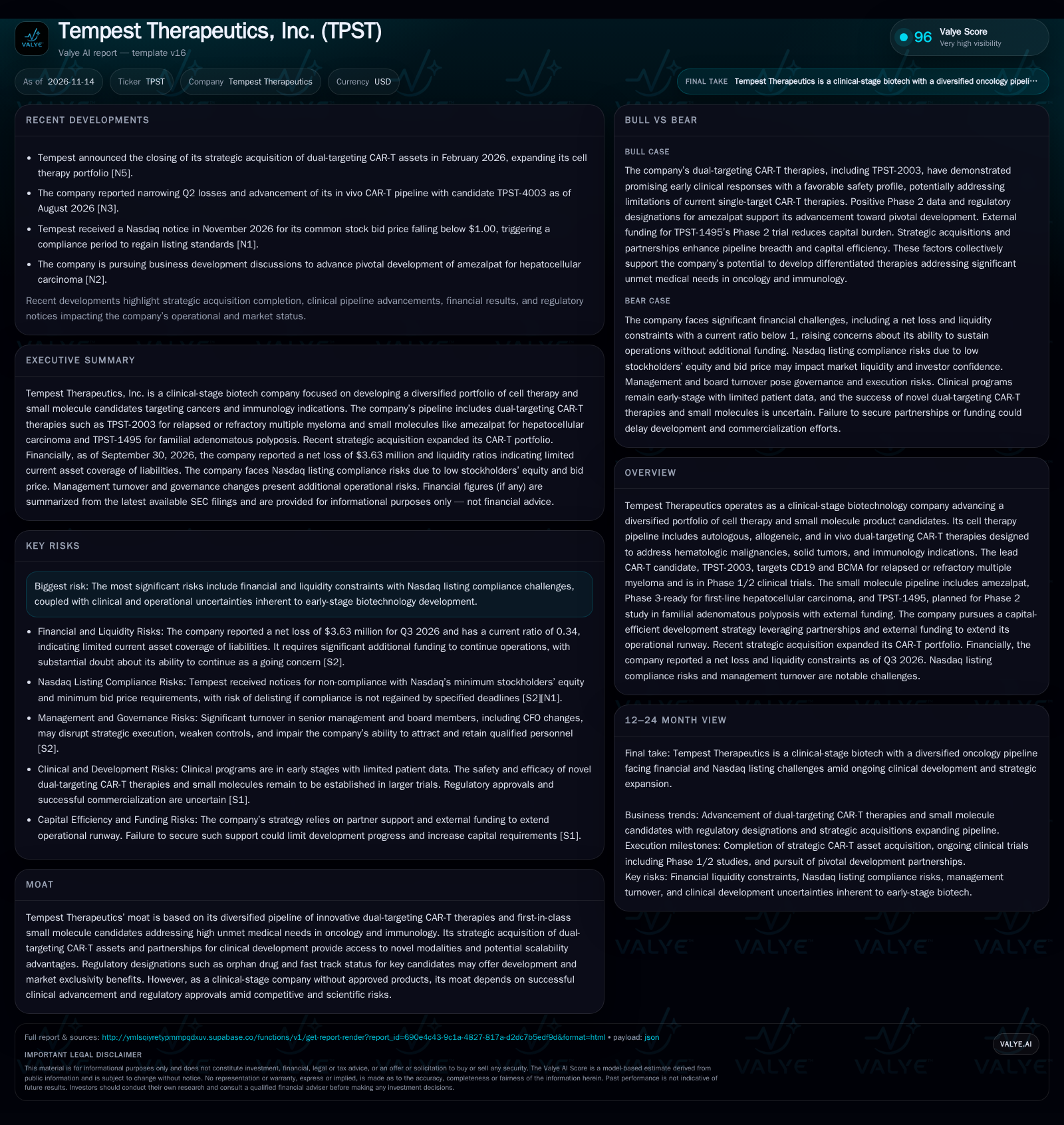
Tempest Therapeutics is advancing dual-targeting CAR-T and small molecule therapies for cancer, highlighted by early promising clinical data and recent strategic acquisitions. The company's future will be determined by its ability to convert scientific assets into value before financial and governance risks overwhelm its opportunity set. [S1] [S2] [N1] [N5]
Tempest Therapeutics stands at an inflection point defined by scientific ambition and financial fragility. Its recent strategic acquisition of dual-targeting CAR-T assets and early clinical signals in multiple myeloma and hepatocellular carcinoma position the company as a potential innovator in next-generation oncology therapeutics. Yet, with less than $1 million in cash, severe current-liability overhang, regulatory delisting risk, and a churned management team, Tempest's ability to bridge science to sustainable value is in question. [S1] [S2] [N1] [N5]
Strategic Acquisition and Clinical Milestones Collide with Liquidity Crisis
In February 2026, Tempest Therapeutics acquired a portfolio of dual-targeting CAR-T assets, notably adding TPST-2003—an autologous CD19/BCMA CAR-T therapy in clinical development for relapsed or refractory multiple myeloma (rrMM)—and advanced its pipeline to include both autologous and in vivo CAR-T candidates. Early clinical data from TPST-2003 have shown a 100% overall response rate among evaluable patients, with a favorable safety profile (no Grade 3 or higher cytokine release syndrome and limited neurotoxicity). [S1] [N5]
Simultaneously, the company’s small molecule candidate amezalpat (TPST-1120) is Phase 3-ready for hepatocellular carcinoma (HCC), having demonstrated a six-month median overall survival improvement in combination therapy and received orphan drug and fast track designations from the FDA, as well as orphan status from the EMA. [S1]
The company has received Nasdaq delisting notices for both minimum equity and minimum bid price non-compliance. [S2] [N1]
Management and board instability, including CFO turnover, compounds execution risk at a time when operational continuity is vital. [S2]
Pipeline-Driven Value Creation Hinges on Capital Efficiency and External Support
Tempest operates as a classic clinical-stage biotech: it does not currently generate product revenue and relies on external funding, partnerships, and equity issuance to finance R&D and operating expenses. The economics of its business are predicated on successfully advancing candidates through clinical milestones, which unlock value via out-licensing, co-development deals, or eventual commercialization—typically with substantial upfront, milestone, and royalty economics if partnered.
The company’s lead assets span both cell therapy and small molecule modalities. Dual-targeting CAR-T programs (autologous, allogeneic, and in vivo) could command premium pricing in hematologic malignancies and solid tumors if clinical efficacy and safety translate in pivotal trials. However, these programs are capital intensive, requiring costly manufacturing, trial infrastructure, and regulatory navigation. Small molecule candidates like amezalpat and TPST-1495 may offer more scalable economics and lower COGS, especially if external funding (such as the planned NCI-supported trial for TPST-1495) offsets internal capital needs. [S1]
Tempest’s stated strategy is to pursue capital efficiency by leveraging partnerships and grants. This approach can reduce dilution and extend operational runway, but also introduces dependence on counterparties and raises the bar for demonstrating compelling early clinical data to attract high-quality partners. The company’s acute liquidity constraints and negative working capital position suggest a limited window to execute this strategy before forced restructuring or asset sales become likely. [S2]
Differentiation Through Dual-Targeting and Modality Breadth—But Facing Intense Sector Headwinds
Tempest’s competitive proposition rests on its diversified approach to next-generation oncology therapeutics: dual-targeting CAR-T therapies designed to overcome antigen escape and resistance mechanisms, and small molecules with novel mechanisms in high-unmet-need indications. In the CAR-T space, dual-targeting (e.g., CD19/BCMA in TPST-2003) is a notable scientific differentiator, as single-target therapies have shown relapse due to antigen loss. Early 100% response rates are promising, but these are from limited patient numbers; durability and scalability remain to be proven. [S1]
The company faces entrenched competition from large-cap biopharma (with approved CAR-Ts and deep resources), as well as a crowded field of clinical-stage peers pursuing multi-antigen, allogeneic, and in vivo engineering strategies. Small molecule innovation in HCC and FAP also faces competition from approved standards of care and numerous pipeline entrants.
Tempest’s regulatory designations (orphan drug, fast track) for amezalpat confer potential market exclusivity and expedited review, but the real competitive test will be robust pivotal trial outcomes and the ability to secure partnering deals before larger players close the innovation gap. The company’s capital constraints and operational turnover may weaken its ability to compete for both talent and partners in a rapidly evolving sector.
Rapid Partnering and Positive Pivotal Data Unlock Asset Value Before Liquidity Cliff
The most favorable scenario for Tempest would see the company leveraging its early clinical data and regulatory designations to secure a substantial partnership or non-dilutive funding for one or more lead programs—most plausibly for amezalpat in HCC or TPST-2003 in rrMM. Such a deal could extend operational runway, validate the pipeline, and provide resources to accelerate pivotal trials. Early signals—such as initiation of pivotal studies, successful grant awards, or a disclosed partnership—would confirm progress.
If TPST-2003’s early 100% response rate holds in larger cohorts with durable safety and efficacy, and if amezalpat’s survival benefit is replicated in Phase 3, Tempest could command premium terms and establish a differentiated clinical profile. This would also increase the likelihood of regaining Nasdaq compliance and stabilizing governance.
This scenario would be falsified if partnership discussions stall, data fail to replicate, or if Tempest is forced into dilutive financings or asset fire sales prior to value inflection points.
Operational Survival Hinges on Bridge Financing and Incremental Clinical Progress
The most plausible path is that Tempest pursues interim financing—potentially via dilutive equity, bridge loans, or asset sales—while continuing ongoing clinical trials with a narrowed focus. The company may secure grant or partner funding for TPST-1495 and progress amezalpat to partnership discussions, but with uncertain timing and terms given the company’s weak bargaining position.
Clinical progress is likely to be incremental: continued enrollment in Phase 1/2 CAR-T studies and authorization of the TPST-1495 Phase 2 trial, but with resource constraints limiting the pace of advancement. Management and board instability may persist, and the risk of Nasdaq delisting remains elevated unless share price and equity levels recover.
This scenario is confirmed if Tempest announces short-term financings, extends cost control measures, and provides regular clinical updates but does not secure a transformative partnership or pivotal data readout in the near term.
Liquidity Exhaustion and Delisting Drive Forced Restructuring or Asset Liquidation
In an adverse scenario, Tempest’s acute liquidity shortfall and continued net losses lead to an inability to meet obligations or fund ongoing trials. Nasdaq delisting, if not remedied, could further restrict access to capital and erode investor confidence.
If no partnership or non-dilutive funding materializes and clinical data fail to attract interest, management may be forced to pursue asset sales, out-licensing at distressed valuations, or a formal restructuring. Board and management churn could accelerate, further impairing continuity and execution.
Evidence confirming this scenario would include missed payroll or vendor payments, cessation of clinical trial enrollment, public disclosure of strategic alternatives, or bankruptcy filings.
Milestones That Will Determine If Tempest Can Bridge Science to Sustainability
Announcement of a substantive partnership or licensing deal for amezalpat, TPST-2003, or other lead assets—terms, counterparties, and upfront economics would be critical.
Disclosure of bridge or non-dilutive funding (e.g., grants, milestone payments, or equity raises) and whether it meaningfully extends operational runway beyond current liabilities.
Nasdaq compliance updates—specifically, progress toward regaining minimum bid price and equity standards, or any waivers/extensions granted.
Initiation and enrollment pace of pivotal or Phase 2/3 trials for amezalpat, TPST-2003, TPST-1495, or in vivo CAR-T candidates. A useful metric would be patient accrual rates and timing of interim data.
Management and board stability: new hires, departures, and governance announcements that signal improved or worsening continuity.
Clinical data disclosures for TPST-2003 (durability, safety, efficacy in larger cohorts), amezalpat (Phase 3 readiness and partner interest), and TPST-1495 (trial start and NCI support).
Quarterly cash burn rate and net loss progression; if disclosed, projections for runway under various funding scenarios.
Any public announcement of asset sales, out-licensing, or strategic alternatives that would signal distress or a shift from development to liquidation mode.
Disclaimer: This is research-only, informational analysis and not investment advice. It may include AI-generated interpretation and general industry context. Always verify important details using primary sources.

Comments