
Securitize Corp.: Liquidity Strength Meets Profitability Hurdles in the Blockchain Race
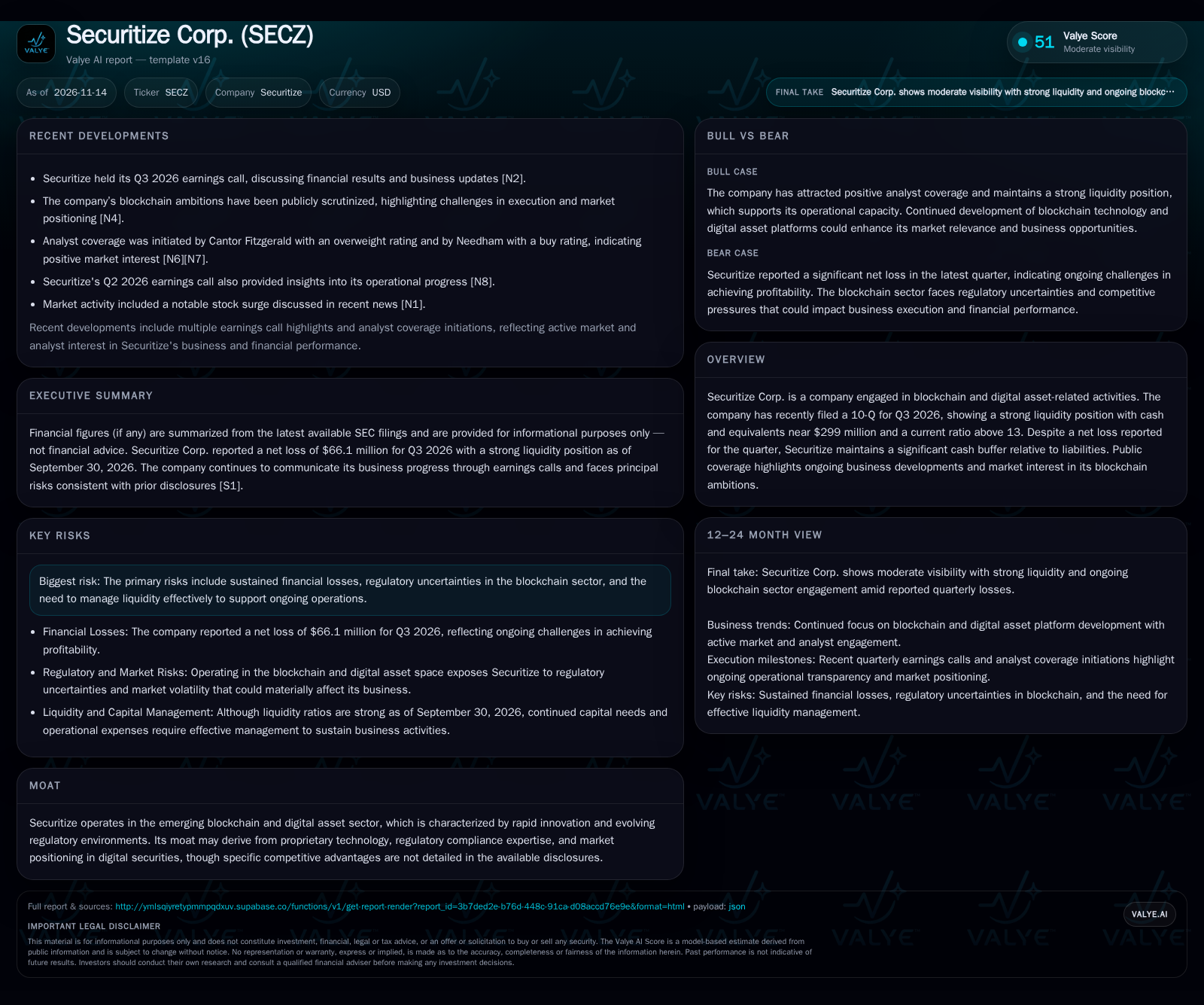
Securitize Corp. stands out in the digital asset sector for its reported liquidity position—nearly $299 million in cash as of Q3 2026—yet it continues to report steep losses as it seeks a viable business model in a rapidly evolving regulatory and competitive landscape. The company’s success will hinge on translating its blockchain ambitions into scalable, profitable solutions amid sector headwinds and execution risk.
Securitize Corp. enters late 2026 with a very reported cash position but ongoing substantial net losses. The next phase will test whether its platform can achieve meaningful adoption and margin improvement before liquidity advantages erode.
Securitize Corp. enters the final quarter of 2026 as a well-capitalized player in the blockchain and digital asset sector, boasting nearly $299 million in cash and a current ratio exceeding 13. Yet, this financial strength contrasts sharply with reported quarterly net losses of $66.1 million, raising key questions about the company’s ability to achieve sustainable profitability. While analyst coverage and market attention have been favorable, the real test will be whether Securitize can operationalize its blockchain ambitions into scalable, revenue-generating platforms amid regulatory uncertainty and fierce competition.
Liquidity Outpaces Profitability as Securitize Charts Its Blockchain Course
[S1] This buffer gives the company significant potential financial flexibility in the near term. However, the company posted a net loss of $66.1 million for the third quarter, with basic and diluted EPS at -$0.41 [S1]. Recent analyst initiations from Cantor Fitzgerald and Needham with overweight and buy ratings, respectively, indicate continued external interest and perceived potential [N6] [N7]. At the same time, media coverage underscores both Securitize’s blockchain ambitions and the critical execution challenges it faces [N4].
How Securitize Could Capture Value in the Digital Asset Ecosystem
Securitize’s business economics are fundamentally shaped by the structure and adoption of its blockchain and digital asset platforms. In principle, blockchain platforms generate revenue through transaction fees, asset tokenization services, custody solutions, compliance-as-a-service, and potentially SaaS licensing models. The sector typically offers high gross margins on software-driven revenue streams but requires substantial upfront investment in technology, regulatory compliance, and customer acquisition. Fixed costs in engineering, compliance, and platform operations can be significant, making operating leverage highly sensitive to scale and adoption rates.
Given Securitize’s reported net loss, it appears that current revenue is insufficient to cover these fixed and variable costs [S1]. The key economic inflection will be whether Securitize can reach a critical mass of digital asset issuance, trading, and custody activity to drive meaningful fee income and platform stickiness. If the company can establish itself as a trusted intermediary for regulated digital securities, it may be able to command premium pricing and benefit from network effects as more issuers and investors join the ecosystem.
Sector Dynamics: Can Securitize Build Defensible Advantages in a Crowded Field?
The blockchain and digital asset sector is intensely competitive and rapidly evolving, populated by both emerging fintechs and established financial incumbents exploring tokenization. Barriers to entry can be low at the technical level but rise sharply with regulatory complexity and the need for institutional trust. Securitize’s potential moat could derive from proprietary compliance frameworks, regulatory approvals, and integration with capital market infrastructure—yet current disclosures do not specify unique advantages beyond broad ambition.
Competitive counterforces include the risk that larger financial institutions will leverage their client bases and regulatory relationships to launch competing platforms, or that open-source protocols will commoditize core functionality and compress margins. Technology substitution is a live threat: advances in decentralized finance (DeFi), new blockchain protocols, or direct peer-to-peer solutions could sideline intermediary platforms unless they deliver essential value. Customer incentives hinge on trust, cost, ease of use, and regulatory compliance; switching frictions are likely low unless Securitize can embed itself deeply in client workflows or regulatory processes. The company’s ability to differentiate on compliance, security, and user experience will be decisive if it is to avoid a race to the bottom on pricing and relevance.
From Ambition to Scale: What Would a Breakout Look Like for Securitize?
A favorable scenario would see Securitize harness its liquidity to accelerate product development, achieve regulatory milestones, and secure marquee issuers and institutional clients. If adoption accelerates—driven by successful tokenization of high-value assets, partnerships with major financial institutions, or regulatory clarity that favors Securitize’s platform—operating leverage could rapidly improve. The company could then transition from cash burn to positive cash flow, with network effects amplifying growth as more participants join the ecosystem.
Confirmation would come from disclosed surges in platform activity (e.g., number and value of tokenized assets, transaction volumes), new high-profile client wins, and improving gross margins. Analyst upgrades, further positive media coverage, and narrowing quarterly losses would also support the upside thesis. Conversely, if liquidity is depleted without clear revenue inflection or if growth remains tepid despite continued investment, the upside scenario would be falsified.
Incremental Progress Amid Unresolved Profitability
The most plausible trajectory is that Securitize continues to invest in its platform and pursue partnerships while facing a slow ramp in user and issuer adoption. Revenue may grow, but not fast enough to offset ongoing development, compliance, and operational expenses, resulting in continued net losses over the next several quarters.
Evidence confirming this scenario would include gradual revenue growth, stable or only modestly narrowing losses, and periodic announcements of incremental platform enhancements or client relationships. If losses begin to accelerate or if regulatory setbacks occur, this scenario would tilt toward the downside. Conversely, if Securitize announces major new partnerships or demonstrates a sudden spike in platform usage, the outlook could shift toward the upside.
When Liquidity Buys Time but Not Traction: The Adverse Outcome
This could result from regulatory headwinds, failure to differentiate from competitors, or a lack of institutional adoption. If core revenue streams remain stagnant and losses persist or worsen, Securitize could be forced to pursue dilutive financing, scale back operations, or explore strategic alternatives.
Downside confirmation would include accelerating quarterly losses, declining cash balances, absence of significant new client wins, or negative regulatory events. Deteriorating analyst sentiment or coverage downgrades would further erode market confidence. If Securitize’s value proposition is not validated by sustained platform adoption and visible revenue growth, liquidity could shift from an asset to a dwindling lifeline.
Milestones That Will Define Securitize’s Blockchain Platform Trajectory
Quarterly trend in cash and equivalents: Is the liquidity buffer stable or rapidly declining, and what is the burn rate relative to disclosed growth initiatives? [S1]
Revenue growth rate and composition: Are new revenue streams emerging, and is there evidence of fee-based, recurring income from platform activity? If disclosed, segment revenue would clarify mix and sustainability.
Platform adoption metrics: A useful metric would be the number and value of tokenized assets, active issuers, and transaction volumes, if disclosed.
Regulatory milestones: Has Securitize secured new licenses, approvals, or partnerships that position it as a preferred provider for compliant digital asset issuance?
Gross margin and operating expense trends: Are margins improving as scale increases, or are fixed costs outpacing revenue growth?
Major client wins or institutional partnerships: Announcements of significant new relationships would signal traction and external validation.
Analyst rating changes and media sentiment: Upgrades or downgrades, as well as shifts in public coverage, can signal changes in perceived execution risk or opportunity.
Sector regulatory developments: Changes in digital asset or securities regulations could materially alter Securitize’s addressable market or compliance burden.
Disclaimer: This is research-only, informational analysis and not investment advice. It may include AI-generated interpretation and general industry context. Always verify important details using primary sources.

Comments