
Presidio Property Trust: Portfolio Repositioning, Concentration Risks, and the Challenge of Surviving as a Small-Cap REIT
Presidio Property Trust is navigating a volatile operating environment through asset sales, selective acquisitions, and capital maneuvers, but faces persistent profitability challenges, tenant concentration in its model home segment, and ongoing Nasdaq compliance risks. The company’s ability to demonstrate recurring cash flow stability and broaden its tenant and geographic exposure will likely determine whether it can shift from survival mode to sustainable value creation.
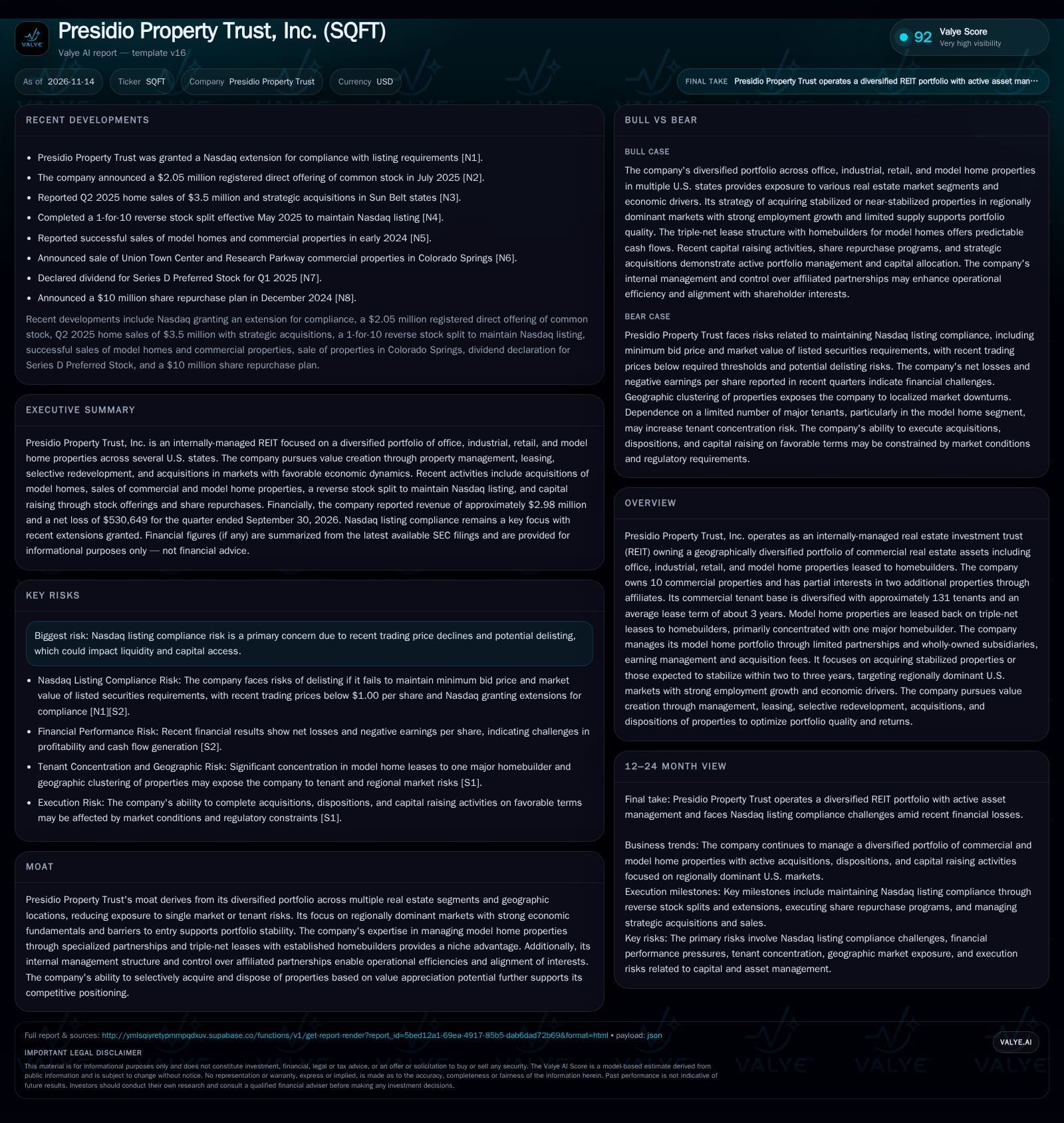
Presidio Property Trust owns a diversified but highly concentrated portfolio of office, industrial, and model home assets, with recent activity focused on property sales, Sun Belt acquisitions, and capital raising. The path to a sustainable recovery hinges on demonstrating recurring cash flow, reducing reliance on key tenants, and executing value-accretive transactions in a challenging market environment. [S1] [S2] [N1] [N2]
Presidio Property Trust, a small-cap internally managed REIT, is fighting on multiple fronts: stabilizing recurring income, repositioning its asset base, and maintaining public market access amid persistent net losses and compliance threats. While recent property sales, Sun Belt acquisitions, and capital actions signal active portfolio management, the company remains hampered by tenant concentration in its model home segment and the risk of regional market downturns. The next phase will test whether Presidio can generate sufficient, diversified cash flow to offset its structural vulnerabilities and justify its public listing.
Recent Asset Sales, Acquisitions, and Market Access Define the Near-Term Outlook
Presidio Property Trust recently reported Q3 2026 revenue of approximately $2.98 million and a net loss of $530,649, with negative basic EPS, underscoring continued profitability pressure. The company’s asset mix has shifted through both acquisitions and dispositions: it acquired 22 model homes for $9.4 million in 2025, while selling two commercial properties for $15.9 million in the same period, reflecting a strategy of portfolio rebalancing. On the capital front, Presidio implemented a 1-for-10 reverse stock split in 2025 to maintain Nasdaq compliance, followed by a $2.05 million registered direct offering and the announcement of a $10 million share repurchase plan. These moves are aimed at preserving market access and potential financial flexibility but also highlight the company’s ongoing struggle to stabilize its financial and public market position. [S1] [S2] [N1] [N2] [N4] [N8]
How Presidio Makes—and Struggles to Sustain—Its Money
Presidio’s revenue is derived primarily from leasing office, industrial, retail, and model home properties. The commercial portfolio is diversified across 131 tenants with an average lease term of about three years, yet the model home segment is highly concentrated: approximately 69% of model home leases are with a single homebuilder, and these are structured as triple-net leases, shifting operating costs to the tenant. This lease model can offer predictable cash flows if tenant credit is strong, but the concentration creates a single point of failure if the homebuilder faces distress or renegotiates terms.
On the cost side, as an internally managed REIT, Presidio avoids external management fees but still bears significant overhead and property-level operating expenses. The company’s net loss in Q3 2026, despite ongoing property sales and acquisitions, suggests that its current scale may not generate sufficient operating leverage to cover fixed costs and preferred dividends. The Series D Preferred Stock, with a 9.375% cumulative dividend, further increases the fixed claims on cash flows, potentially squeezing common shareholders if rental income does not improve.
The company’s strategy of acquiring stabilized or near-stabilized properties in regionally strong markets aims to balance risk and return. However, recent asset sales and capital raises suggest Presidio is cycling through assets to manage liquidity and compliance, rather than scaling up a high-margin, recurring income base. In this context, the economics hinge less on property appreciation and more on the reliability and diversification of rental income, as well as the company’s ability to control overhead and debt costs.
Where Presidio Stands in the REIT Landscape: Niche Positioning Meets Structural Vulnerabilities
Presidio’s competitive position is mixed. On one hand, it offers a geographically diversified asset base spanning office, industrial, retail, and model home segments across key U.S. states. Its focus on regionally dominant markets and internally managed structure could, in theory, provide operational efficiencies and local market insight. The model home leasing business—where properties are leased back to homebuilders on triple-net terms—represents a specialized niche that is less crowded than traditional commercial or multifamily REIT categories.
However, the company’s small scale, tenant concentration (especially in model homes), and modest bargaining power versus larger peers create structural vulnerabilities. Larger REITs typically benefit from greater access to capital, broader tenant bases, and the ability to weather market volatility through portfolio rebalancing at scale. Presidio’s reliance on single-tenant relationships in its model home segment, and its need to frequently raise capital or recycle assets, limits its ability to build durable pricing power or long-term rent growth.
The broader market context is also challenging: office and retail real estate faces secular headwinds from remote work and e-commerce, while industrial and Sun Belt residential assets are more resilient but increasingly competitive. Presidio’s partial interests in some properties further complicate value extraction and control. In sum, while the company occupies a defensible niche, its lack of scale and tenant diversification expose it to risks that larger, more diversified REITs can better absorb.
If Asset Rebalancing and Tenant Diversification Succeed, Cash Flow Stability Could Follow
The most favorable scenario for Presidio involves successful execution of its strategy to diversify both assets and tenants while stabilizing recurring rental income. This would require (1) continued acquisitions of stabilized or near-stabilized properties in markets with strong economic tailwinds, (2) gradual reduction of tenant concentration in the model home segment, and (3) positive leasing momentum in the commercial portfolio, particularly if new tenants can be signed at higher rates or occupancy can be lifted.
Confirmation of this scenario would come from improved quarterly rental revenue, a trend toward positive net income, and a reduction in the share of rent coming from the largest model home tenant. Additional evidence would include successful refinancing or reduction of preferred equity obligations, and the ability to maintain or increase dividends without resorting to asset sales. If Presidio can demonstrate that its capital recycling leads to rising cash flow per share, rather than short-term liquidity fixes, investors may begin to price in a sustainable recovery. [S1] [S2]
Falsification would occur if asset sales are needed merely to cover operating losses or preferred dividends, tenant concentration remains high, and rental income continues to lag overhead and financing costs.
A Tenuous Balance: Ongoing Asset Cycling and Compliance Battles
The most plausible outcome is that Presidio remains in a holding pattern: cycling through assets via selective sales and acquisitions, raising modest amounts of capital to maintain liquidity, and relying on defensive actions—such as share repurchases and stock splits—to preserve its Nasdaq listing. Rental income may remain stable but insufficient to fully offset fixed costs and preferred dividends, resulting in continued net losses or break-even performance.
Tenant concentration, particularly in the model home segment, is likely to persist for the near term, leaving the company exposed to the fortunes of its largest homebuilder tenant. Commercial leasing markets may offer only modest growth given ongoing sector headwinds, and competitive pressures from larger REITs will constrain Presidio’s ability to raise rents or expand its footprint quickly.
This scenario would be confirmed by a continuation of quarterly net losses, repeated extensions or new measures to maintain listing compliance, and further small-scale capital raises. Falsification would require a sustained move into positive net income, a meaningful reduction in tenant concentration, or a successful expansion into new markets or asset classes that materially improves recurring cash flow.
Concentration and Compliance Risks Compound: What Failure Could Look Like
In a negative scenario, Presidio faces one or more shocks that expose its structural weaknesses. A financial or operational setback at its largest model home tenant could lead to lease defaults, vacancies, or forced rent concessions, severely impacting cash flow. Simultaneously, if commercial real estate markets in its key geographies deteriorate, Presidio could face rising vacancies or declining rents, further eroding income.
If the company is unable to raise new equity or dispose of assets on favorable terms, liquidity could tighten, putting pressure on its ability to meet preferred dividend obligations and basic operating costs. Persistent low share prices or market value could trigger Nasdaq delisting, reducing visibility and potentially raising borrowing costs or limiting access to capital. The combination of tenant defaults, asset write-downs, and loss of public market access could create a downward spiral, forcing distressed asset sales or even threatening REIT status if income and asset thresholds are breached.
Evidence confirming this scenario would include a spike in vacancies, missed or reduced dividend payments, asset sales at depressed prices, and a formal delisting from Nasdaq. Falsification would require visible resilience in rental income and liquidity even amid adverse tenant or market events.
Benchmarks That Will Reveal Whether Presidio Can Transition from Survival to Sustainable Growth
Quarterly net income or loss trends: Sustained movement toward positive net income, or continued losses, will clarify whether operating leverage is improving or eroding. [S2]
Tenant concentration metrics: The proportion of model home rental income attributable to the largest homebuilder; a useful metric would be the share of model home leases renewed or diversified over time. [S1]
Nasdaq listing status and compliance updates: Any new extensions, warnings, or loss of listing would materially affect capital access and investor perception. [N1] [N4] [S2]
Rental revenue growth and occupancy rates by property segment: If disclosed, trends in occupancy and rent per square foot for office, industrial, and model home assets would help test portfolio health.
Preferred dividend coverage: Ratio of recurring cash flow to preferred dividend obligations; a useful metric would be whether dividends are paid from operating income or require asset sales. [S1]
Asset acquisition and disposition cadence: The volume, pricing, and strategic rationale for new property purchases or sales, as disclosed in filings or news releases.
Share repurchase and capital raise activity: The pace and scale of repurchases versus new equity or preferred issuance as indicators of management confidence and liquidity needs. [N2] [N8]
Changes in geographic and asset diversification: Any meaningful expansion into new markets or asset types would suggest a proactive effort to reduce concentration risk.
Disclaimer: This is research-only, informational analysis and not investment advice. It may include AI-generated interpretation and general industry context. Always verify important details using primary sources.

Comments