
McKinley Acquisition Corp and Space-Eyes: SPAC Deal Dynamics, Strategic Potential, and Execution Crossroads
McKinley Acquisition Corp’s announced business combination with Space-Eyes marks a pivotal transition from SPAC capital formation to AI-driven defense technology operations.
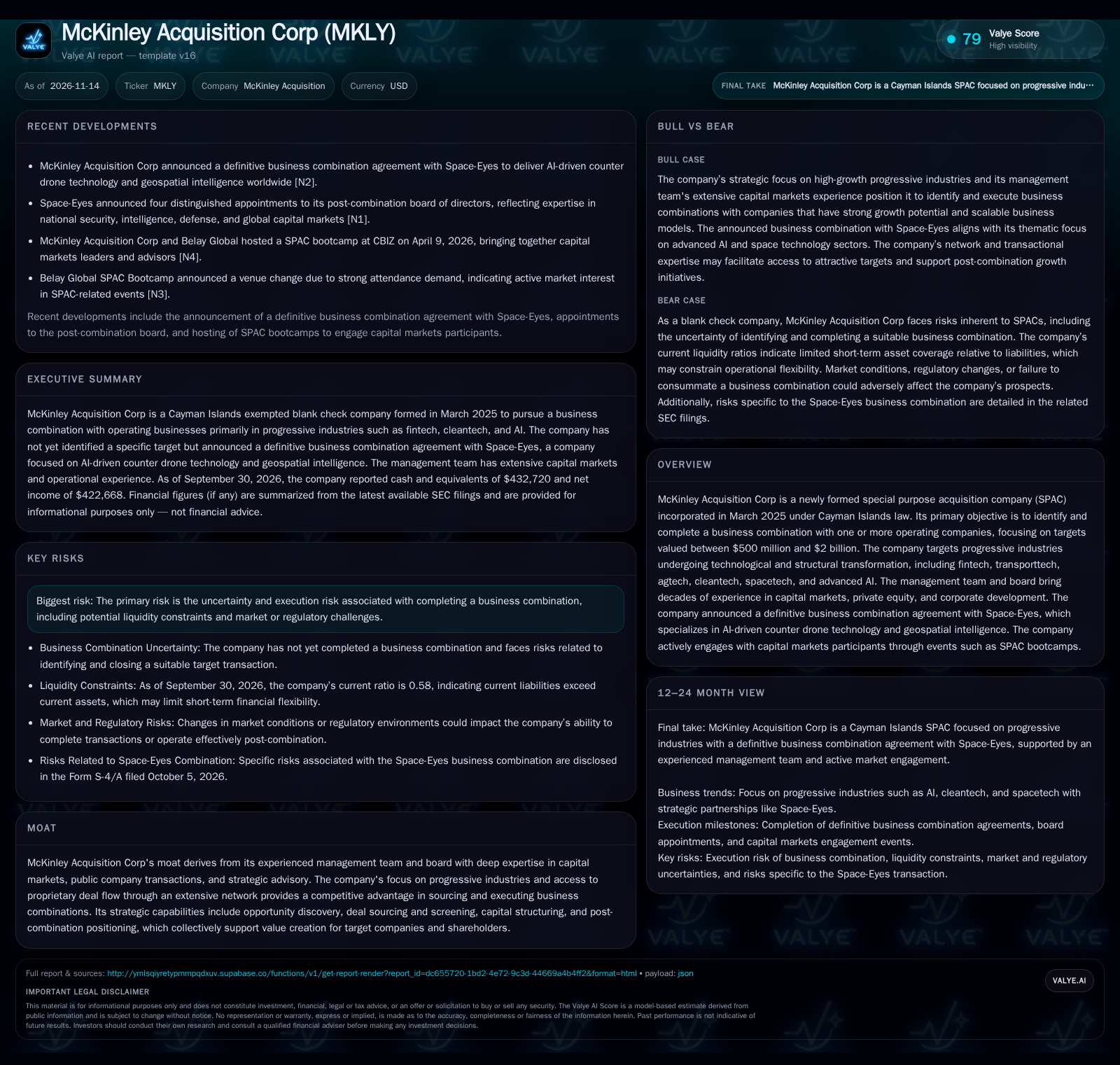
McKinley Acquisition Corp has entered a definitive merger agreement with Space-Eyes, targeting AI-powered counter-drone and geospatial intelligence markets. The deal structure includes an implied $275 million equity value and a share-based transaction, with Space-Eyes convertible notes converting at $5.50 per share. Execution risk centers on closing the deal, post-merger capital needs, and realizing operational scale in national security tech.
McKinley Acquisition Corp’s definitive agreement to combine with Space-Eyes signals a crucial inflection point for the SPAC: from capital-raising shell to public platform for AI-driven counter-drone and geospatial intelligence solutions. While the $275 million implied equity value and share-based consideration provide a framework for the transaction, the real test will be in closing the deal, managing post-merger operational and capital needs, and delivering on Space-Eyes’ high-growth narrative in a sector marked by complex customer procurement cycles and evolving regulatory scrutiny. The intersection of capital market mechanics, national security technology demand, and SPAC execution risk forms the core of the thesis going forward.
From Blank Check to AI Defense: McKinley’s Pending Space-Eyes Merger
As of November 2026, McKinley Acquisition Corp has transitioned from SPAC formation to executing a definitive business combination agreement with Space-Eyes, an AI-powered counter-drone and geospatial intelligence company [N2] [S2]. The deal carries an implied equity value of $275 million, with 27.5 million shares of New Space-Eyes to be issued and Space-Eyes convertible notes converting at $5.50 per share [S2]. [S2] The company is set to domesticate as a Delaware entity prior to closing, and completion of the merger will make Space-Eyes the operating business of the combined public company [S2]. These developments significantly shift the risk-reward profile from SPAC search-phase uncertainty to post-deal integration, capital structure, and execution risk.
Deal Structure, Capital Stack, and the Path to Operating Scale
SPAC economics are fundamentally shaped by the mechanics of the merger agreement. In this case, McKinley’s transaction with Space-Eyes is structured as a share-based deal at a $275 million implied equity value, with 27.5 million shares issued to Space-Eyes stakeholders and convertible notes converting at a specified price point [S2]. This structure is likely to result in significant dilution for public shareholders, especially considering the anti-dilution provisions and potential for additional share issuance tied to redemptions or PIPE financing, if pursued.
Upon closing, the company may access trust account funds, but this is contingent on the level of redemptions from existing shareholders. If redemptions are high, the surviving entity could face a capital shortfall, necessitating PIPE, debt, or other financing—each with distinct implications for dilution, leverage, and operational runway.
The underlying economics of Space-Eyes post-merger will hinge on the scalability of its AI-driven defense and intelligence offerings. These markets typically feature long sales cycles, lumpy contract-driven revenue, and significant upfront investment in R&D and customer validation. Gross margins could be attractive if software and analytics drive the bulk of value, but hardware or integration-heavy solutions may compress margins and increase capital intensity. Operating leverage may materialize only after key contract wins and successful scaling of deployments.
Navigating the Defense-Tech Landscape: Sourcing, Differentiation, and Barriers
The competitive landscape for AI-powered counter-drone and geospatial intelligence technology is characterized by a mix of established defense contractors, specialized startups, and dual-use technology companies. While McKinley’s access to capital markets and Space-Eyes’ technology focus could provide a wedge, incumbents often benefit from entrenched procurement relationships, regulatory certifications, and multi-year programmatic contracts.
Potential sources of differentiation for Space-Eyes post-merger could include proprietary AI algorithms, the integration of real-time geospatial data, and the ability to deliver actionable intelligence at scale. However, barriers to entry are high: new entrants must demonstrate technical efficacy, reliability in mission-critical scenarios, and compliance with evolving national security regulations. Switching costs for government and defense customers are typically substantial, but winning initial contracts can be slow and expensive.
Peer competition is not limited to pure-play counter-drone firms; it extends to broader geospatial analytics, surveillance, and aerospace technology providers. The potential for technology substitution (e.g., from alternative sensor platforms or electronic warfare tools) and rapid innovation cycles further complicates the competitive calculus.
A Virtuous Cycle: Successful Integration and Accelerating Defense Adoption
In the favorable scenario, the business combination closes with minimal redemptions, providing ample cash to fund Space-Eyes’ growth initiatives. The new entity leverages its board’s expertise in national security and capital markets to win flagship contracts in the counter-drone and geospatial intelligence sectors, validating its technology with key government or defense customers.
If Space-Eyes demonstrates superior technical performance—such as higher detection accuracy, lower false positives, or seamless integration with existing defense systems—it could achieve premium pricing and rapid adoption, unlocking operating leverage as contract awards scale. Strong execution would be evidenced by a robust backlog, growing recurring revenue streams, and customer references from high-profile agencies or allied governments.
Confirmation of this scenario would include: low SPAC redemption rates, successful post-merger fundraising (if needed), rapid customer traction, and public disclosure of major contract wins. Falsification would occur if the deal fails to close, redemptions are overwhelming, or Space-Eyes struggles to convert its pipeline into revenue.
Post-Merger Realities: Moderate Redemptions, Capital Needs, and Execution Hurdles
The most plausible outcome is that the merger proceeds with a moderate level of redemptions, resulting in some capital inflow but also a need for supplemental fundraising (PIPE or debt) to meet operational and growth requirements. The new Space-Eyes entity faces a typical post-SPAC operating environment: intense focus on integration, cost discipline, and the pressure to validate its business model with early customer wins.
Revenue growth may be uneven, reflecting the realities of government procurement and the time required to move from pilot programs to full-scale contracts. Gross margins could be compressed initially if hardware or service components dominate early deployments. Operating leverage may be delayed as the company invests in product development, regulatory compliance, and customer support.
Confirmation would come from closing the deal, raising sufficient post-merger capital to fund 12-24 months of operations, and achieving measurable contract milestones with public sector or defense customers. Weak execution, persistent cash burn, or inability to convert pipeline opportunities into signed agreements would challenge this scenario.
Deal Failure, Heavy Redemptions, and Funding Gaps
The adverse trajectory is defined by failure to close the merger, excessive redemptions that drain the trust account, or an inability to secure alternative financing. In this scenario, McKinley may be forced to seek additional extensions, attempt to renegotiate deal terms, or even liquidate if no viable path to combination or capital formation emerges.
If the merger closes but leaves Space-Eyes undercapitalized, the company could face immediate liquidity pressures, missed payroll or vendor payments, and loss of customer confidence. In the competitive defense-tech sector, such stumbles can be existential, with competitors quickly exploiting any operational missteps.
Evidence confirming the downside would include a surge in redemptions, failure to raise post-merger capital, public disclosure of covenant breaches or going-concern warnings, or regulatory or market obstacles that delay or derail the transaction. Conversely, evidence of a successful close, sufficient funding, and initial contract traction would challenge the downside case.
Milestones and Metrics That Will Define McKinley-Space-Eyes Trajectory
Redemption rates at or near the merger closing—high redemptions would signal skepticism and constrain post-merger capital, while low redemptions would support operational runway.
Disclosure and timing of PIPE or debt financing, if pursued, which would indicate the company’s ability to supplement trust proceeds and fund growth.
Announcement and scale of initial government or defense contracts secured by Space-Eyes post-combination—a leading indicator of commercial validation.
Gross margin trends post-merger, especially the mix of software versus hardware/services in delivered solutions (if disclosed).
Board and management turnover, particularly if key members with defense or capital markets expertise depart post-close.
Public disclosure of regulatory or customer onboarding delays, which could signal execution or compliance headwinds.
Updates on customer pipeline conversion—win rates, backlog growth, and renewal activity (if disclosed) would help test the thesis.
Disclaimer: This is research-only, informational analysis and not investment advice. It may include AI-generated interpretation and general industry context. Always verify important details using primary sources.

Comments