
NMP Acquisition Corp.: Timing, Redemption Trends, and Implications of the GTS Deal
As NMP Acquisition Corp. seeks to finalize a merger with GTS Holdings and Gibson Technical Services, the SPAC faces a narrowing runway, heightened redemption risk, and the challenge of translating trust capital and management expertise into lasting shareholder value.
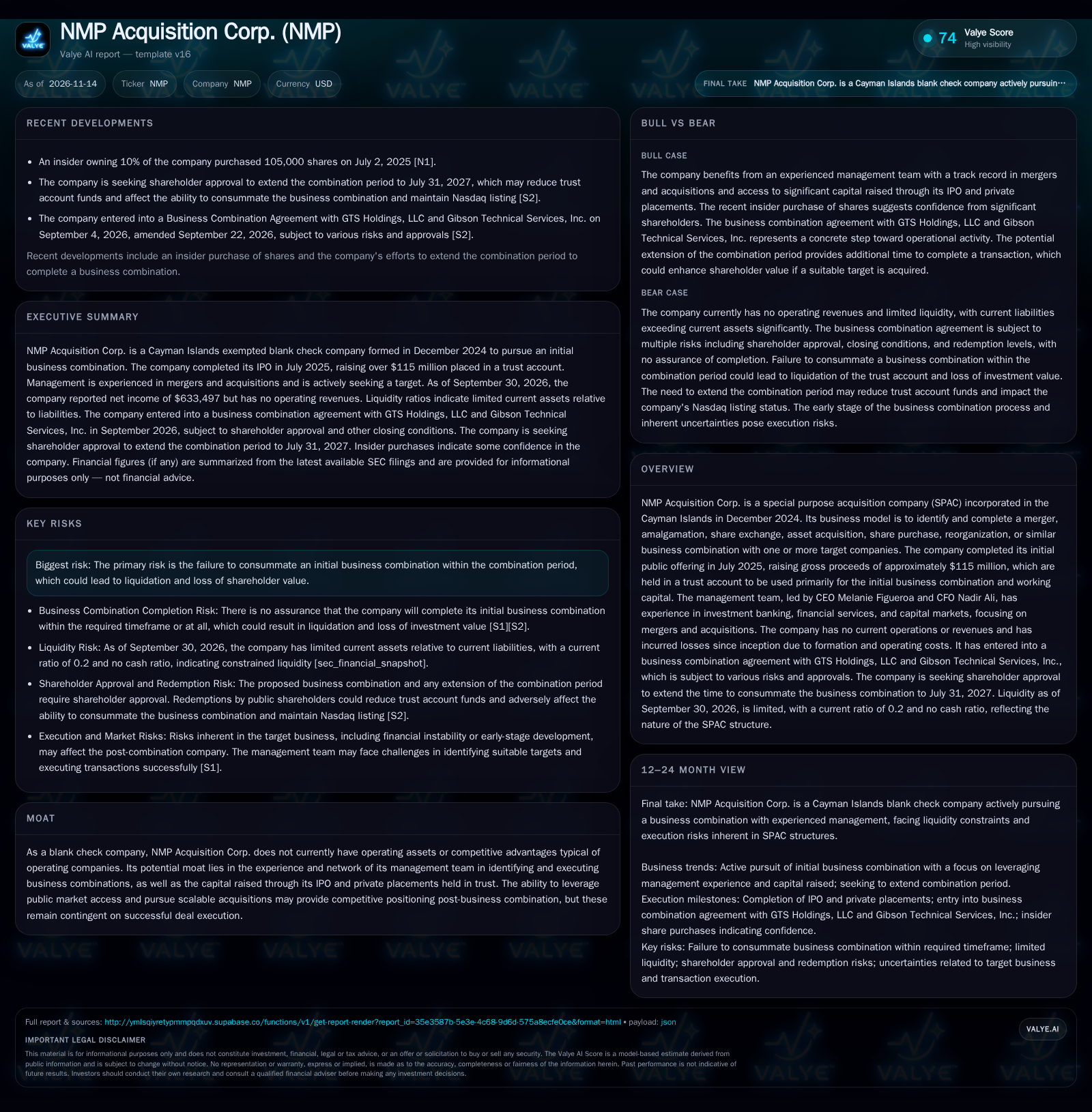
NMP Acquisition Corp. is a Cayman Islands SPAC that raised $115 million in trust via its July 2025 IPO and is now pursuing a business combination with GTS Holdings and Gibson Technical Services. The outcome hinges on the successful close—and subsequent performance—of the proposed GTS deal, as well as on the SPAC's ability to manage redemption pressure and Nasdaq listing standards in an increasingly competitive market for de-SPAC transactions. [S1] [S2]
NMP Acquisition Corp., a Cayman Islands-based SPAC, stands at a pivotal juncture as it races to close a business combination with GTS Holdings and Gibson Technical Services. With $115 million in trust and an experienced dealmaking team, NMP was designed to capitalize on public market access and M&A opportunities. Yet as of September 2026, it faces mounting liquidity pressure, an approaching deal deadline, and the specter of shareholder redemptions that could erode both its trust capital and its Nasdaq listing. The coming months will test whether NMP can convert the resources and relationships amassed during its formation into a successful de-SPAC outcome—or whether it will join the growing ranks of SPACs forced to liquidate and return capital to shareholders.
Current Status of NMP Amid Deal Timing and Redemption Activity
NMP Acquisition Corp. completed its IPO and overallotment in July 2025, placing $115 million in trust for its initial business combination. As of September 30, 2026, the company reported current assets of $123,939 and current liabilities of $609,645, resulting in a current ratio of 0.2 and no cash ratio—an expected but stark reflection of the SPAC structure, where nearly all capital is sequestered in trust until a deal closes. [S1] [S2]
On September 4, 2026, NMP entered into a business combination agreement with GTS Holdings, LLC and Gibson Technical Services, Inc., later amended on September 22, 2026. This deal is subject to multiple contingencies, including shareholder approval, closing conditions, and the level of public shareholder redemptions. [S2]
The company is seeking an extension of its deal deadline to July 31, 2027, which, if approved, may reduce trust account funds due to further redemptions and could threaten its ability to maintain a Nasdaq listing if too many shares are redeemed. [S2]
A notable 10% insider purchase of 105,000 shares at IPO underscores some internal confidence in the SPAC’s prospects, though this does not guarantee deal completion or post-merger value. [N1]
SPAC Economics Influencing NMP’s Incentive Structures and Risk Profile
The core economics of a SPAC like NMP revolve around the interplay between capital raised in trust, sponsor incentives, and the costs of pursuing a deal. Public investors' funds are held in a trust account, invested in low-risk instruments and redeemable pro rata if no business combination is consummated. Sponsors typically contribute a relatively small amount of risk capital for founder shares and private placement units, which can become highly valuable if a deal closes—but may become worthless if the SPAC liquidates.
Operating leverage in the pre-deal phase is minimal, as SPACs are structured to minimize expenses until a transaction is found. However, legal, advisory, and administrative costs accrue regardless of deal success, and are typically paid from the interest earned on trust assets or additional sponsor capital. Once a business combination is completed, the economics shift entirely to those of the acquired operating company, making the quality and growth prospects of the target business paramount.
The economics of the proposed GTS deal are not detailed in the current report, so the post-merger capital structure, dilution, and cash flow profile remain uncertain. Redemption levels at the time of the vote are critical: high redemptions drain trust proceeds, increase leverage, and can undermine the viability of the combined entity. The company’s request for a deadline extension suggests a need for additional time to secure approvals and potentially renegotiate terms if redemptions are high.
Market Crowding and Sponsor Credibility Impacting NMP’s Target Selection
NMP’s competitive position rests on its ability to source and close an attractive business combination before its deadline, in a market where SPAC supply has outstripped high-quality target demand. The management team, with backgrounds in investment banking, capital markets, and M&A, may offer a sourcing advantage and deal execution expertise. However, the current SPAC landscape is crowded, with many vehicles competing for a shrinking pool of willing and suitable targets, especially as regulatory scrutiny and market skepticism have increased since the mid-2020s SPAC boom.
NMP’s capital raised ($115 million in trust) is typical for mid-sized SPACs, providing enough scale for small-to-mid-cap transactions but potentially limiting access to larger, more mature targets. The proposed combination with GTS Holdings and Gibson Technical Services could provide an operational platform, but its ultimate competitiveness will hinge on the financial health, growth prospects, and sector positioning of the acquired business—data not yet disclosed in the report.
Redemption risk and the ability to maintain a Nasdaq listing are significant counterforces. If redemptions are high, NMP could be left with insufficient capital to fund the transaction or support post-merger operations, weakening its position relative to both traditional IPOs and other SPACs able to secure PIPE (private investment in public equity) financing or lower redemption rates.
Potential for GTS Deal to Enhance Operating Efficiency and Sponsor Returns
The most favorable scenario for NMP is the successful closing of the GTS Holdings and Gibson Technical Services business combination, accompanied by manageable shareholder redemptions and retention of sufficient trust capital to fund growth.
Key evidence confirming this scenario would include: (1) shareholder approval of the deal and deadline extension; (2) low-to-moderate redemption rates, preserving most of the trust fund; (3) positive disclosures about the target’s financial health and growth trajectory; and (4) the ability to meet Nasdaq listing standards post-merger. Evidence of PIPE financing or strategic partnerships to backstop redemptions would further support the upside case.
This pathway would validate the management team’s sourcing and execution credentials and allow sponsors and public shareholders to realize the intended upside of the SPAC structure—leveraging public market access to accelerate a private company’s growth and value creation.
Expected Scenario: Extended Deadline, Elevated Redemptions, and Reduced Combined Entity
The most plausible scenario is that NMP secures a shareholder-approved extension, but faces elevated redemptions at or before the business combination vote. This would reduce the amount of trust capital available for the GTS merger, potentially forcing renegotiation of deal terms, a smaller operating footprint post-merger, or reliance on third-party financing to close.
This outcome is consistent with broader SPAC market trends, where many vehicles have faced high redemption rates, shrinking post-merger capitalizations, and challenges in maintaining public listing standards. The result could be a combined entity with less potential financial flexibility and a longer road to value creation, but still a path for sponsors to realize some upside if the target business performs well.
Evidence confirming this scenario would include approval of the extension and business combination, but with a material portion of public shares redeemed and trust funds depleted. Falsification would require either (a) an inability to secure approvals, leading to liquidation, or (b) an unexpectedly low redemption rate, preserving more capital than the market expects.
Consequences of Deal Collapse: Redemption Surge and Stakeholder Loss Exposure
The adverse scenario is one in which NMP fails to secure shareholder approval for either the business combination or the extension, or faces such high redemptions that the GTS deal becomes unviable. In this case, the SPAC would be forced to liquidate, returning pro rata trust proceeds to public shareholders and leaving sponsor shares and rights worthless.
This scenario could be triggered by negative sentiment toward the proposed target, adverse market conditions, or regulatory or Nasdaq listing hurdles. High redemptions may also signal market skepticism about the deal’s value or the target’s prospects. The result would be a total loss for sponsor capital and potentially for any public shareholders holding rights or warrants, with only trust cash returned to common shareholders.
Confirmation of this scenario would involve failed shareholder votes, deal termination announcements, or public disclosures of excessive redemptions that render the business combination impractical.
Critical Milestones Shaping the Longevity of NMP’s Trust Capital
Shareholder approval rates for both the business combination and any extension of the combination period—if disclosed—will be decisive in determining whether the GTS merger proceeds.
Actual redemption rates at the time of the business combination vote: high redemptions would reduce available trust capital and may threaten deal viability.
Disclosure of PIPE (private investment in public equity) or other backstop financing arrangements would help test the ability to offset redemptions and support post-merger liquidity.
Detailed financials, growth projections, and management commentary from GTS Holdings and Gibson Technical Services—if disclosed—would clarify the quality of the target and the long-term value proposition.
Nasdaq listing status and compliance with minimum shareholder and market capitalization requirements post-merger will be a key threshold for continued public trading.
Progress updates on regulatory or additional closing conditions for the proposed business combination, such as antitrust or industry-specific approvals.
Sponsor and insider share purchases or sales around key vote dates could indicate confidence or concern regarding the outcome and future prospects.
Disclaimer: This is research-only, informational analysis and not investment advice. It may include AI-generated interpretation and general industry context. Always verify important details using primary sources.

Comments