
Alset Inc.: Testing Diversified Ambition Across Real Estate, Digital Platforms, and Biohealth
Alset Inc. seeks to create value through a multi-pronged portfolio spanning real estate, digital transformation, and biohealth, supported by recent acquisition moves and a reported cash position. The challenge lies in scaling segment economics, integrating new ventures, and translating diversification into durable returns.
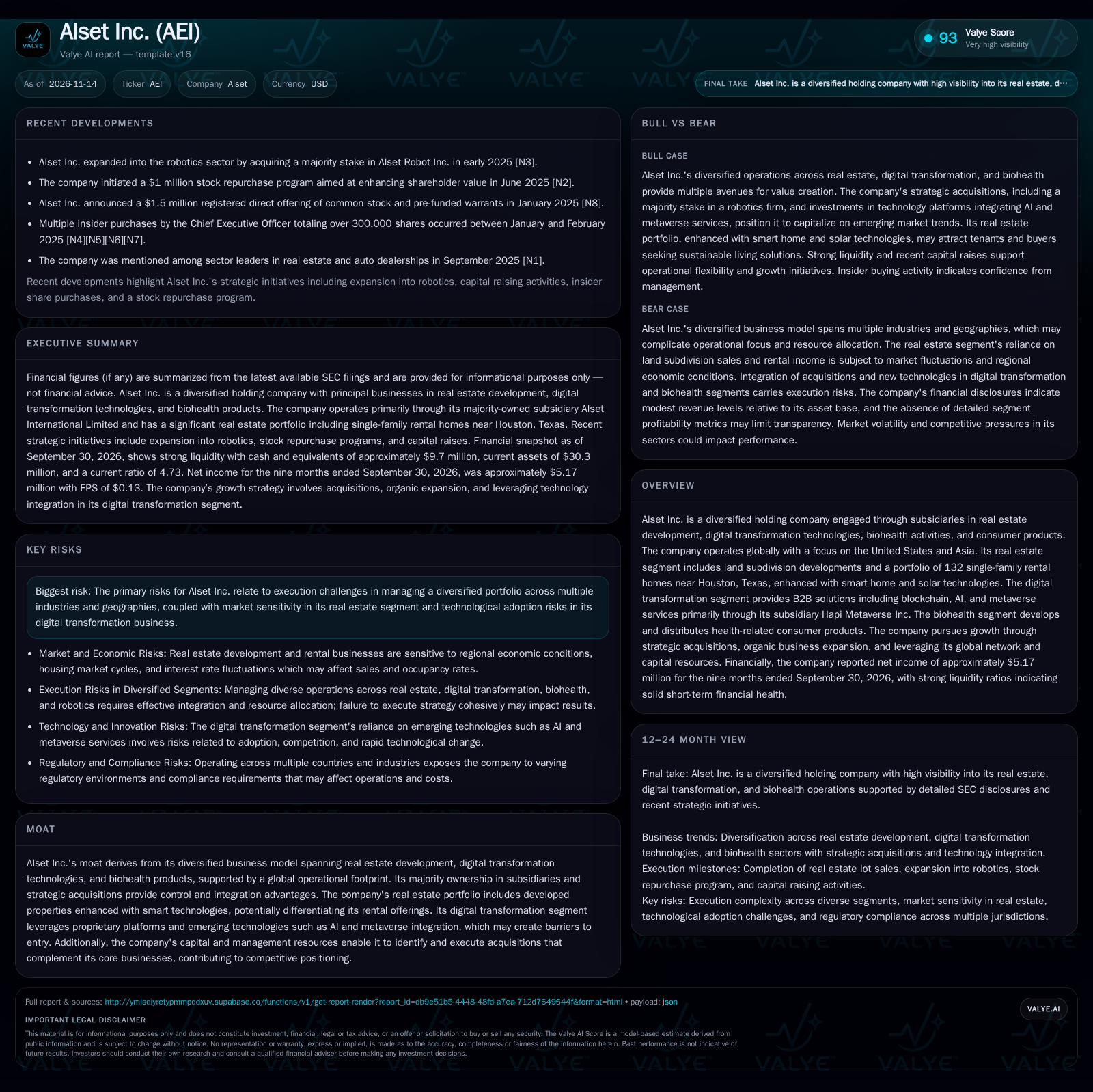
Alset Inc. operates as a diversified holding company with principal activities in real estate development, digital transformation, and biohealth, recently expanding into robotics and executing capital actions including a $1 million stock repurchase and a $1.5 million direct offering. As of September 2026, Alset reported $9.7 million in cash, a current ratio of 4.73, and net income of $5.17 million for the first nine months of the year. The company’s business model is predicated on leveraging strategic acquisitions and technology integration, but faces execution complexity and the need to demonstrate sustainable segment-level profitability as it grows across geographies and industries. [S2] [N2] [N3] [N8]
Alset Inc. stands out for its ambition to weave together real estate, digital transformation, and biohealth under a single diversified holding framework. With a footprint that stretches from U.S. residential developments to Asian digital ventures and new robotics initiatives, Alset is betting that a portfolio approach can unlock both resilience and upside. The company’s 2026 financials show positive net income and a reported liquidity position, but the critical question is whether this breadth can translate into sustainable, scalable returns—especially given the lack of detailed segment-level economics, the integration demands of recent acquisitions, and the inherent complexity of managing such a wide-ranging enterprise. For investors and analysts, the next phase is less about headline diversification and more about proof points in execution and profitability.
Recent Moves Redefine Alset’s Portfolio and Financial Standing
Alset Inc. reported net income of $5.17 million for the nine months ended September 30, 2026, alongside cash and equivalents of $9.7 million and a current ratio of 4.73. This points to a period of operational profitability and a reported liquidity position as of the latest filing. [S2]
Strategically, Alset has executed a $1 million stock repurchase program and a $1.5 million registered direct offering in 2025, signaling both a return of capital to shareholders and ongoing capital needs to fund expansion. [N2] [N8]
The company’s acquisition of a majority stake in Alset Robot Inc. marks a notable extension into robotics, adding to its existing real estate, digital transformation, and biohealth platforms. [N3]
Insider buying by the CEO—over 300,000 shares in early 2025—may reinforce perceived management alignment but does not directly establish business momentum or future performance. [N4] [N5] [N6] [N7]
Portfolio Economics: Where Value Might Be Created (or Lost)
Alset’s economics are shaped by the interplay of capital-intensive real estate, asset-light digital transformation, and consumer biohealth. The real estate segment generates income from land sales and rental homes, with 132 single-family units near Houston offering steady, albeit regionally concentrated, cash flows. The addition of smart home and solar technologies could support premium pricing or higher occupancy, but the ultimate impact on blended yields depends on local rental market dynamics and the cost of these enhancements. [S2]
Lot sales at Lakes at Black Oak and Alset Villas have delivered multi-million dollar revenues, but the sustainability of these sales is subject to Texas housing cycles and lot inventory. Real estate, while offering tangible asset backing, requires ongoing capital for development, maintenance, and potential acquisitions, introducing cyclical risk and high fixed costs.
The digital transformation arm—via Hapi Metaverse Inc.—offers B2B platforms in blockchain, e-commerce, and AI/metaverse, which if successful, could scale with low marginal cost and high operating leverage. However, without disclosed segment revenue or customer traction, it is unclear whether this segment is contributing meaningfully to consolidated earnings or remains in investment mode.
Biohealth provides another avenue for margin expansion, leveraging direct selling and e-commerce to potentially minimize distribution costs. Yet, without segment-specific disclosure, the scale and profitability of this operation remain opaque.
Assessing Alset’s Edge Across Segments: Diversification or Dilution?
Alset’s competitive position is predicated on diversification: real estate assets in Texas, a digital platform portfolio spanning blockchain to AI, and a biohealth business with global reach. In real estate, the addition of smart home and solar features could help differentiate rentals, but these are increasingly being adopted by regional peers and national homebuilders, limiting sustainable advantage unless Alset can achieve cost or technology leadership.
In digital transformation, Alset’s Hapi Metaverse subsidiary competes in crowded markets against specialized SaaS, blockchain, and metaverse firms. The company’s ability to integrate AI and metaverse features may create initial barriers to entry, but true defensibility would require demonstrable network effects, proprietary technology, or sticky customer relationships—elements not yet proven by available disclosures.
Biohealth is a fragmented sector with intense competition from both established multinationals and aggressive direct-to-consumer entrants. Success here likely hinges on product differentiation, regulatory compliance, and the ability to build scale in distribution—a challenge for any new or diversified entrant.
The robotics expansion could offer future optionality, but integrating a new vertical also introduces execution and capital allocation risks, especially if the segment lacks synergies with existing operations.
How Alset Could Translate Breadth into Durable Growth
The optimistic scenario is one in which Alset’s diversified segments each reach critical mass, with real estate providing a stable asset base and cash flow, digital transformation delivering scalable, high-margin services, and biohealth achieving profitable growth through differentiated products and efficient e-commerce channels.
Key to this outcome would be successful execution on current residential developments—such as maintaining high occupancy and premium rents in Houston, and consistently completing and selling new residential lots. If the digital segment demonstrates customer adoption and recurring revenue (e.g., via SaaS or platform subscription models), operating leverage could drive margin expansion.
Further, if recent investments in robotics yield commercial products that integrate with or enhance existing platforms, Alset could unlock new revenue streams and cross-segment synergies.
Evidence that would validate this scenario includes growing segment-level revenues, margin expansion, visible customer wins for digital platforms, and recurring income from biohealth and rental operations.
Diversification Delivers Stability but Limits Near-Term Breakout
The most likely trajectory is that Alset continues to operate as a diversified holding company, with real estate serving as the primary earnings and cash flow engine. Rental income and periodic lot sales provide baseline stability, but the digital and biohealth segments remain sub-scale or in investment mode through the next 12-24 months.
Incremental growth may come from opportunistic acquisitions or small-scale digital wins, but the lack of disclosed segment profitability or recurring digital revenues suggests that group-level performance will track the pace and volatility of regional real estate activity.
Integration of robotics and other new ventures may yield optionality, but is unlikely to materially shift consolidated earnings in the near term unless accompanied by outsized execution or a step-change in digital platform traction.
Confirmation of this scenario would come from continued net income, steady but moderate revenue growth, and limited evidence of breakout performance in digital or biohealth.
Execution Complexity and Segment Underperformance Threaten Value Creation
A negative outcome could emerge if the company’s diversification leads to organizational complexity, diluting management focus and resulting in underperformance across key segments. Real estate could face headwinds from Texas housing downturns, leading to lower occupancy, reduced pricing power, or unsold inventory.
If digital transformation and biohealth fail to achieve commercial traction, sunk investment costs and ongoing operating expenses could weigh on consolidated margins and drag on cash flow. The foray into robotics, if not synergistic or accretive, could further stretch capital and management resources.
Additional capital raises—if required to fund ongoing operations or new ventures—could dilute existing shareholders, especially if not matched by clear progress in segment economics.
Evidence of this scenario would include declining or stagnant real estate income, rising operating expenses, persistent lack of segment-level profitability, and potentially negative cash flow or further dilutive financings.
Testing Alset’s Multi-Segment Model: What Will Prove or Disprove the Thesis?
Segment-level revenue and operating income disclosure—if provided—would clarify which businesses are driving group performance and whether diversification is adding value or masking underperformance.
Occupancy rates, average rent, and tenant retention in the Houston-area single-family rental portfolio would demonstrate the health and competitiveness of the real estate segment.
Gross margins and recurring revenue metrics for digital transformation platforms (e.g., SaaS subscription, B2B contract wins), if disclosed, would indicate progress toward scalable digital economics.
Biohealth product sales growth, customer acquisition costs, and repeat purchase rates would help assess whether this segment can achieve sustainable, profitable scale.
Progress on robotics commercialization—such as partnerships, product launches, or initial sales—would show whether the recent acquisition is likely to be accretive or remains speculative.
Cash flow from operations and capital expenditures, segmented by business line, would help test whether Alset’s investments are generating appropriate returns or consuming cash.
Frequency and terms of any future capital raises, especially if accompanied by limited operating progress, would signal potential dilution risk or funding stress.
Management updates on acquisition integration and strategic priorities would provide qualitative insight into execution discipline and risk management.
Disclaimer: This is research-only, informational analysis and not investment advice. It may include AI-generated interpretation and general industry context. Always verify important details using primary sources.

Comments