
Fly-E Group: Urban EV Ambitions Confront Legal, Financial, and Execution Crosswinds
Fly-E Group, Inc. has carved a niche in the U.S. electric two-wheeler market with a broad portfolio, multichannel strategy, and specialized offerings—yet faces persistent legal, financial, and operational headwinds that could determine whether it scales or stalls.
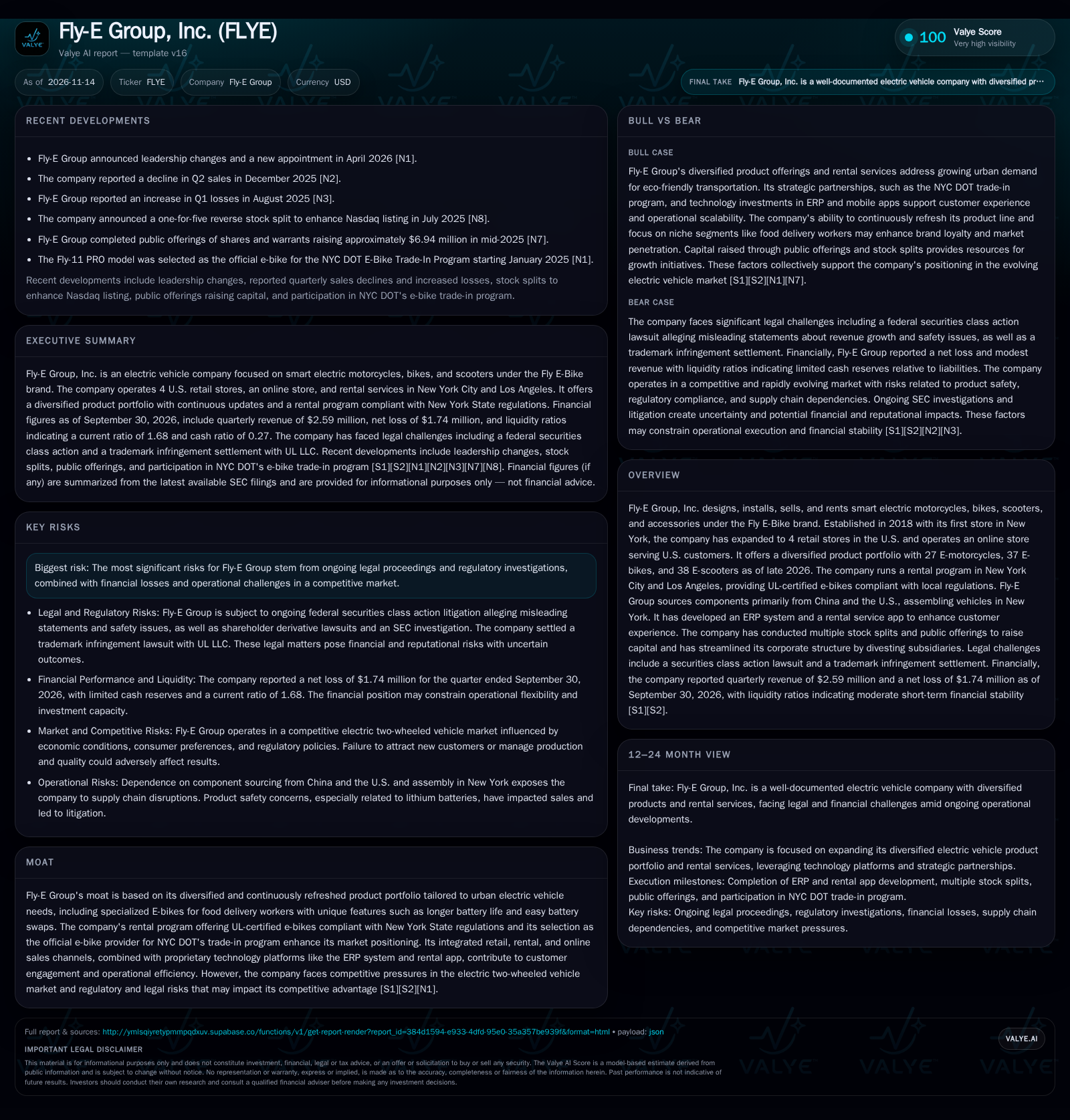
Fly-E Group is a U.S.-based electric vehicle company selling and renting smart e-bikes, motorcycles, and scooters, with 4 retail stores, an online presence, and a growing rental platform. Execution on regulatory partnerships and tech-enabled rentals is promising, but supply chain, litigation, and financial pressures leave the company at a crossroads [S1] [S2].
Fly-E Group, Inc. has emerged as a contender in the U.S. electric two-wheeled vehicle market, leveraging a diversified portfolio of smart e-bikes, motorcycles, and scooters, as well as a growing rental service for urban commuters and delivery workers. The next phase for Fly-E Group will hinge on its capacity to convert product breadth and regulatory wins into sustained growth amid a volatile competitive and legal landscape [S1] [S2].
Recent Developments Set the Stage for a Pivotal Phase
As of September 30, 2026, Fly-E Group reported quarterly revenue of $2.59 million but a net loss of $1.74 million, reflecting ongoing challenges in achieving profitability at scale [S2]. The company reported cash and liquidity metrics for the period; these figures do not by themselves establish operating runway, investment capacity, financial flexibility, or financing capacity. [S2] Legal and regulatory issues loom large: a federal securities class action lawsuit alleges misleading statements about revenue growth and battery safety; an SEC investigation is ongoing; and a lender is seeking to recover nearly $4 million over an alleged breach of a revolving credit note [S2]. On the operational front, Fly-E Group's Fly-11 PRO model was selected as the official e-bike for the NYC DOT E-Bike Trade-In Program, a notable regulatory partnership that could bolster its brand and volumes if successfully executed [S1] [S2].
How Fly-E Group’s Revenue Mix and Cost Structure Shape Its Economic Engine
Fly-E Group’s revenue comes from direct retail sales (via four stores and an online channel), rentals, and accessories. The company’s ability to assemble vehicles domestically allows for some control over final quality and compliance, but component sourcing from China and the U.S. exposes it to cost volatility and potential supply disruptions [S2].
The economics of electric two-wheelers are typically characterized by moderate gross margins, with higher-margin accessories and rentals offsetting lower-margin unit sales. Rentals, especially through the Go Fly app, could provide recurring revenue with higher utilization rates if fleet management costs are contained and asset longevity is proven. However, the capital intensity of fleet procurement, maintenance, and technology development (ERP, mobile apps) creates fixed cost leverage but also amplifies losses if utilization lags. The company’s net loss, despite product diversification, suggests that fixed costs and ongoing legal and compliance expenses are outpacing revenue gains [S2].
Brand, Product Breadth, and Regulatory Compliance: Can Fly-E Group Stand Out?
Fly-E Group’s competitive position rests on three pillars: a broad and frequently refreshed product portfolio (27 e-motorcycles, 37 e-bikes, and 38 e-scooters as of late 2026), a multichannel presence (retail, online, and rentals), and a focus on regulatory compliance—most notably UL certification and the NYC DOT program [S2]. This regulatory alignment, especially in New York, provides a moat against less-compliant competitors and appeals to municipalities and commercial customers seeking safety and legal clarity.
Specialization in delivery-focused models (longer battery life, swappable batteries) targets a high-frequency user segment underserved by generic e-bike makers, potentially driving brand loyalty and repeat business. However, Fly-E Group faces intense competition from both established global brands and aggressive low-cost importers. Switching costs in the e-bike segment are generally low, though integration with proprietary rental platforms and municipal programs could enhance stickiness.
The company’s legal overhang and supply chain exposure, however, may erode competitive advantages if not resolved. Sustained investment in product innovation, compliance, and customer experience will be critical to defending and expanding market share.
Urban Electrification Tailwinds and Regulatory Partnerships Unlock Growth
In a favorable scenario, Fly-E Group leverages its participation in programs like the NYC DOT E-Bike Trade-In to drive volume growth and establish itself as a trusted supplier for cities and commercial fleets. If the company can scale its rental platform—driven by continued enhancements to the Go Fly app and ERP systems—recurring revenue and asset utilization could improve, creating a base for operating leverage.
Margin improvement may come from a mix shift toward rentals and accessories, as well as supply chain optimization and further localization of assembly. Regulatory compliance and safety could become a selling point as cities tighten e-bike standards, favoring certified suppliers. Confirmation of this scenario would include evidence of sustained rental fleet utilization above industry benchmarks, margin expansion on a per-unit basis, renewal or expansion of municipal partnerships, and a resolution of legal uncertainties without major financial penalties.
Mixed Progress: Growth Opportunities Tempered by Execution and Financial Hurdles
The most plausible outcome is that Fly-E Group achieves incremental growth through its diversified product line and selective regulatory wins but continues to face margin pressure and periodic liquidity constraints. Rentals and municipal partnerships provide some visibility, but competition and cost inflation offset much of the operating leverage from scale.
Legal and regulatory matters remain a drag, consuming management bandwidth and resources. The company is able to maintain operations and modestly grow revenue, but persistent net losses and cash burn require periodic capital raises or cost-cutting. Evidence for this scenario includes stable or slightly increasing revenue, continued net losses, and a pattern of follow-on financings or working capital adjustments. Signs of progress would be a narrowing net loss margin, improved cash conversion, and new customer wins in the delivery or municipal segments.
Legal, Liquidity, and Operational Risks Converge to Derail Momentum
In a negative scenario, Fly-E Group is unable to overcome mounting legal, liquidity, and operational risks. An adverse outcome in the federal securities class action or the SEC investigation could trigger significant settlements, fines, or reputational damage, further constraining access to capital and customer trust.
Supply chain shocks, further product safety incidents, or failure to comply with evolving municipal regulations could lead to lost contracts, recalls, or regulatory bans. If rental utilization falters or the company cannot maintain product innovation, fixed costs and asset depreciation could drive deeper losses. Evidence confirming this scenario would include cash burn accelerating, liquidity ratios falling further, legal provisions spiking, or the loss of key municipal or commercial contracts. A forced asset sale, delisting, or bankruptcy filing would be a clear sign of this outcome.
Testing the Fly-E Group Thesis: Execution, Legal Outcomes, and Rental Uptake
Rental fleet utilization rates and revenue mix by channel—if disclosed—would reveal whether the rental strategy is generating recurring revenue and operating leverage.
Resolution status and financial impact of the federal securities class action and SEC investigation, with updates on settlements, legal provisions, or ongoing discovery.
Progress in the NYC DOT E-Bike Trade-In Program: unit sales delivered, renewal/expansion of the partnership, and feedback from city agencies.
Changes in supply chain cost structure, particularly in response to tariffs or disruptions in China or the U.S., and their effect on gross margin.
Adoption and retention rates among delivery worker segments, and whether proprietary features (e.g., battery swap) are driving repeat business.
Follow-on financing activity, including terms and dilution, as a signal of capital access and investor confidence.
Any evidence of further product safety incidents or regulatory noncompliance that could impact sales or trigger new litigation.
Disclaimer: This is research-only, informational analysis and not investment advice. It may include AI-generated interpretation and general industry context. Always verify important details using primary sources.

Comments