
Syntec Optics: Advanced Photonics Ambition Meets Execution Challenges in Defense and Emerging Tech Markets
With a Q3 2026 return to profitability and a diversified portfolio spanning defense, aerospace, and next-gen vision technologies, Syntec Optics faces a high-stakes balancing act: sustaining growth through innovation and key contract wins while navigating shipment delays, margin pressures, and geopolitical risk.
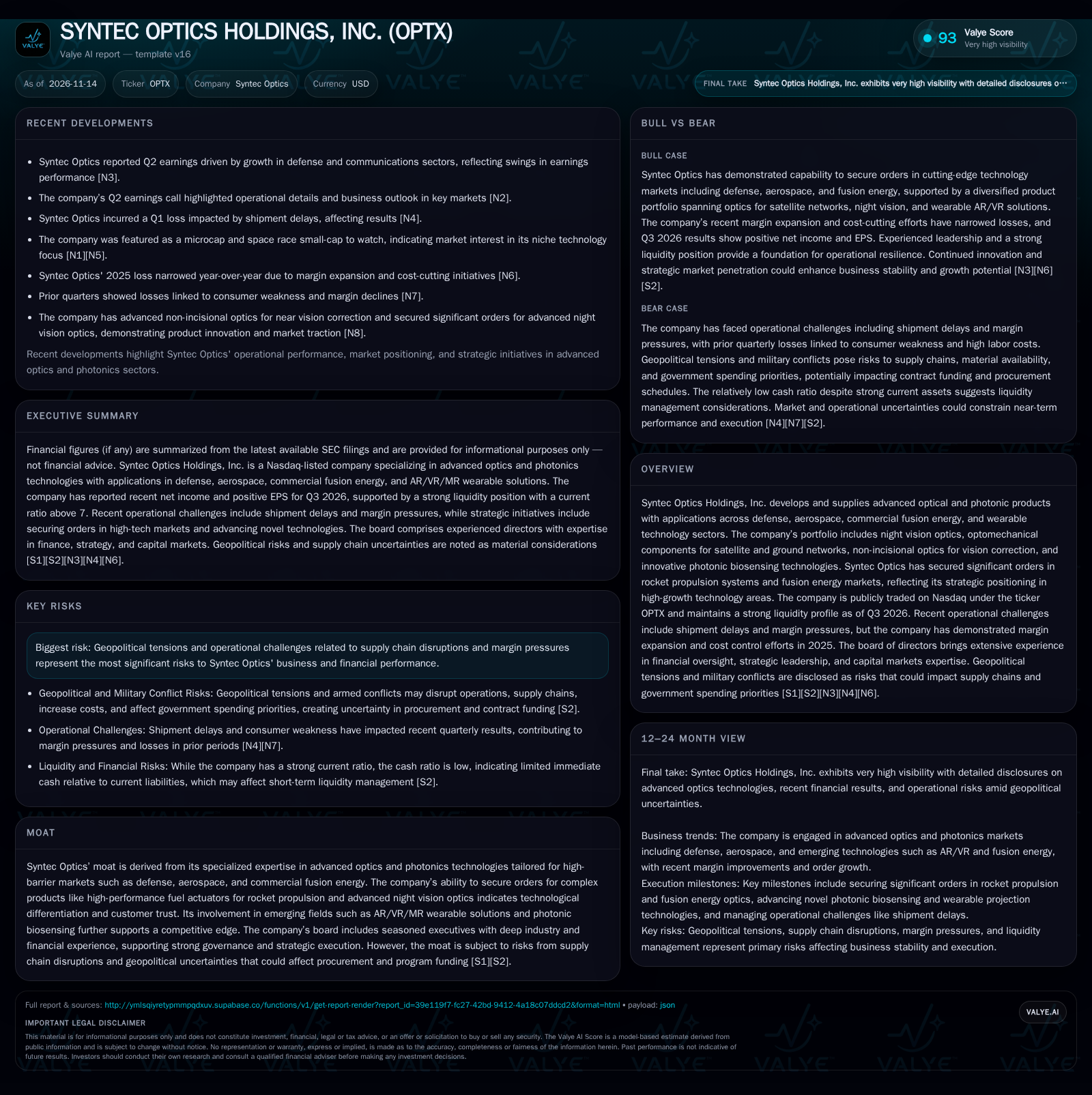
Syntec Optics Holdings, Inc. reported a modest Q3 2026 profit as it pursues growth in defense, aerospace, and cutting-edge photonics—including night vision, satellite optics, and wearable AR/VR tech. The next phase hinges on translating innovation and strategic orders into consistent performance and margin resilience amid global uncertainty. [S2] [N3] [N4] [N8]
Syntec Optics Holdings, Inc. stands at a crossroads as it seeks to parlay its advanced optics and photonics expertise into sustainable growth across defense, aerospace, and next-generation technology markets. Q3 2026 marked a return to profitability, but this achievement follows a period marked by shipment delays, margin compression, and operational volatility.
Recent Profitability and Strategic Orders Reshape Syntec’s Risk-Reward Profile
For the quarter ended September 30, 2026, Syntec Optics reported net income of $246,574 and basic/diluted EPS of $0.01, reversing a string of quarterly losses that were driven by shipment delays and margin pressure [S2] [N4]. This improvement follows a narrowing of year-over-year losses in 2025, attributed to margin expansion and cost-cutting [N6].
Strategically, Syntec has secured notable orders for optics in commercial fusion energy markets and high-performance fuel actuators in rocket propulsion systems, reinforcing its presence in defense and emerging tech verticals. Product innovation continues, with advances in non-incisional optics for vision correction and photonic biosensing technology collaborations [N8]. These developments are material because they demonstrate both market traction in high-barrier sectors and Syntec’s intent to diversify beyond traditional defense optics.
How Syntec’s Product Mix and Cost Structure Could Shape Margin Trajectory
Syntec’s business model is anchored in the design and supply of highly engineered optical and photonic components across defense, aerospace, and commercial technology markets. Revenue is likely driven by a mix of project-based and potentially recurring supply relationships for specialized components, though the specific commercial mechanics—such as the proportion of recurring versus one-off contracts—are not disclosed in public filings or news reports.
The economics of advanced optics are typically characterized by high upfront engineering and manufacturing costs, but with potential for attractive margins on successful programs due to technical complexity and long qualification cycles. The company’s recent ability to expand margins and reduce losses points to some operating leverage as higher-value orders ramp and cost controls take effect [N6]. However, shipment delays and swings in demand—especially from consumer segments—have exposed Syntec to revenue volatility and margin compression in prior periods [N4] [N7].
Capital intensity is a persistent theme: advanced photonics manufacturing often requires ongoing investment in precision equipment, R&D, and compliance, limiting near-term free cash flow especially when immediate liquidity is tight.
Barriers, Differentiation, and the Threat of Substitution in Advanced Optics
Syntec’s competitive positioning is defined by its ability to deliver complex, high-specification optics and photonic solutions to demanding customers in defense, aerospace, and emerging technology sectors. These markets are characterized by high technical and regulatory barriers to entry, long sales cycles, and sticky customer relationships once qualification is achieved. Product areas such as night vision optics, optomechanicals for satellite networks, and direct-to-eye AR/VR projection require deep domain expertise and robust quality assurance, potentially supporting a defensible moat.
However, the sector is also subject to intense price and technology competition. Larger defense contractors, specialized photonics firms, and diversified electronics manufacturers all operate in overlapping segments. Substitution risk exists if customers adopt alternative sensing, imaging, or vision correction technologies—especially as AR/VR/MR markets evolve rapidly and commercial fusion energy matures. The company’s foray into biosensing and wearable tech is a double-edged sword: while it opens new markets, it also pits Syntec against well-capitalized tech incumbents and nimble startups.
Sustained differentiation will likely depend on maintaining technological leadership, securing long-term relationships in defense and aerospace, and demonstrating reliability in delivery and performance. Any slip in quality, cost, or supply chain resilience could erode trust and open the door to substitutes or competitor encroachment.
From Innovation to Recurring Revenue: How Syntec Could Achieve Durable Growth
The upside scenario for Syntec Optics envisions the company translating its recent order wins and technology advances into a robust, recurring revenue base across defense, aerospace, and next-gen commercial applications. If the company can consistently deliver on complex projects—such as high-performance fuel actuators for rocket propulsion and specialized optics for fusion energy—while expanding its footprint in biosensing and AR/VR, it could establish itself as a go-to provider for critical photonic components.
Margin expansion would be confirmed by a sustained increase in gross margin percentage, reflecting both pricing power and operational efficiency.
Falsification would occur if new order wins fail to materialize into top-line growth, or if cost overruns and supply chain issues erode margins and delay project delivery. A lack of progress in commercializing biosensing or wearable optics, or evidence of customer churn in core defense programs, would undermine the thesis.
Volatility Persists as Syntec Juggles Growth Opportunities and Operational Risks
The most plausible trajectory for Syntec Optics is continued operational volatility as the company seeks to balance high-potential order wins with execution risks in a complex, capital-intensive industry. Revenue and earnings are likely to remain lumpy, reflecting the episodic nature of large defense and aerospace orders, shipment timing, and ongoing exposure to consumer and emerging tech cycles.
Confirmation of this scenario would come from continued swings between profitable and loss-making quarters, with margin performance closely tied to order mix and cost discipline. Incremental improvements in operating margin and working capital management, even if uneven, would signal incremental progress. On the other hand, persistent shipment delays, margin compression, and a stagnant or deteriorating cash ratio would point to ongoing execution headwinds.
The company’s ability to manage geopolitical and supply chain disruptions, secure follow-on orders, and maintain strong customer relationships will be decisive in determining whether this volatility resolves into sustainable growth or persistent underperformance.
Liquidity Strain and Supply Chain Shocks Could Derail Progress
The adverse scenario for Syntec Optics centers on a convergence of liquidity pressures, supply chain disruptions, and geopolitical shocks.
A sharp rise in input costs, loss of key customer programs, or extended delays in defense/aerospace shipments could trigger negative operating leverage, eroding margins and potentially leading to renewed losses. In this scenario, Syntec might be forced to seek external financing under less favorable terms or curtail R&D and growth investments, risking technological obsolescence.
The downside would be confirmed by a reversal to consecutive quarterly losses, deteriorating margin metrics, and further slippage in liquidity ratios. Additional warning signs would include management commentary on cash conservation, delayed project deliveries, or lost orders due to supply chain or geopolitical factors.
Milestones That Will Shape Syntec Optics’ Competitive and Financial Trajectory
Quarterly gross margin and operating margin trends, especially in relation to order mix and input cost volatility.
Revenue growth from defense, aerospace, and emerging commercial segments—separate disclosure by end market would clarify the sustainability of recent wins.
Order flow and award disclosures (if provided), which would help assess revenue visibility and pipeline strength.
Progress in converting current assets—particularly receivables and inventory—into cash, as evidenced by reported liquidity-ratio trends.
Shipment timing and fulfillment performance, with a focus on whether operational delays are resolved or persist.
Customer concentration metrics: a breakdown of revenue by top customers or programs (if disclosed) would illuminate dependence risk.
Commercialization milestones for photonic biosensing and wearable optics, such as new product launches or partnership announcements.
Management commentary on geopolitical and supply chain risk mitigation, including sourcing diversification or contingency planning.
Disclaimer: This is research-only, informational analysis and not investment advice. It may include AI-generated interpretation and general industry context. Always verify important details using primary sources.

Comments