
Forum Markets: Advancing Blockchain Tokenization and AI Infrastructure for Real-World Asset Platforms
Forum Markets is pivoting from legacy blockchain ventures to a dual strategy: tokenizing income-generating real-world assets (RWAs) on Ethereum and building out AI compute infrastructure. The next phase will test whether Forum’s access to originator relationships and programmable finance can create defensible economics—or be outpaced by regulatory, funding, and competitive headwinds.
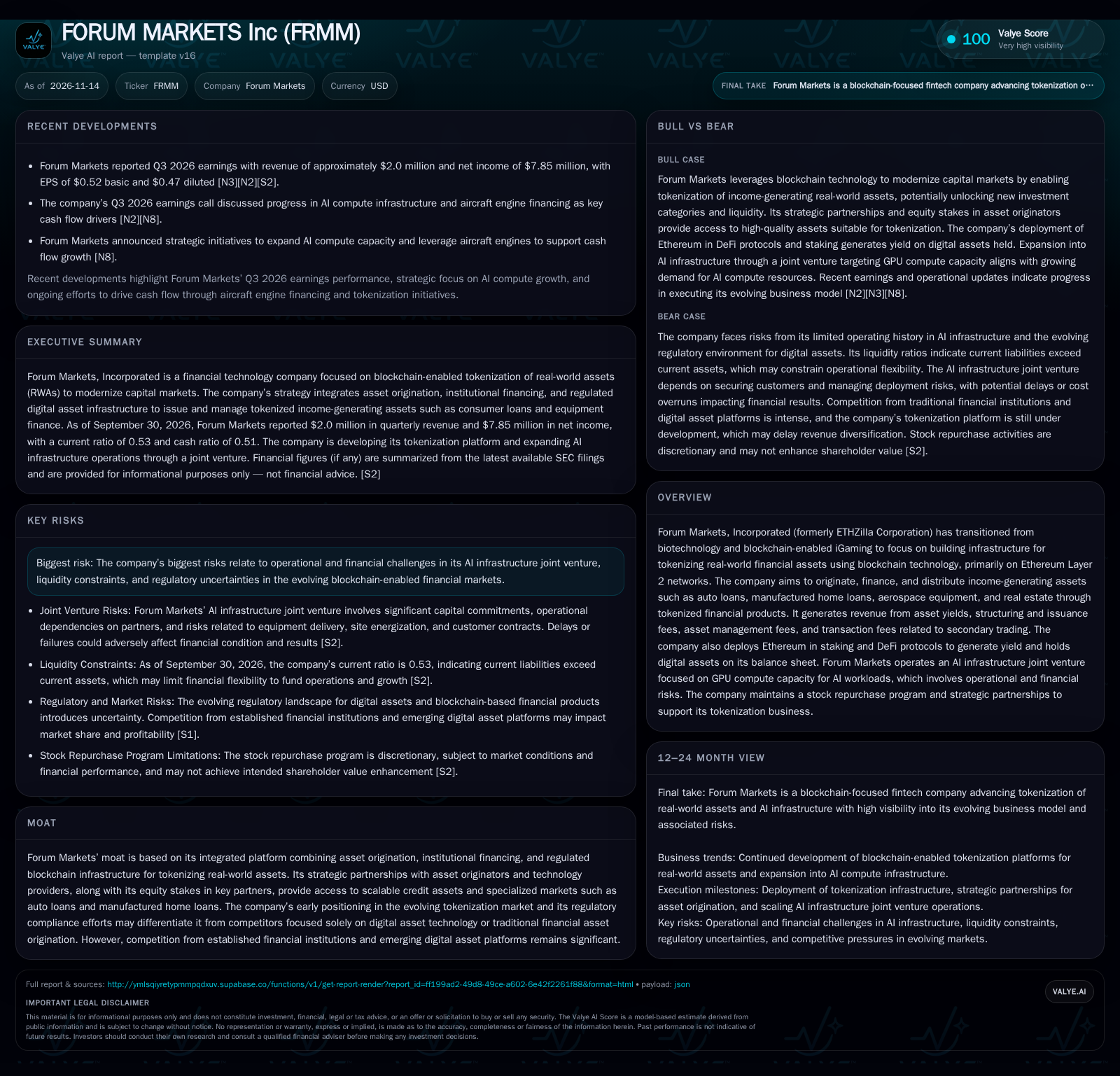
Forum Markets is building a blockchain-based capital markets platform to tokenize real-world assets and expanding into AI compute infrastructure through a joint venture. Q3 2026 reported $2M in revenue and $7.85M in net income, but current liabilities far exceed current assets, raising near-term liquidity concerns. Success depends on scaling tokenization, managing AI deployment risks, and navigating regulatory and competitive pressures. [S2]
Forum Markets is attempting a rare feat: bridging blockchain capital markets infrastructure with the tokenization of real-world assets, while simultaneously investing in AI compute capacity. Forum’s future will hinge on its ability to operationalize tokenization at scale, secure sustainable cash flow from both digital and physical assets, and outmaneuver both regulatory uncertainty and established financial incumbents.
Forum’s Latest Financial Results and Strategic Shifts Set the Stage
Forum Markets’ Q3 2026 results reveal $2.0 million in revenue and $7.85 million in net income, with diluted EPS of $0.47. However, the balance sheet is strained: current assets of $16.0 million stand against current liabilities of $30.39 million, yielding a current ratio of just 0.53. The company holds $3.22 million in cash and equivalents, and $12.14 million in short-term investments. These figures underscore a business at a critical juncture—generating positive earnings but operating with reported liquidity position, which could constrain growth or even operational stability if not addressed. [S2]
Forum’s business model has undergone a significant shift: from its origins in biotechnology and iGaming to a focus on blockchain-enabled tokenization of income-generating real-world assets (RWAs) and an AI infrastructure joint venture. This dual-pronged strategy is designed to capture value from both programmable finance and the AI compute boom, but also increases complexity and capital requirements. [S1] [S2]
Strategic partnerships with asset originators such as Satschel, Karus, and Zippy are central to Forum's ability to source auto loans, manufactured home loans, aerospace equipment, and real estate assets for tokenization. The company’s platform—still under development—seeks to integrate origination, financing, and regulated digital asset infrastructure, with a goal of enabling programmable, efficient settlement and new forms of asset distribution. [S1]
Monetization Pathways Through Tokenization and AI Infrastructure at Forum Markets
Forum’s revenue model is intentionally diversified: it aims to earn from net yield on held assets (by deploying Ethereum in staking, DeFi protocols, and lending), origination and issuance fees on tokenized products, asset management fees, and transaction fees from secondary trading. In principle, this blend offers both recurring (management and transaction fees) and episodic (origination/issuance) revenue streams, with the potential for operating leverage if asset volumes and platform activity scale.
The economics of tokenizing real-world assets are shaped by the quality and scalability of asset origination, the efficiency and security of the blockchain infrastructure, and the ability to attract both institutional and retail capital. Fee structures in tokenization can vary widely, but early-stage platforms often face pressure to subsidize onboarding and liquidity to overcome network effects and build trust. Forum’s partnerships with asset originators may help lower sourcing costs, but if asset quality or default rates are poor, yield economics could deteriorate.
The AI infrastructure joint venture introduces a capital-intensive, operationally complex dimension. Revenue is likely tied to GPU compute capacity deployed and long-term compute contracts, but margins could be compressed by high upfront equipment costs, power/energization delays, and the cyclical nature of AI workload demand. If the company can secure stable, high-value compute contracts and operate at scale, the joint venture could provide significant cash flow; otherwise, capital at risk may weigh on overall returns.
Forum’s balance sheet reveals immediate funding needs. With short-term liabilities outpacing liquid assets, the company may need to secure additional financing, monetize digital asset holdings, or accelerate revenue recognition to avoid liquidity-driven operational constraints.
Forum’s Position Within an Increasingly Competitive Tokenization Environment
Forum faces competition from both traditional financial institutions (banks, credit funds, asset managers) and a growing cohort of digital asset platforms seeking to tokenize RWAs. Large banks and fintechs have deep capital, established distribution, and regulatory credibility—advantages that can make institutional clients less likely to switch to a new, unproven platform unless the economics or functionality are clearly superior.
Forum’s differentiators may include its early integration of Ethereum and Layer-2 protocols for scalable, programmable settlement; its direct partnerships with asset originators; and its hybrid approach to combining physical asset cash flows with digital infrastructure. However, these potential advantages are countered by the rapid pace of innovation among competitors, regulatory uncertainty (especially for tokenized securities), and the risk that established players could replicate or undercut Forum’s offerings.
Substitution risk is also material: traditional securitization, private credit funds, and even existing digital asset platforms can provide alternative liquidity and exposure to similar underlying assets. Forum’s ability to create sticky, recurring revenue will likely depend on whether its platform delivers superior transparency, settlement speed, or access to unique asset pools—none of which are guaranteed at this stage.
Potential for Growth if Forum’s Platform Attracts Institutional and Retail Engagement
The most favorable outcome would see Forum successfully launching its tokenization platform, onboarding a critical mass of income-generating assets, and establishing itself as a trusted intermediary for both originators and investors. In this scenario, revenue would scale from both origination/issuance fees and growing asset management and transaction fees as secondary trading of tokenized assets gains momentum.
If the AI infrastructure joint venture secures multi-year compute contracts (as indicated by recent news of a $94.4 million agreement [N6]), this could provide a stable, high-margin cash flow stream to complement the tokenization business and help alleviate liquidity pressures.
Confirmation of this scenario would include: rapid growth in assets tokenized on-platform; recurring, diversified fee income; extension or refinancing of near-term liabilities to improve liquidity; and evidence of sticky customer relationships (retention rates, follow-on contracts, or platform lock-in). Falsification would come from stalled asset onboarding, customer attrition, or inability to scale transaction volumes.
Forum Markets Faces an Extended Development Phase with Intermittent Progress
The most plausible path is uneven progress: Forum gradually onboards new asset classes for tokenization, but faces ongoing challenges in achieving critical mass, regulatory clarity, and sustainable fee economics. Revenue growth may be lumpy, tied to episodic asset onboarding or origination deals rather than a steady stream of recurring fees.
The AI infrastructure joint venture could deliver occasional large contracts, but operational risks—delays in energizing sites, equipment supply issues, or customer churn—may prevent the business from operating at optimal scale or margin. Liquidity management remains a near-term concern, with the need for external funding or asset monetization likely recurring until the underlying platforms reach scale.
Evidence supporting this scenario would include modest but growing platform usage, lumpy or project-driven revenue, continued use of partnerships to access new asset pools, and periodic balance-sheet management actions (e.g., asset sales, new debt or equity raises). Falsification would be a sudden acceleration in either platform adoption or sustained, large-scale compute contracts.
Risks from Liquidity Constraints and Execution Challenges Threaten Forum’s Plans
If Forum is unable to convert its platform development into scaled, revenue-generating operations, the company could face a liquidity squeeze that forces asset sales, dilutive capital raises, or even operational retrenchment. [S2]
The AI infrastructure joint venture could exacerbate these risks if equipment or site delays lead to cost overruns or missed customer milestones, resulting in contract cancellations or penalties. Regulatory setbacks in tokenized asset markets, or a major default in the underlying asset pools, could further undermine confidence and access to capital.
Watchpoints for this scenario include: worsening liquidity ratios; asset write-downs; failed or delayed platform launches; and negative news regarding regulatory actions, customer defections, or loss of strategic partnerships.
Key Developments That Will Reveal Forum Markets’ Platform Expansion Prospects
Progress on the commercial launch and scaling of Forum’s tokenization platform, including the number and value of assets onboarded (if disclosed).
Recurring revenue contribution from origination, management, and transaction fees as a share of total revenue—would help test the shift from episodic to recurring economics.
Execution and financial performance of the AI infrastructure joint venture—specifically, contract wins, operational uptime, and margin realization.
Liquidity trends: changes in cash, current ratio, and any new financing or asset sales.
Asset quality and performance of tokenized pools (e.g., default rates, yield stability, if disclosed).
Retention and expansion of strategic partnerships with asset originators and technology providers.
Updates on regulatory developments affecting tokenized securities and digital asset infrastructure.
Management commentary on capital allocation priorities—balancing platform investment, AI infrastructure funding, and shareholder returns (e.g., buybacks).
Disclaimer: This is research-only, informational analysis and not investment advice. It may include AI-generated interpretation and general industry context. Always verify important details using primary sources.

Comments