
Dragonfly Energy’s Battery Ambition: Innovation and OEM Shifts Under Financial Pressure
Dragonfly Energy Holdings is pushing lithium iron phosphate (LFP) battery technology into RV, marine, and industrial markets through OEM partnerships and recent acquisitions—yet persistent losses, tight liquidity, and Nasdaq non-compliance cast doubt on its ability to realize its product and channel strategy without new capital.
The integration of Dakota Lithium assets may support revenue diversification, though ongoing losses and tight cash resources make access to new capital essential for survival and execution of its strategy. Nasdaq listing compliance is a near-term existential milestone. [S2]
Dragonfly Energy Holdings Corp. is at a crossroads: the company is seeking to leverage its proprietary lithium iron phosphate battery technology and U.S.-based manufacturing to win share in the RV, marine, and industrial energy storage markets, pivoting from direct-to-consumer to OEM and fleet channels. Yet, as of Q3 2026, Dragonfly’s financial foundation remains fragile, with recurring losses, reported cash balance, and a need to regain Nasdaq compliance by the end of the year. The integration of Dakota Lithium’s assets may offer a new growth lever, but execution and capital access remain existential challenges.
Operating Reality: Losses Mount as Liquidity Tightens and Strategic Acquisition Unfolds
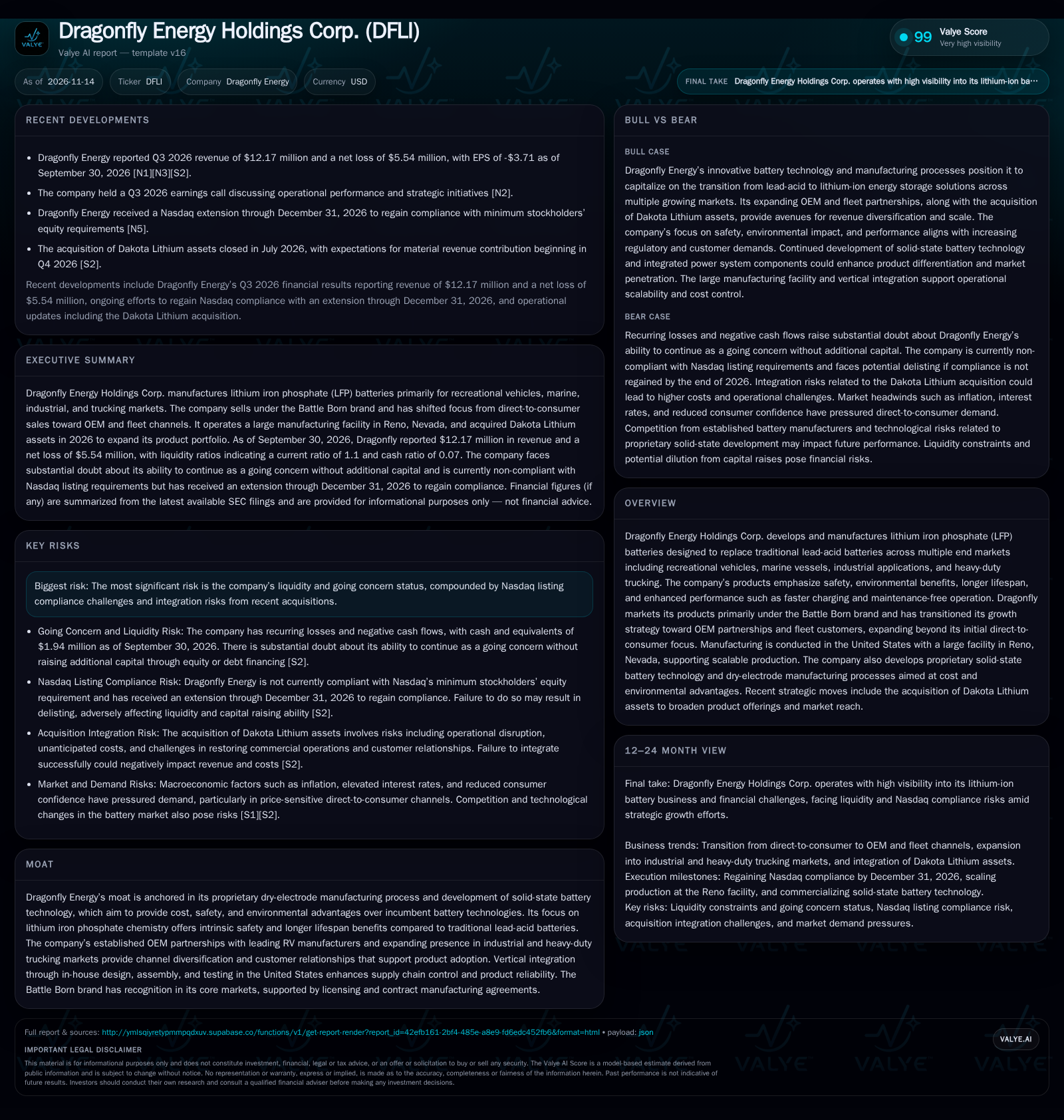
As of September 30, 2026, Dragonfly Energy reported revenue of $12.17 million and a net loss of $5.54 million, with basic and diluted EPS at -$3.71 for the quarter [S2]. The company’s cash and equivalents totaled just $1.94 million, with a current ratio of 1.1 and a cash ratio of only 0.07, reflecting a very tight liquidity position [S2]. Management has disclosed recurring losses and negative cash flows, raising substantial doubt about the company’s ability to continue as a going concern without raising additional capital [S2].
Dragonfly is currently non-compliant with Nasdaq’s minimum stockholders’ equity requirement but has secured an extension through December 31, 2026, to regain compliance—making this deadline a critical near-term catalyst [S2].
In July 2026, Dragonfly acquired the Dakota Lithium assets, anticipating material revenue contributions starting in Q4 2026 [S2]. This move is intended to diversify the product portfolio and expand market reach, but integration risk and execution hurdles remain.
Cost Dynamics and Channel Evolution Challenge the Path to Profitable Growth
Dragonfly’s revenue model is built around manufacturing and selling lithium iron phosphate (LFP) battery packs, primarily targeting RV, marine, industrial, and trucking sectors under the Battle Born brand [S1]. Historically, the company relied on direct-to-consumer (DTC) sales, but has shifted focus to OEM and fleet channels, where larger contract volumes can drive higher throughput and potentially improve operating leverage if fixed manufacturing costs are spread over more units.
LFP batteries offer cost and longevity advantages over lead-acid batteries, but Dragonfly’s margin structure is likely pressured by the need to compete with larger, better-capitalized battery manufacturers and by the capital intensity of U.S.-based production. The Reno, Nevada facility supports production scale and process automation, yet high fixed costs mean that underutilization—evident in declining battery sales year-over-year—can exacerbate losses.
The company’s proprietary dry-electrode process and ongoing solid-state battery development could lower future cost per unit and enhance product differentiation, but these benefits are not yet fully realized in the reported financials. Integration of Dakota Lithium assets may bring operational synergies and broaden the product mix, but also introduces short-term integration costs and execution risk. The company reported cash and liquidity metrics for the period; these figures do not by themselves establish operating runway, investment capacity, financial flexibility, or financing capacity.
Standing Out in a Saturated Battery Market: Balancing Differentiation with Scale
Dragonfly Energy competes in the rapidly evolving energy storage market against established lithium-ion battery manufacturers, legacy lead-acid providers, and new entrants developing next-generation chemistries. Its focus on LFP chemistry offers safety and lifespan advantages, particularly relevant for RV and marine applications where fire risk and maintenance are critical customer concerns.
The company’s moat is based on proprietary dry-electrode manufacturing, integration of battery management systems, and the development of solid-state technology, potentially offering cost and environmental benefits. OEM relationships with major RV manufacturers such as Airstream and THOR Industries provide valuable sales channels that can support volume growth and brand credibility [S1].
However, price competition remains intense, especially as larger players can leverage greater scale and supply chain advantages. Substitution risk persists from both incumbent lead-acid solutions (on price) and from alternative lithium chemistries (on performance or cost). Long-term customer retention may depend on demonstrated reliability, total cost of ownership, and support services—areas where larger competitors may have an edge if Dragonfly cannot match on service or innovation.
Potential for Margin Gains and Market Share Growth Despite Financial Constraints
In a favorable scenario, Dragonfly successfully integrates Dakota Lithium assets, accelerating revenue growth and product portfolio breadth in Q4 2026 and beyond. OEM and fleet channel sales ramp up as macro conditions stabilize and RV/industrial demand recovers, enabling higher utilization of the Reno facility and unlocking operating leverage. Proprietary manufacturing processes and solid-state battery development lower unit costs and differentiate Dragonfly’s offerings, allowing for premium pricing or improved margins.
Access to new capital—whether through equity, debt, or strategic partnerships—would be essential to bridge the near-term liquidity gap, fund production scale-up, and support ongoing R&D. Confirmation of this scenario would come from sequential revenue growth, improving gross margin, a positive inflection in operating cash flow, and public disclosure of new or expanded OEM contracts. Timely Nasdaq compliance and a stable or growing cash balance would further validate execution and reduce existential risk.
Survival Depends on Capital Access and Execution Amid Incremental Advances
The most plausible near-term path is one of incremental improvement, with Dragonfly managing to stabilize revenue through a mix of modest OEM growth and partial contribution from Dakota Lithium assets starting in Q4 2026. Operating losses persist, but are somewhat mitigated by cost control and gradual production optimization at the Reno plant.
Capital raises—likely dilutive—are required to sustain operations, maintain R&D, and meet Nasdaq compliance. The pace of OEM adoption and end-market recovery in RV and industrial segments remains moderate, with price competition and macro headwinds limiting margin expansion. The company’s survival depends on its ability to secure external financing before cash runs out, execute on integration, and retain key OEM relationships. This scenario is confirmed by continued but slow revenue growth, persistent (but narrowing) losses, and timely disclosures regarding new financing or compliance milestones.
Risks of Liquidity Depletion and Delisting Increase with Execution Challenges
In a negative scenario, Dragonfly fails to secure sufficient capital before liquidity is exhausted, forcing drastic cutbacks, potential asset sales, or even bankruptcy. Delisting from Nasdaq due to non-compliance with equity requirements would further constrain access to public capital and hurt customer and partner confidence.
Integration of Dakota Lithium assets could falter, resulting in higher costs and delayed revenue contribution. OEM demand may remain soft due to continued macroeconomic weakness or competitive displacement, leading to underutilization of manufacturing capacity and persistent negative operating cash flow.
Evidence of this scenario would include further sequential revenue declines, deteriorating margins, negative working capital trends, and public announcements of missed compliance deadlines, failed financing attempts, or restructuring actions.
Critical Milestones Will Shape the Future of Dragonfly’s Battery Ambition
Quarterly revenue growth, particularly evidence of material contribution from Dakota Lithium assets beginning in Q4 2026, would help test integration and channel expansion progress.
Gross margin trends and unit economics, if disclosed, would clarify the impact of manufacturing scale and proprietary process adoption.
Cash balance and operating cash flow metrics are critical to assessing near-term survival and the need for further capital raises.
Updates on OEM partnership expansion or renewals, especially with large RV or industrial customers, would signal channel traction.
Public disclosure of new capital raised, credit facilities, or strategic investments would indicate success in bridging the liquidity gap.
Nasdaq compliance status and any associated extensions, warnings, or delisting actions are existential milestones.
Progress reports on solid-state battery development and commercial readiness would help gauge long-term differentiation potential.
Evidence of successful Dakota Lithium integration, such as new product launches or cross-selling contracts, would support the thesis of portfolio synergy.
Disclaimer: This is research-only, informational analysis and not investment advice. It may include AI-generated interpretation and general industry context. Always verify important details using primary sources.

Comments