
Eightco Holdings: Digital Asset Ambition and the Fragile Economics of E-Commerce Funding
Eightco Holdings stands at the intersection of digital asset investing and e-commerce funding, with its fortunes increasingly tied to volatile digital markets and a risky transition in its core operating business. Strategic bets on AI and digital identity offer transformative upside, but the collapse of Forever 8’s principal customer and unproven new business model highlight acute execution risk.
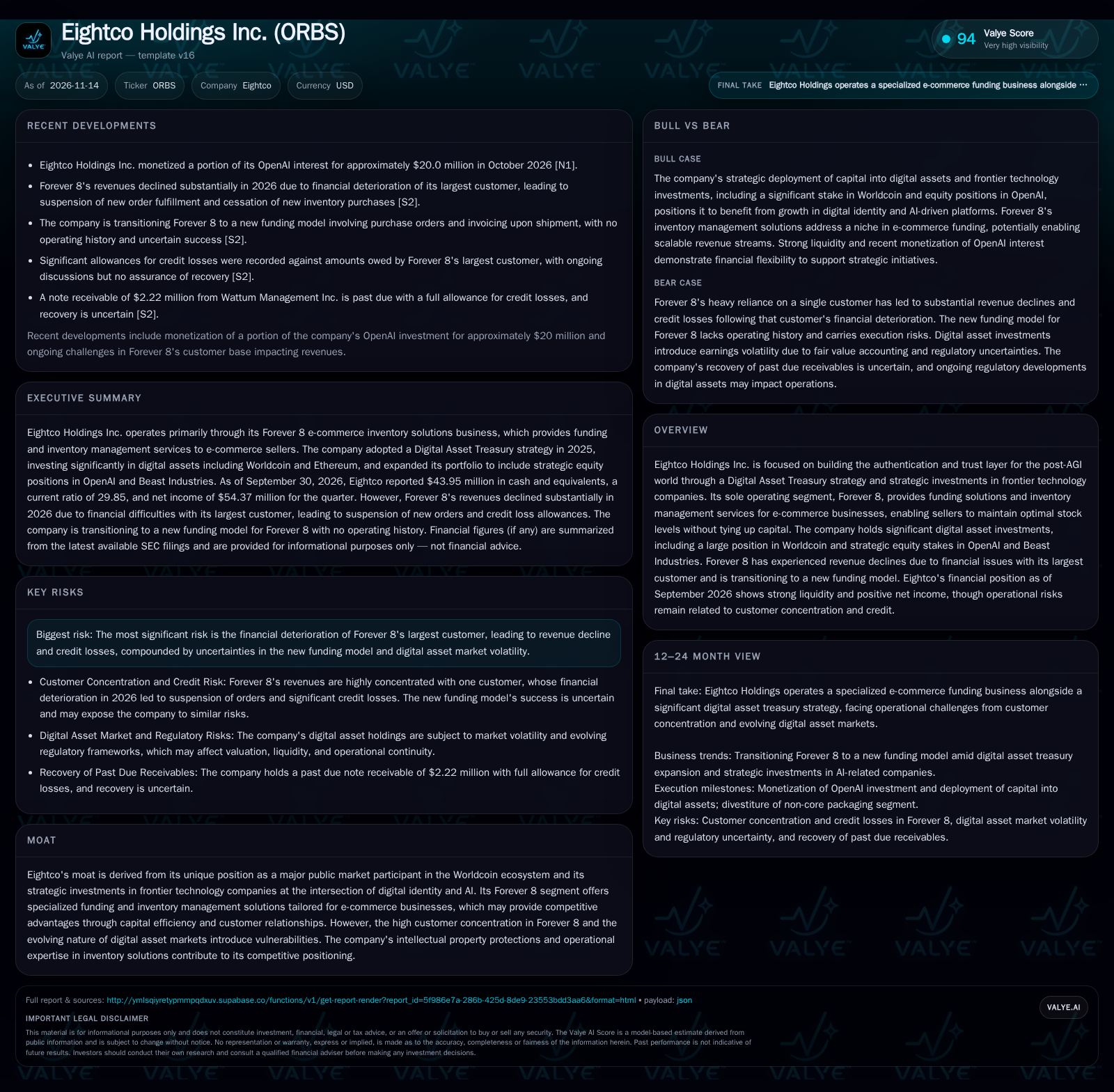
Eightco Holdings has pivoted from traditional operations to a hybrid model: operating Forever 8’s e-commerce inventory funding business and managing a large, actively traded digital asset treasury. While the company’s strategic stakes in Worldcoin and OpenAI create exposure to high-growth technology, Forever 8’s collapse in revenue—driven by the financial distress of its dominant customer—exposes the fragility of its current business model. The transition to a new, untested funding approach and the reliance on digital asset gains introduce both transformative upside and existential risk. [S1] [S2] [N1]
Eightco Holdings has become a hybrid of two high-risk, high-reward strategies: a digital asset treasury with exposure to frontier technology and an e-commerce funding business grappling with existential challenges. The company’s fortunes have swung dramatically—from the windfall of digital asset appreciation and monetization of OpenAI equity, to the collapse of Forever 8’s primary revenue source and the adoption of an untested operating model. The next phase for Eightco will be defined by its ability to stabilize Forever 8, navigate the volatility and regulatory headwinds of digital assets, and convert its strategic investments into long-term value.
Recent Revenue Collapse and Strategic Monetization Define the Present
The most material recent development for Eightco Holdings is the sharp revenue decline at Forever 8, its sole operating business, following the financial collapse of its principal customer—responsible for approximately 89% of segment revenue in 2025. The customer’s unauthorized disposal of inventory triggered significant credit losses and forced Forever 8 to suspend new order fulfillment and inventory purchases for that customer. [S2]
In parallel, Eightco has aggressively expanded its Digital Asset Treasury, holding about 10% of Worldcoin’s circulating supply as of year-end 2025 and acquiring strategic equity stakes in OpenAI and Beast Industries. The company monetized a portion of its OpenAI interest for $20 million in October 2026, providing liquidity and demonstrating the potential value of its venture investments. [S1] [N1]
As of September 30, 2026, Eightco reported $43.95 million in cash and equivalents and a current ratio of nearly 30, although these figures are substantially shaped by the mark-to-market accounting of digital asset holdings. [S2]
How Digital Asset Gains and E-Commerce Funding Shape the Financial Engine
Eightco’s earnings profile is now a blend of two fundamentally different economic models: the Forever 8 e-commerce funding business and a volatile digital asset investment strategy. Forever 8 historically generated revenue by providing working capital and inventory management for e-commerce sellers, charging fees or earning spread on inventory funding. However, the collapse of its largest customer has exposed the fragility of this model—especially when customer concentration is extreme and credit risk is not adequately diversified. [S1] [S2]
The company’s new proposed model involves purchasing goods via customer purchase orders and invoicing upon shipment, with receivables secured by inventory. While this structure may reduce some inventory risk and theoretically allow for more scalable growth, it introduces new uncertainties: it has no operating history, and the creditworthiness of new customers will be critical. The economics could improve if the company can attract a broader, more diversified customer base and enforce tighter collateralization and payment discipline.
On the treasury side, Eightco’s significant digital asset holdings—including Worldcoin, Ethereum, and equity in OpenAI—are measured at fair value, with unrealized gains and losses flowing through earnings. This introduces substantial earnings volatility unrelated to Forever 8’s underlying operations. The company’s net income in recent quarters is therefore as much a function of digital asset price movements as it is of operational success, potentially masking or amplifying true business performance. [S1] [S2]
Assessing Moat: Technology-Driven Differentiation Versus Structural Weakness
Eightco’s competitive positioning is built on two pillars: its status as a major public market participant in the Worldcoin ecosystem and its role as a niche provider of e-commerce inventory funding solutions. The Worldcoin exposure and strategic stakes in OpenAI and Beast Industries offer differentiated access to digital identity and AI-driven platforms—categories with high strategic value if adoption accelerates. However, these are capital allocations rather than defensible operating moats.
In the e-commerce funding space, Forever 8’s value proposition—enabling sellers to optimize inventory without tying up capital—addresses a real pain point for small and mid-sized merchants. Theoretically, this could create stickiness if Forever 8 can offer superior capital efficiency, risk management, and tech-enabled service. Yet, the catastrophic customer concentration and recent credit losses highlight a structural weakness: without a diversified customer base and proven underwriting, competitive advantage is fragile.
Competitive threats come from alternative working capital providers, fintech lenders, and e-commerce platforms with embedded financing. Meanwhile, the digital asset treasury faces little direct competition but is highly exposed to market cycles, regulatory shifts, and the risk of technological obsolescence or adverse events in its core holdings.
How a Successful Transition and Asset Appreciation Could Unlock Transformative Value
If Forever 8’s new funding model proves effective—attracting a broader range of e-commerce customers, diversifying credit risk, and securing reliable payment streams—the business could recover and even scale. The shift to invoicing upon shipment with secured receivables could improve cash conversion and reduce exposure to inventory write-offs. Confirmation would come from a rebound in segment revenue, a more balanced customer mix, and declining credit loss allowances.
On the treasury side, further appreciation in Worldcoin, Ethereum, or OpenAI’s value could deliver outsized mark-to-market gains, providing both liquidity and headline net income. Additional monetizations of strategic equity (as with the recent OpenAI sale) would validate the company’s investment acumen and provide capital for reinvestment or shareholder returns.
Falsification would occur if the new Forever 8 model fails to gain traction or if digital asset prices sharply correct, erasing reported profits and straining liquidity.
A Volatile Mix: Balancing Unproven Operations with Asset-Driven Earnings Swings
The most plausible middle path is that Forever 8’s revenues remain subdued or recover only gradually, as the company experiments with its new funding model and seeks to rebuild its customer base. Credit losses may moderate, but the business will likely face ongoing volatility in customer quality and payment reliability.
Digital asset holdings will continue to drive periodic swings in reported earnings, with net income and liquidity fluctuating in line with market prices. The company may pursue further monetizations of strategic equity, but its core operating business will remain challenged until the new model is proven.
Confirmation would be visible in stabilized or slowly improving Forever 8 revenues, a more diversified receivables book, and less reliance on a single customer. Falsification would be a renewed spike in credit losses, continued revenue decline, or a major drawdown in digital asset values leading to reported losses.
Compounding Risks: Persistent Revenue Weakness and Digital Asset Drawdowns
In an adverse scenario, Forever 8’s new model fails to attract enough creditworthy customers, leading to ongoing low revenues and further credit losses. The business could struggle to rebuild after the loss of its dominant customer, with reputational damage and customer skepticism limiting growth.
Simultaneously, a sharp decline in digital asset prices—whether due to market cycles, regulatory shocks, or adverse events in the Worldcoin or Ethereum ecosystems—could wipe out mark-to-market gains, triggering reported net losses and eroding the perceived liquidity cushion.
This scenario would be confirmed by persistent negative operating cash flow from Forever 8, swelling credit loss allowances, and a rapid decline in the value of digital assets held on the balance sheet.
What Will Determine Eightco’s Trajectory: Operational and Asset-Driven Milestones
The pace and scale of revenue recovery in Forever 8’s new funding model—evidence of customer acquisition, retention, and credit quality would help test the model’s viability.
Customer concentration metrics: A shift toward a more diversified customer base would reduce systemic risk and support a more resilient revenue stream.
Credit loss allowances and bad debt expense trends: Persistent or rising credit losses would signal ongoing weaknesses in underwriting and risk management.
Disclosure of new customer wins or multi-year agreements (if any): Announcements of material new relationships would suggest traction for the revised business model.
Mark-to-market changes in the value of digital asset holdings—especially Worldcoin, Ethereum, and OpenAI equity—will directly impact reported earnings and liquidity.
Regulatory developments affecting digital asset holdings or the structure of Eightco’s treasury strategy could materially alter risk/return dynamics.
Further monetization of strategic equity positions: Additional sales, particularly of OpenAI or other portfolio stakes, would provide evidence of realized value and capital discipline.
Resolution or recovery progress on the $2.22 million past due note from Wattum Management Inc., as this may signal improvements (or continued issues) in credit practices.
Disclaimer: This is research-only, informational analysis and not investment advice. It may include AI-generated interpretation and general industry context. Always verify important details using primary sources.

Comments