
CISO Global: AI-Driven Cybersecurity Ambition Meets Acute Liquidity Strain
CISO Global, Inc. leverages AI-powered cybersecurity and insurance solutions to target underserved verticals, but its severe working capital deficit and persistent losses cast doubt on its operational future—even as differentiated offerings and strategic partnerships signal potential market fit.
CISO Global, Inc. stands out for integrating AI-driven cybersecurity with insurance, addressing the needs of SMBs and niche sectors like dental and financial services. Strategic partnerships and compliance milestones offer commercial credibility, but a pronounced working capital deficit and ongoing losses threaten its ability to execute.
CISO Global, Inc. occupies a distinctive niche in the cybersecurity landscape, fusing AI-driven protection with insurance to serve segments often overlooked by larger providers—such as dental clinics and financial management firms. Recent product rollouts and strategic partnerships suggest strong commercial intent and technical differentiation. Yet, as the company faces a critical liquidity crunch and mounting net losses, the question is whether its business model can gain sufficient traction before financial pressures force retrenchment or restructuring. The coming quarters will test whether CISO Global’s integrated approach and vertical focus can translate into sustainable growth—or whether acute funding constraints will override even the most compelling product innovations.
Liquidity Crisis and Vertical Expansion Define the Present
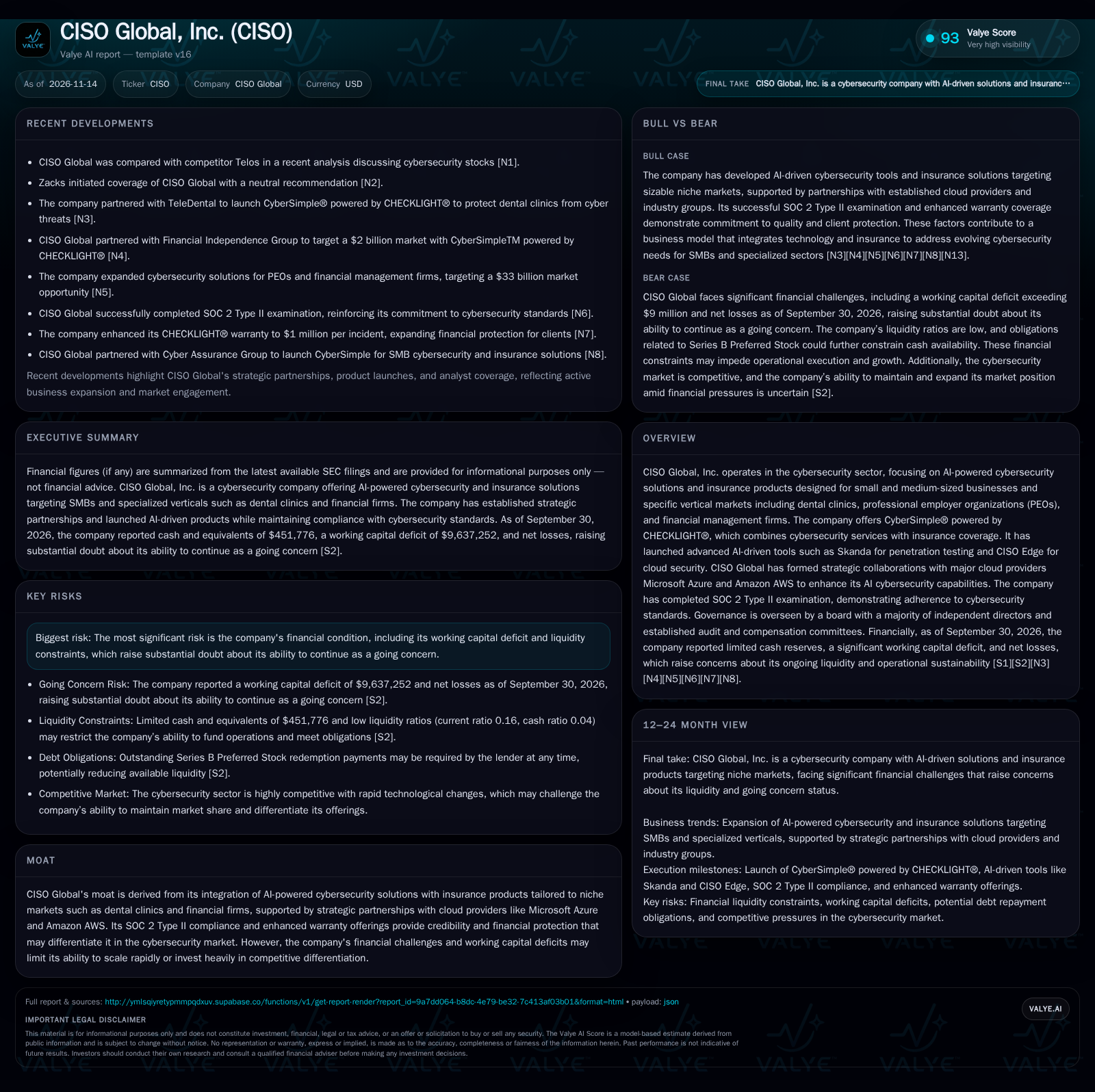
CISO Global is contending with a pronounced financial squeeze: as of September 30, 2026, it held just $451,776 in cash and faced a working capital deficit of $9,637,252, with ongoing net losses and negative operating cash flows. This situation has led management to disclose substantial doubt about the company’s ability to continue as a going concern [S2]. On the commercial front, CISO Global has launched AI-driven cybersecurity and insurance bundles—such as CyberSimple® powered by CHECKLIGHT®—targeting SMBs, dental clinics, and financial management firms, and has expanded its warranty coverage to $1 million per incident [N3] [N4] [N5] [N7]. Strategic partnerships with Microsoft Azure and Amazon AWS, along with completion of a SOC 2 Type II examination, bolster technical credibility and market access [N6]. The company reported cash and liquidity metrics for the period; these figures do not by themselves establish operating runway, investment capacity, financial flexibility, or financing capacity.
Bundled Cybersecurity and Insurance: Economic Promise and Structural Challenges
CISO Global’s business model blends AI-powered cybersecurity tools with insurance, aiming to create bundled offerings that offer both technical protection and financial risk transfer for SMBs and niche verticals. This integration could allow for premium pricing versus standalone security solutions—particularly in sectors with acute regulatory or reputational risk, such as dental or financial services. Fixed costs are largely driven by R&D, cloud platform partnerships, and compliance (e.g., SOC 2 Type II), while variable costs include service delivery, claims payouts, and customer acquisition.
The economics hinge on three levers: (1) the ability to generate recurring revenue through multi-year contracts or subscriptions (if achieved), (2) managing insurance risk and claims costs to preserve gross margins, and (3) achieving scale in verticals where switching costs and compliance requirements could drive sticky adoption. However, with current liquidity so constrained, CISO Global may be unable to invest adequately in product development, marketing, or claims reserves, hampering both customer acquisition and long-term retention. Unless the company can demonstrate strong unit economics—such as high contract renewal rates, low churn, or favorable loss ratios—the business risks being structurally unprofitable even if top-line growth materializes.
Differentiation through Integration—But Can It Last?
CISO Global attempts to differentiate itself by bundling cybersecurity software, insurance, and AI-driven tools, targeting verticals often underserved by larger, horizontal players. This approach leverages partnerships with cloud giants (Microsoft Azure, Amazon AWS) and credible standards compliance (SOC 2 Type II) to build trust among risk-averse clients [N6]. The company’s product focus—offering features like Skanda (AI-powered penetration testing) and CISO Edge (cloud security)—is tailored to the evolving threat landscape and regulatory demands.
However, the cybersecurity market remains intensely competitive, with large incumbents, specialized MSPs, and new SaaS entrants all vying for SMB and vertical-specific share. Larger competitors typically benefit from greater R&D resources, brand recognition, and the ability to cross-sell across broader portfolios. The question is whether CISO Global’s vertical focus and bundled insurance offering can create real switching costs or network effects. If competitors begin to integrate insurance or AI-powered tools into their own offerings, CISO Global’s initial differentiation could erode quickly—especially if financial constraints limit its ability to keep pace with innovation and customer support.
If Vertical Penetration and Recurring Revenue Take Hold
A favorable outcome for CISO Global would see its bundled cybersecurity-insurance solution gaining traction in targeted verticals, leading to robust recurring revenues and improved customer retention. The company could leverage partnerships with sector organizations (e.g., TeleDental, Financial Independence Group) to access large pools of SMB clients [N3] [N4], while the enhanced $1 million incident warranty serves as a key differentiator to win deals in risk-sensitive environments [N7]. As the installed base grows, positive word-of-mouth and regulatory mandates could drive further adoption, and recurring software/insurance contracts could provide a predictable revenue stream.
To confirm this scenario, investors would look for evidence of multi-year contract wins, customer renewal rates trending upward, and tangible growth in deferred revenue or contracted ARR (if disclosed). A successful capital raise or strategic investment that alleviates near-term liquidity risk would further support this trajectory. The scenario would be falsified if customer acquisition stalls, claims costs outpace premiums, or if the company is unable to raise funds, forcing operational retrenchment.
Navigating Market Opportunity While Managing Survival Risks
The most plausible near-term outcome is that CISO Global continues to pursue market expansion in its chosen verticals, but progress is hampered by severe liquidity constraints and ongoing net losses. The company may secure some customer wins through its partnerships and differentiated offerings, but limited capital restricts the pace of product development, sales hiring, and claim reserve funding. Without a substantial capital infusion, CISO Global is likely to face tough choices—such as scaling back operations, seeking strategic alternatives, or restructuring obligations.
Confirmation of this scenario would come from continued but modest topline growth, ongoing net losses, and incremental customer announcements without transformative contract wins. If the company is able to negotiate bridge financing or extend payables with key vendors, it may buy time but not fundamentally alter its financial trajectory. The base case would be disproven if CISO Global either rapidly accelerates recurring revenue growth with improved margins—or is forced into bankruptcy or a distressed sale due to inability to meet short-term obligations.
Liquidity Exhaustion and the Risks of Forced Retrenchment
In an adverse scenario, CISO Global’s cash position deteriorates further, and no new capital is secured—forcing the company to curtail operations, delay product enhancements, or even enter bankruptcy proceedings. Obligations related to Series B Preferred Stock could be called at any time, further straining liquidity [S2]. The company may be forced to lay off staff, exit unprofitable verticals, or sell assets at distressed valuations. Customer and partner confidence could erode rapidly, leading to increased churn and difficulty landing new contracts.
This scenario would be confirmed by further declines in cash and working capital, failure to announce new contract wins or renewals, and public disclosures of restructuring or insolvency actions. Evidence that would disprove this scenario would include a major capital infusion, a strategic acquisition, or a significant uptick in profitable recurring revenue that stabilizes the company’s finances.
Milestones That Will Determine CISO Global’s Next Chapter
Net new customer additions in targeted verticals—especially dental clinics, PEOs, and financial management firms—would help gauge product-market fit and demand for bundled cybersecurity-insurance solutions.
Evidence of multi-year or recurring contracts, if disclosed, would clarify the durability of revenue and validate the company’s ability to create sticky relationships.
Deferred revenue growth or contracted annual recurring revenue (ARR), if reported, would provide insight into future revenue visibility and subscription traction.
Gross margin trends, particularly as insurance claims costs emerge, would indicate the sustainability of the bundled model and the effectiveness of risk management.
Any capital-raising activity—equity, debt, or strategic investment—will be critical for sustaining operations and funding growth.
Updates on Series B Preferred Stock obligations and any lender actions will directly impact liquidity risk and operational flexibility.
Notable customer churn or contract non-renewals, if disclosed, would signal product or service dissatisfaction and test the stickiness of the company’s offerings.
Continued compliance with cybersecurity standards (e.g., SOC 2 Type II) and expansion of technical partnerships will be necessary to maintain credibility, especially as competitive pressure increases.
Disclaimer: This is research-only, informational analysis and not investment advice. It may include AI-generated interpretation and general industry context. Always verify important details using primary sources.

Comments