
Awaysis Capital: Real Estate Ambitions Collide With Financial Constraints and Execution Risk
Awaysis Capital, Inc. pursues a strategy of acquiring, repositioning, and managing residential vacation communities in global destinations. While recent lease agreements and asset presentations underscore operational progress, the company's modest revenue base and near-parity liquidity raise pressing questions about scalability, capital sufficiency, and the path to sustainable profitability.
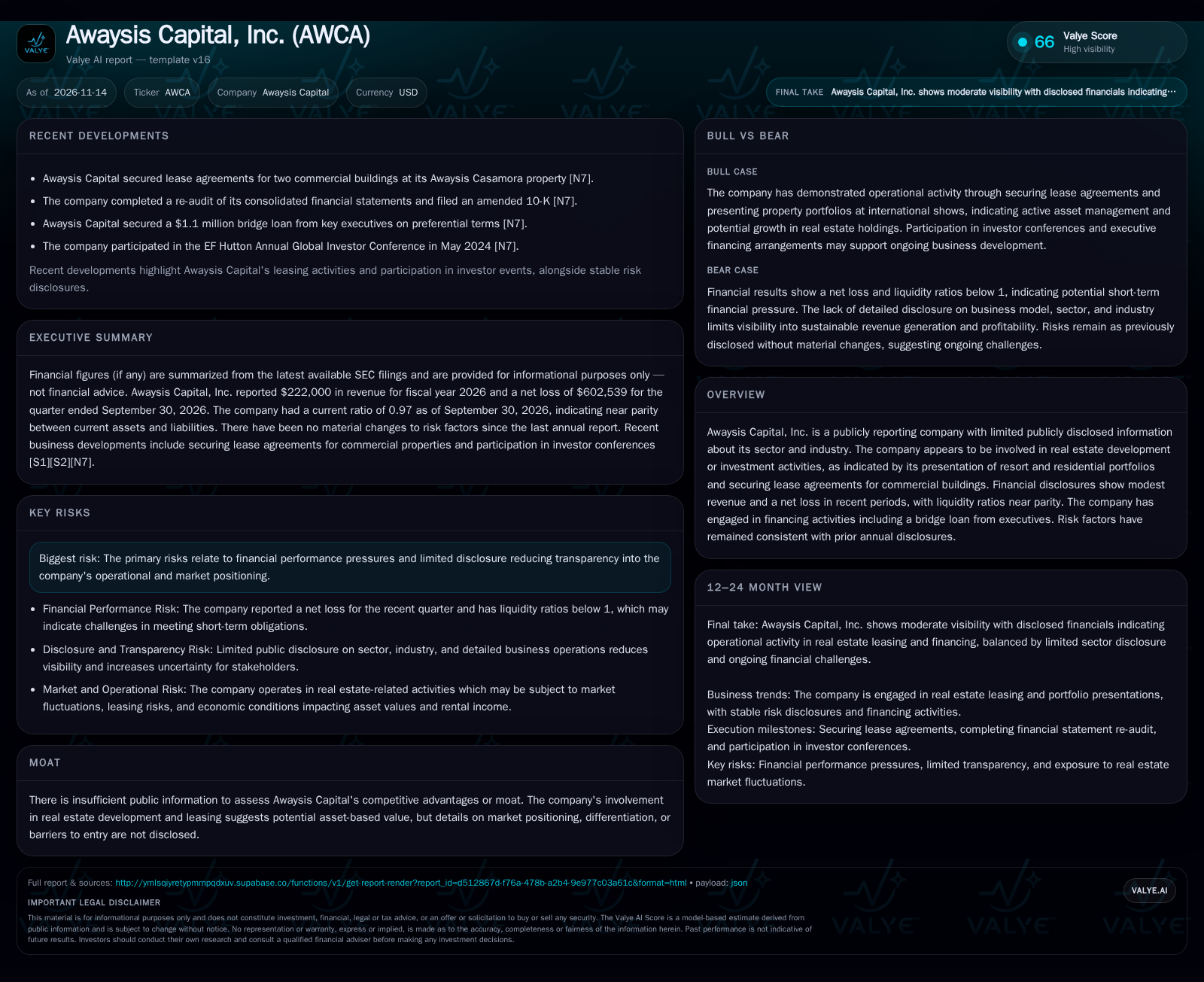
Awaysis Capital is advancing a real estate platform focused on vacation rental communities, with recent lease activity at its Casamora property and ongoing portfolio presentations. Despite these moves, its limited revenue, net losses, and a current ratio below 1 highlight significant financial pressures. The investment thesis rests on whether operational execution and asset monetization can outpace capital constraints and market risks in an opaque disclosure environment. [S1] [S2]
Awaysis Capital, Inc. is attempting to carve out a niche in the fragmented and capital-intensive world of vacation rental real estate, targeting undervalued communities for acquisition, development, and branded management. Recent moves—like new lease agreements at its Casamora property and active portfolio marketing—demonstrate operational intent. The tension between ambition and resource constraints defines the immediate outlook for Awaysis Capital.
Recent Lease Activity and Financial Position Frame Immediate Challenges
Awaysis Capital’s most tangible operational development has been securing lease agreements for two commercial buildings at its Casamora property, a step that suggests progress in activating owned assets for revenue generation. However, the company’s revenue for fiscal 2026 was only $222,000, and it posted a net loss of $602,539 in the most recent quarter [S1] [S2]. Liquidity is tight: as of September 30, 2026, the current ratio was 0.97 and the cash ratio was 0, indicating that current assets barely cover liabilities and immediate liquidity is negligible [S2]. A $1.1 million bridge loan from executives in late 2024 provided short-term funding but underscores the ongoing need for external capital. These facts collectively highlight a business at an early stage of asset monetization, contending with acute short-term financial pressures.
How Asset Repositioning and Rental Management Could Drive Profits—If Scale and Occupancy Are Achieved
Awaysis Capital’s business model centers on acquiring, upgrading, and repositioning undervalued residential and resort communities, relaunching them under the Awaysis brand, and generating returns through a mix of property sales and recurring rental income. In theory, this approach can deliver attractive margins if fixed acquisition and repositioning costs can be spread across a large, stabilized portfolio with high occupancy and effective yield management. The economics are highly sensitive to capital intensity and absorption rates: property acquisition, renovation, and compliance are front-loaded expenses, while rental and management revenues accrue over time.
Revenue composition is likely to be a mix of transaction-based income from property sales and ongoing property management or rental fees. If the company can scale its portfolio, operating leverage could improve as corporate overhead and brand costs are amortized across more units. However, with current revenue still modest and recent losses, Awaysis Capital remains in the heavy investment phase, heavily reliant on access to external capital to fund both development and working capital. The absence of recurring cash flows at scale leaves the business exposed to timing mismatches between outlays and realized income, especially in a cyclical or illiquid real estate market.
Fragmented Vacation Rental Market Limits Barriers—Brand and Asset Quality Must Differentiate
Awaysis Capital operates in a fragmented, intensely competitive market for vacation rentals and branded resort communities. The company faces competition from traditional hospitality chains, local property management firms, and tech-enabled platforms aggregating short-term rentals (such as Airbnb or Vrbo). Barriers to entry in property acquisition and management are low outside of capital constraints, meaning that asset location, quality, and brand reputation become the primary differentiators.
Awaysis Capital’s strategy to reposition undervalued assets and rebrand them under a unified identity could, if executed well, create a differentiated portfolio that appeals to both travelers and investors. However, the lack of scale, limited marketing resources, and unproven brand equity are significant counterforces. The company’s ability to secure favorable lease agreements and present assets internationally suggests some traction, but without a clear, recurring revenue base or demonstrable customer loyalty, competitive advantage remains theoretical.
Scaling Asset Monetization and Brand Recognition Could Unlock Operating Leverage
The most favorable scenario for Awaysis Capital is one where recent lease agreements at Casamora translate into sustained rental income, and the company successfully activates additional properties in its portfolio. As more units come online and occupancy rates rise, recurring cash flows could begin to cover fixed costs, allowing the company to achieve positive operating leverage. International portfolio presentations could yield new investor partnerships, joint ventures, or asset sales, providing both cash inflows and expanded brand reach.
Confirmation of this scenario would require evidence of: (1) material growth in rental or management revenue quarter-over-quarter, (2) successful absorption of new units with high occupancy rates, (3) additional lease or sales agreements beyond the Casamora property, and (4) reduced reliance on bridge loans or related-party financing. If Awaysis Capital can demonstrate a pattern of asset monetization and improved liquidity from organic operations, the platform could begin to scale in a way that validates its strategy.
Slow Asset Activation and Persistent Funding Needs Keep Business in Early Stage
The most plausible near-term outcome is that Awaysis Capital continues to activate its existing asset base gradually, with lease agreements and property launches occurring sporadically but not at a pace sufficient to offset ongoing operating losses. Revenue may grow incrementally, but the company will likely remain dependent on new capital infusions, either from executive loans, external investors, or asset sales. This scenario is characterized by continued tight liquidity, modest revenue growth, and a delicate balancing act between funding needs and asset monetization.
Evidence confirming this path would include minimal or inconsistent quarter-over-quarter revenue growth, recurring net losses, and continued bridge or related-party financing. Falsification would require a visible inflection in revenue and cash flow generation—particularly from recurring rental income—that reduces dependence on external funding.
Liquidity Crunch or Asset Underperformance Triggers Forced Sales or Restructuring
If asset activation lags, occupancy falls short, or market conditions deteriorate, Awaysis Capital could face an acute liquidity crunch. With a current ratio below 1 and negligible cash reserves, even modest delays in lease-up or property sales could force the company into distressed asset sales or restructuring. External shocks—such as regulatory changes in key jurisdictions, adverse tourism trends, or unexpected property expenses—could exacerbate these pressures.
This scenario would be confirmed by continued or widening net losses, a shrinking portfolio due to asset liquidations, escalating payables, or the inability to secure further bridge financing. If disclosed, signs such as property foreclosures, default notices, or staff reductions would indicate the thesis is playing out on the downside.
Milestones and Metrics That Will Clarify Whether Awaysis Capital Can Scale Its Platform
Quarterly growth in rental and property management revenue—if disclosed—would provide a direct test of asset monetization progress.
Occupancy rates and average daily rates (ADR) for leased or managed properties; these would illuminate whether activated assets are generating sustainable cash flow.
Number of new lease agreements, property launches, or acquisitions completed each quarter, indicating the pace of portfolio expansion.
Recurring net losses or a shift toward operating income; a move toward break-even would suggest improved business health.
Trends in current liabilities and bridge loan balances—persistent increases could foreshadow liquidity stress.
Disclosure of third-party or institutional financing (beyond executive bridge loans), which would validate external confidence in the asset base.
Any regulatory or legal developments affecting property operations in Belize, Florida, or other target jurisdictions.
Disclaimer: This is research-only, informational analysis and not investment advice. It may include AI-generated interpretation and general industry context. Always verify important details using primary sources.

Comments