
Fifth Era Acquisition Corp I: SPAC Ambitions, Liquidity Constraints, and the Stakes of Tech-Driven Deal Sourcing
The management’s industry pedigree and network may enable access to high-quality targets, but the absence of independent valuation, potential conflicts of interest, and a looming redemption/liquidation clock sharpen the focus on deal selection, structure, and shareholder alignment.
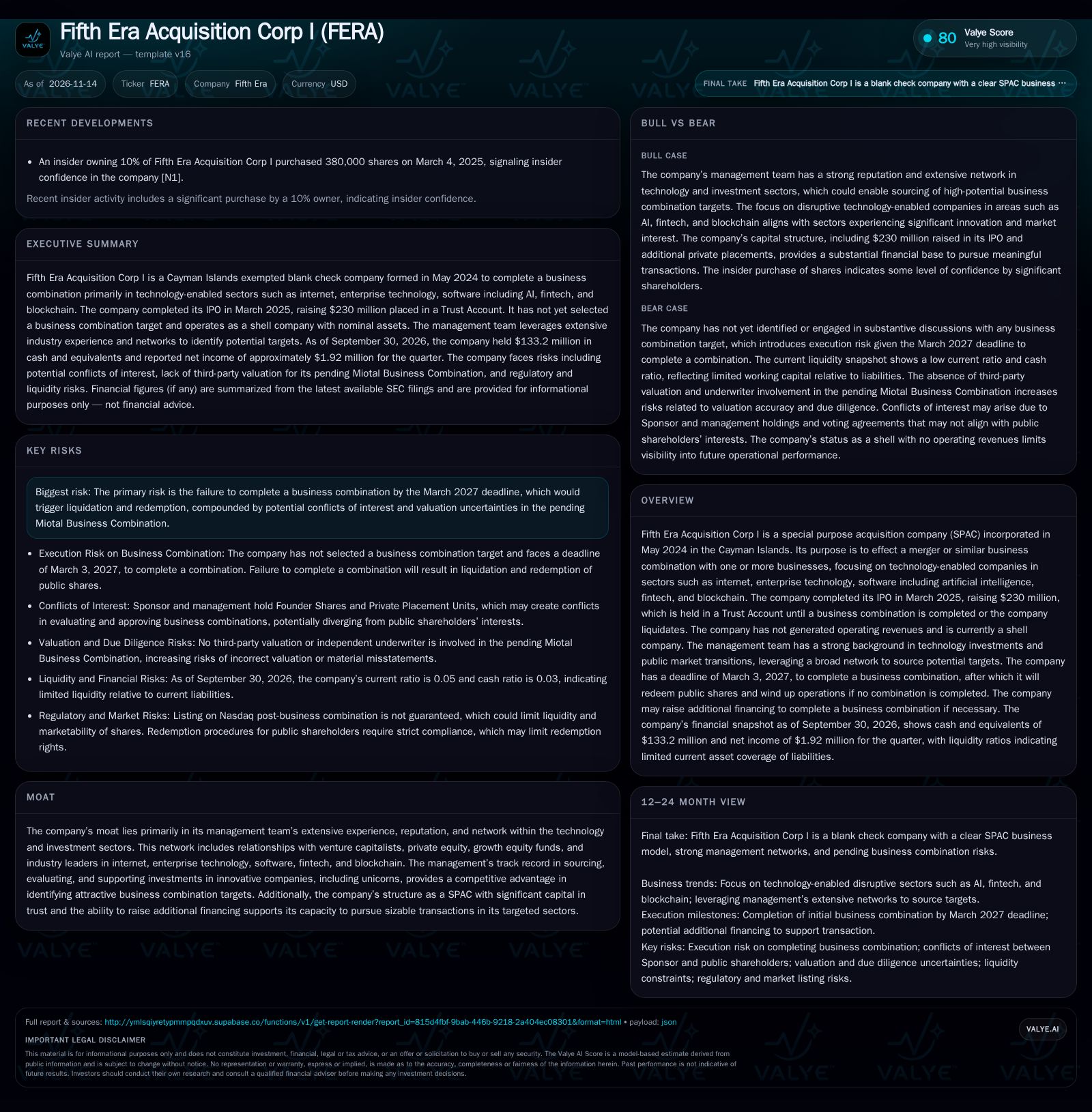
Fifth Era Acquisition Corp I, a technology-focused SPAC, has yet to finalize a business combination despite substantial trust capital from its $230 million IPO. Management’s deep tech investment background could help source a compelling target, but risks around conflicts of interest, due diligence rigor, and shareholder redemptions remain elevated as the SPAC approaches critical deadlines. [S2] [N1]
Fifth Era Acquisition Corp I epitomizes the late-stage SPAC dilemma: substantial trust capital remains earmarked for a technology-enabled business combination, yet the clock is ticking on regulatory deadlines and shareholder patience. Management’s enviable network and sector expertise could unlock access to high-growth targets in AI, fintech, and blockchain, but the absence of a finalized deal, reported liquidity position relative to liabilities, and the lack of third-party valuation for the pending Miotal Business Combination raise the stakes for execution and governance. As redemption and liquidation thresholds loom, the next moves will determine whether Fifth Era transforms into a durable public tech platform—or joins the ranks of SPACs forced to unwind.
Material Developments: IPO Proceeds, Pending Deal, and Liquidity Compression
Fifth Era Acquisition Corp I completed its $230 million IPO in March 2025, placing proceeds in a U.S.-based trust account to fund a future business combination. As of September 30, 2026, the company had $133.2 million in cash and equivalents and $224.9 million in current assets, but current liabilities totaled $4.51 billion, yielding a current ratio of just 0.05 and a cash ratio of 0.03. Despite these liquidity constraints, Fifth Era reported net income of approximately $1.92 million for the quarter. The company has not yet selected or announced a definitive business combination target, though the Miotal Business Combination is pending without third-party valuation or underwriter involvement. These facts underscore a classic SPAC tension: ample trust capital versus mounting time and liquidity pressures, with execution risk heightened by the lack of independent deal validation and the potential for substantial shareholder redemptions. [S2] [N1]
SPAC Mechanics: Trust Asset Economics, Redemption Dynamics, and the Cost of Delay
Fifth Era’s business model is typical of SPACs: it earns minimal operating income and exists primarily to merge with a private company, transferring trust proceeds to the target in exchange for public shares. The economics are fundamentally binary—either a business combination is consummated, creating a new public entity with access to trust capital (minus redemptions and transaction costs), or the SPAC liquidates and returns remaining funds to shareholders. The $230 million trust was originally intended to provide a substantial acquisition 'currency,' but redemptions and expenses can sharply reduce available proceeds, especially if public shareholders lose confidence or see better alternatives elsewhere.
Operating leverage and capital needs post-merger will depend entirely on the target’s underlying business model. For now, Fifth Era’s cost structure is dominated by administrative, legal, and compliance expenses, with minimal revenue-generating activity. The company reported cash and liquidity metrics for the period; these figures do not by themselves establish operating runway, investment capacity, financial flexibility, or financing capacity.
If a deal closes, the economics hinge on the target’s growth prospects, scalability, and the ability to leverage public markets for further capital—particularly relevant in tech sectors where rapid scaling and capital intensity are common. However, absent a disclosed target, these economics remain hypothetical and highly sensitive to deal terms, redemption levels, and market conditions at the time of the merger.
Sourcing Advantage or Crowded Field? Management Networks Versus SPAC Market Saturation
Fifth Era’s primary competitive advantage lies in its management team’s reputation and network within technology investing, venture capital, and public market transitions. This could provide privileged access to high-quality, late-stage private companies—particularly in coveted verticals like AI, fintech, and blockchain. In theory, this sourcing edge could yield a business combination with a more compelling growth or innovation profile than the average SPAC transaction.
However, the broader SPAC landscape is highly competitive, with dozens of technology-focused blank-check companies also chasing a limited pool of attractive targets. As the SPAC market has matured, targets have gained bargaining power, often demanding founder-friendly terms, high valuations, or substantial retained equity. Furthermore, the absence of a third-party valuation or independent underwriter in the pending Miotal Business Combination increases the risk of overpaying or missing critical diligence issues—potentially eroding any sourcing advantage.
Competition also comes from traditional IPOs, direct listings, and private capital, which may offer faster access to liquidity or less dilution. Ultimately, Fifth Era’s ability to secure a differentiated target—at an attractive valuation and with strong post-merger prospects—will determine whether its network translates into sustainable advantage or is offset by market saturation and adverse selection.
Unlocking Value: If Management’s Network Delivers a High-Growth Tech Merger
The favorable scenario for Fifth Era hinges on its management team leveraging industry relationships to secure a business combination with a disruptive, high-growth technology company. If the target demonstrates strong revenue momentum, defensible market position, and scalable unit economics, the transaction could generate outsized value for both public shareholders and the sponsor. The post-merger entity would benefit from public market access, enabling further capital raises, strategic M&A, or accelerated R&D.
Evidence confirming this scenario would include announcement of a business combination with a widely recognized, fast-growing tech company in AI, fintech, or blockchain; independent validation of the target’s financials and growth prospects; limited shareholder redemptions (signaling confidence in the deal); and post-merger performance exceeding public projections. Falsification would occur if the announced target lacks clear differentiation, faces structural headwinds, or if redemptions materially deplete trust proceeds, undermining the growth thesis.
Navigating Execution and Redemption Risk as the SPAC Clock Winds Down
The most plausible near-term scenario is that Fifth Era announces and seeks to close a business combination—possibly with Miotal or a similar tech-enabled target—under conditions of heightened scrutiny and substantial redemption risk. Shareholder alignment is complicated by the sponsor’s voting agreement and potential conflicts of interest, while the absence of third-party valuation may stoke skepticism regarding deal fairness.
If the deal advances, the level of public shareholder redemptions will be critical: high redemptions could leave the post-merger company undercapitalized, while low redemptions would signal confidence and preserve the ability to execute the growth plan. The outcome will also hinge on regulatory compliance (especially Nasdaq listing requirements) and the ability to resolve any litigation or claims against the trust account.
Confirmation of this scenario would entail a deal announcement, a proxy process with robust shareholder engagement, and finalization of the merger with a moderate but manageable level of redemptions. Falsification would be evident if the SPAC is unable to secure shareholder approval, if redemptions are so high that the merger becomes unviable, or if regulatory or legal hurdles force liquidation.
Deal Failure, High Redemptions, and the Liquidation Trap
The adverse scenario materializes if Fifth Era fails to complete a business combination within the regulatory timeline, or if announced terms are viewed unfavorably by public shareholders, resulting in overwhelming redemptions. In this case, the trust account would be liquidated and distributed to shareholders, and the sponsor’s founder shares would become worthless.
Other downside triggers include unresolved claims against the trust account, failure to meet Nasdaq listing requirements, or post-announcement due diligence revealing material issues with the target. The lack of independent valuation further amplifies the risk of adverse selection and post-merger disappointment.
Evidence supporting this scenario would be a lack of credible deal activity as deadlines approach, proxy materials indicating tepid shareholder support or rising redemption intentions, or regulatory developments signaling non-compliance. Conversely, a credible, independently validated target announcement and strong shareholder engagement would undermine the downside thesis.
Testing Fifth Era’s Deal Thesis: Milestones That Will Separate Success from Liquidation
Announcement of a definitive business combination agreement, including detailed target financials, sector fit, and rationale for selection.
Level of public shareholder redemptions at the time of deal approval—a critical measure of market confidence and post-merger capitalization.
Disclosures regarding independent valuation, fairness opinions, or third-party diligence on the target (if disclosed), which would help test deal rigor.
Progress toward meeting Nasdaq listing and regulatory requirements through and after the business combination process.
Resolution of any litigation, claims, or contingent liabilities that could erode trust account assets prior to deal closure.
Disclosure of post-merger capital structure, including any PIPE (private investment in public equity) financings or debt arrangements.
Monitoring insider/sponsor transactions or changes in voting/lock-up agreements, as these could signal shifts in alignment or deal confidence.
Updates on the timeline for closing the business combination versus approaching the 36-month SPAC deadline.
Disclaimer: This is research-only, informational analysis and not investment advice. It may include AI-generated interpretation and general industry context. Always verify important details using primary sources.

Comments