
Woodbridge Liquidation Trust: Asset Sales and Litigation Shape Bankruptcy Recovery Prospects
Woodbridge Liquidation Trust manages the complex wind-down of assets from a high-profile Ponzi scheme bankruptcy, with progress and distributions currently halted by a major construction defect claim. The outcome of this litigation—and the Trust’s ability to efficiently liquidate real estate holdings—will determine ultimate recoveries for Interestholders.
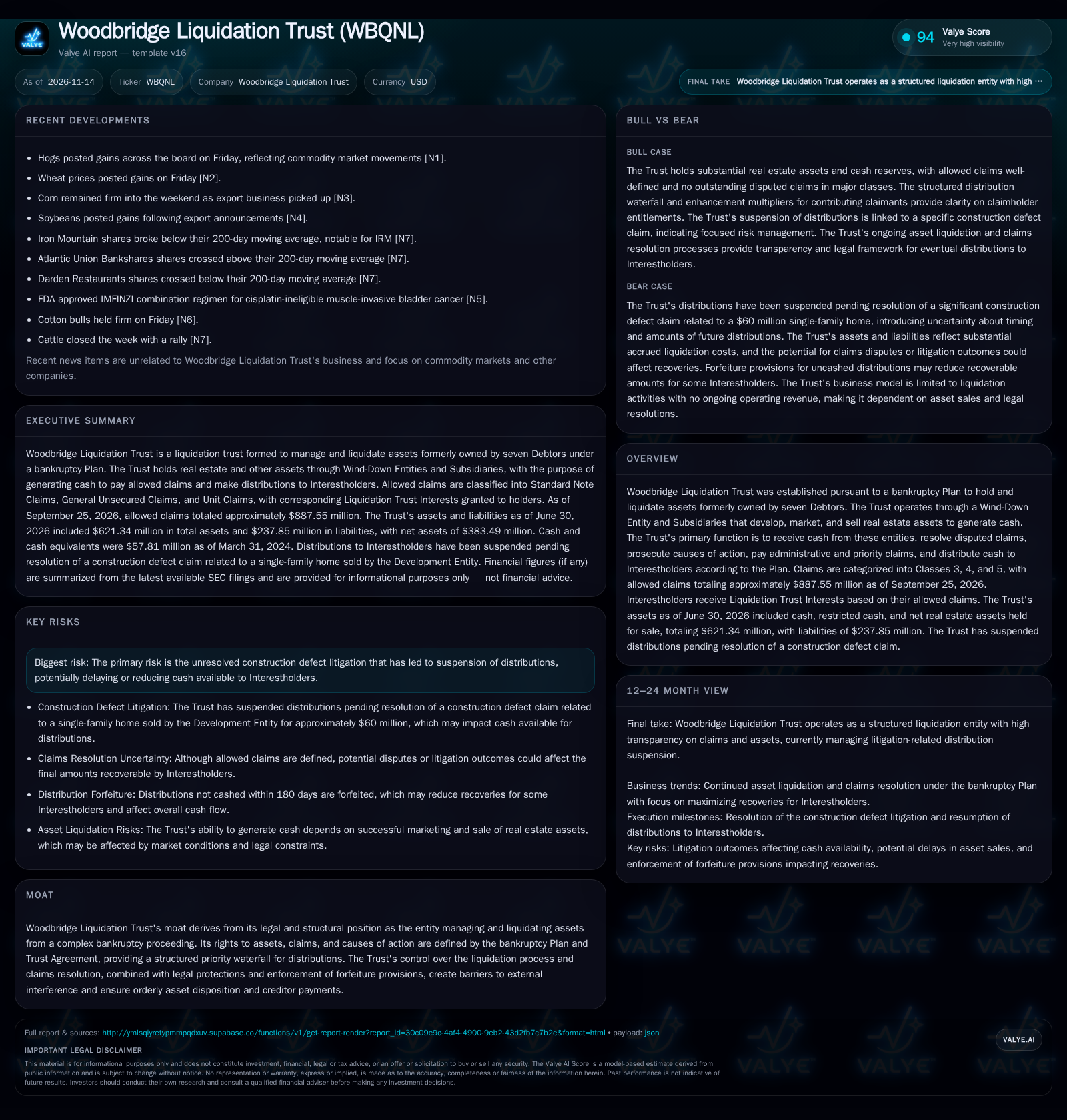
Woodbridge Liquidation Trust’s asset monetization and cash distributions are on hold pending resolution of a significant construction defect claim tied to a $60 million property sale. The Trust holds $621 million in assets against $888 million in allowed claims, with a clearly structured distribution waterfall and substantial accrued liquidation costs. Final outcomes hinge on litigation, real estate market conditions, and the pace of claim resolutions. [S1] [S2]
Woodbridge Liquidation Trust sits at the intersection of legal process, asset monetization, and creditor recovery, emerging from one of the largest real estate Ponzi schemes in recent memory. The Trust’s mandate is to maximize cash recoveries for thousands of defrauded investors by liquidating a portfolio of real estate and related assets, while navigating a complex web of claims and litigation. With distributions currently frozen due to a major construction defect dispute, the Trust’s progress will be shaped by both external legal outcomes and its ability to convert illiquid holdings into distributable cash.
Distributions Frozen as Construction Defect Litigation Drives Near-Term Uncertainty
As of June 30, 2026, Woodbridge Liquidation Trust reported $621.34 million in total assets—including $582.71 million in net real estate held for sale and $36.02 million in cash and equivalents—against $237.85 million in liabilities, yielding net assets of $383.49 million for Interestholders. However, all distributions have been suspended since August 3, 2023, due to a pending construction defect claim involving a $60 million single-family home previously sold by the Trust’s Development Entity. This litigation introduces substantial uncertainty around the timing and magnitude of future recoveries for Interestholders, whose $887.55 million in allowed claims are prioritized through a defined distribution waterfall. The Trust continues to enforce strict forfeiture rules for uncashed distributions, adding another layer of complexity to final payouts. [S2]
Asset Liquidation Economics and Cost Structures in a Court-Supervised Wind-Down
The Trust’s economic model is dictated by the bankruptcy Plan: it does not generate recurring revenue, but instead seeks to maximize recovery through the orderly sale of real estate and other assets inherited from the Debtors. Proceeds are collected by a Wind-Down Entity and funneled into the Trust, which allocates cash through a strict distribution hierarchy—first repaying principal to Class A and B Interestholders, then compounding interest, and finally any subordinated claims.
The Trust faces substantial fixed and variable costs, most notably $232.07 million in accrued liquidation expenses as of June 30, 2026. These include legal fees, asset management, property marketing, and administrative overhead. Because costs are front-loaded and the asset pool is finite, every dollar spent on litigation or asset management directly reduces the pool available for distribution. There is no operating leverage in the traditional sense; instead, efficiency in asset sales and claims resolution drives ultimate value for Interestholders.
Capital needs are limited to covering ongoing legal and administrative costs until all assets are liquidated and claims resolved. There is no ongoing business reinvestment or growth spending, but delays (such as those caused by litigation) can increase cumulative costs and erode net recoveries.
Structural Protections and External Risks in Bankruptcy Asset Liquidation
Woodbridge Liquidation Trust’s competitive position is defined by its legal authority and Plan-mandated control over the asset pool, rather than by commercial competition. The Trust’s ‘moat’ comes from court oversight, the Plan’s distribution waterfall, and exclusive rights to pursue claims and causes of action related to the former Debtors.
However, the Trust is exposed to risks common to asset liquidations: real estate market volatility, legal challenges to asset ownership or sales, and the unpredictability of litigation outcomes. While there are no direct commercial substitutes, the Trust must optimize its asset disposition process against these counterforces. Its ability to enforce forfeiture provisions and prioritize distributions provides some insulation from external interference, but does not shield Interestholders from the impact of market downturns or adverse legal rulings.
Peer comparisons are limited; other bankruptcy liquidation trusts may offer reference points, but each is highly idiosyncratic, shaped by its asset mix, claims structure, and litigation environment.
Litigation Resolution Unlocks Asset Monetization and Accelerated Distributions
If the construction defect claim is resolved favorably—either through a settlement or a court ruling that limits Trust liability—distributions could resume quickly, releasing significant cash to Interestholders. A positive legal outcome would also enable the Trust to accelerate remaining real estate sales without the overhang of contingent liabilities, potentially improving market prices and reducing holding costs.
Further upside could come from successful recoveries on outstanding causes of action, or from real estate sales above current book value, especially if market conditions are favorable. The Trust’s clear distribution formulas ensure that any incremental gains flow predictably to Interestholders.
Evidence for this scenario would include public disclosure of a settled or dismissed construction defect claim, resumed or increased distributions, and asset sale proceeds exceeding conservative appraisals. A reduction in accrued liquidation costs or a narrowing gap between gross and net asset values would further confirm upside progress.
Gradual Real Estate Liquidation Amid Protracted Claims Resolution
The most plausible trajectory is a drawn-out wind-down, with periodic asset sales and incremental claims resolutions punctuated by ongoing legal expenses. In this scenario, the construction defect litigation is eventually resolved, but not before incurring additional costs and delay. Real estate assets are sold opportunistically, but may face price pressure from market conditions or the need for expedient liquidation.
Interestholders receive distributions in tranches as cash becomes available, with the total recovery reflecting both asset sale outcomes and cumulative liquidation costs. The waterfall structure ensures that principal claims are repaid first, but the compounding of legal and administrative expenses may erode ultimate payouts relative to initial allowed claims.
Progress in this scenario would be evidenced by intermittent asset sale disclosures, gradual reductions in real estate assets held for sale, periodic updates on major litigation, and resumption of distributions following claim resolutions.
Adverse Litigation Outcome and Asset Sale Weakness Erode Recoveries
The downside scenario is characterized by an unfavorable resolution of the construction defect litigation—either a large judgment or costly settlement—that consumes a significant portion of available cash, amplifies legal costs, and forces asset sales under distressed conditions. Protracted litigation could further delay distributions and increase total liquidation expenses.
Simultaneously, if the real estate market weakens or specific properties prove difficult to sell, the Trust may be compelled to accept discounts, further shrinking the distributable pool. Additional claims disputes or unexpected liabilities could exacerbate the drain on resources.
Confirmation of this scenario would come from adverse legal disclosures, steep increases in accrued liquidation costs, downward revisions to asset values, and continued suspension or reduction of distributions over multiple periods.
Milestones That Will Shape Woodbridge Liquidation Trust Outcomes
Resolution status and ultimate outcome of the construction defect litigation tied to the $60 million property sale.
Timing, magnitude, and frequency of resumed cash distributions to Class A and B Interestholders once litigation is resolved.
Trends in real estate assets held for sale—rate of disposition, realized sale prices versus book values, and any impairments recognized.
Changes in accrued liquidation costs, especially legal and administrative expenses, as a percentage of total assets.
Emergence or resolution of additional material claims, disputes, or causes of action that could affect available cash.
Enforcement and financial impact of forfeiture provisions for uncashed distributions, if disclosed.
Transparency and regularity of Trust communications regarding asset sales, claims resolutions, and distribution status.
Disclaimer: This is research-only, informational analysis and not investment advice. It may include AI-generated interpretation and general industry context. Always verify important details using primary sources.

Comments