
RYVYL Inc.: Merging Fintech Ambitions with Digital Media and Crypto Volatility
RYVYL's transformation through its merger with RTB Digital creates a complex entity straddling fintech payment processing, digital media SaaS, and material Bitcoin holdings. The company's focus on higher-risk merchant verticals and internally developed platforms offers differentiation, but persistent operating losses, integration challenges, and crypto-linked uncertainty raise fundamental questions about long-term value creation.
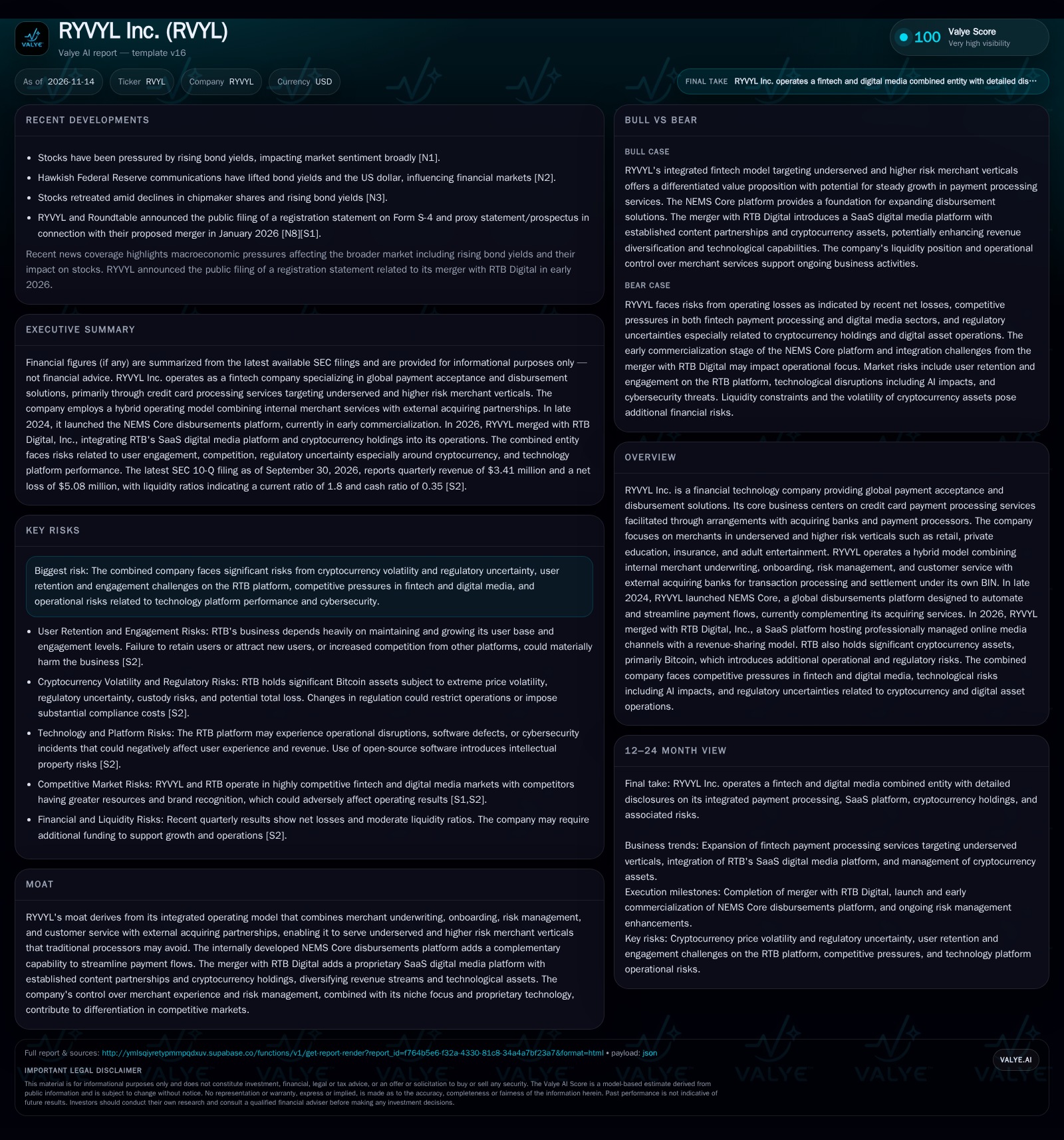
RYVYL Inc. now integrates a niche fintech payment platform, a digital media SaaS business, and significant crypto assets. While the company targets underserved merchant sectors and has expanded its product suite, it continues to post quarterly losses and faces heightened operational, regulatory, and integration risks. The success of its hybrid model will depend on execution in payment processing, user engagement in digital media, and prudent management of volatile crypto assets [S1] [S2].
RYVYL Inc. now stands at the intersection of three volatile industries: fintech payment processing, digital media SaaS, and cryptocurrency asset management. Following its merger with RTB Digital in mid-2026, the company combines its legacy focus on high-risk merchant payments with a digital media platform dependent on user engagement and advertising, all underpinned by significant Bitcoin holdings. This multifaceted strategy offers the potential for diversified revenue streams and technological leverage—but exposes RYVYL to amplified operational, regulatory, and market risks. The next phase hinges on integrating these businesses while stemming persistent losses and navigating the unpredictable tides of crypto and digital advertising.
Merger Reshapes RYVYL’s Risk and Revenue Profile
The most material change in RYVYL’s business is the completed merger with RTB Digital, Inc. in May 2026. This transaction folds a SaaS digital media platform and substantial Bitcoin holdings into RYVYL’s legacy fintech payment processing activities [S1] [S2]. The company reported $3.41 million in revenue and a net loss of $5.08 million for the quarter ended September 30, 2026, with cash and equivalents at $3.51 million and a current ratio of 1.8 [S2]. RTB’s platform monetizes digital content through advertising and subscriptions, while also holding significant Bitcoin assets—exposing the company to crypto price swings and regulatory uncertainty [S2]. These developments mark a pivot from a pure-play fintech to a hybrid digital media and fintech entity with heightened financial and operational complexity.
Revenue Streams: Payment Processing Margins Meet Digital Platform Volatility
RYVYL’s core fintech business generates revenue through credit card processing fees, targeting underserved and higher-risk merchant verticals such as retail, private education, insurance, and adult entertainment. These segments often face higher transaction fees and risk-adjusted pricing, which can support above-average gross margins if underwriting and fraud losses are controlled. The company’s hybrid model internalizes merchant onboarding, underwriting, and risk management, while relying on third-party acquiring banks for transaction settlement [S1]. This structure can allow for tighter control of risk costs but also concentrates operational dependency on key partners.
The recently launched NEMS Core platform aims to automate and streamline payment flows—potentially unlocking incremental take rates or cross-selling opportunities if merchant adoption accelerates. However, as NEMS Core is in early commercialization, its revenue contribution and margin profile remain uncertain.
RTB’s SaaS media platform introduces a new stream: digital advertising and subscription revenues, split with content creators. This business is typically high operating leverage—platform costs are largely fixed, while incremental users and advertisers drive gross margin expansion. However, digital ad markets are highly cyclical and sensitive to shifts in user engagement, algorithm changes, and advertiser demand. The addition of Bitcoin assets adds a non-operating, mark-to-market component to reported results, amplifying volatility without directly contributing to core operating cash flows [S2].
Niche Merchant Focus and Platform Ownership Offer Differentiation—but Not Immunity
RYVYL’s competitive positioning in payment processing stems from its willingness to serve higher-risk merchant categories that traditional processors often avoid. This niche focus can yield pricing power but also exposes the company to elevated fraud risk, regulatory scrutiny, and potential customer churn if risk is poorly managed. The hybrid model—combining internal controls with external acquiring—enables customization but may limit scalability compared to fully integrated or larger-scale competitors.
In digital media, RTB’s proprietary platform competes with established SaaS content and streaming providers, many of whom benefit from larger user bases and deeper advertiser relationships. The revenue-sharing arrangement with Platform Partners is standard in the industry, but user retention and content quality remain critical differentiators.
The presence of significant Bitcoin holdings is unusual among payment processors or SaaS platforms, introducing idiosyncratic risk rather than a clear competitive advantage. While crypto assets could offer a speculative balance-sheet boost in bull markets, they also expose RYVYL to regulatory, custody, and reputational risks that most sector peers actively avoid [S2].
Unlocking Synergy: If Platforms Scale and Crypto Surges
The bullish scenario for RYVYL hinges on the successful integration of fintech and digital media operations, with both platforms scaling in parallel. If the NEMS Core platform achieves wide merchant adoption, RYVYL could increase its share of payment flows and diversify beyond traditional credit card processing. Simultaneously, if RTB’s SaaS platform grows its user base and attracts premium advertisers, operating leverage could drive improved margins and positive cash flow.
A further upside lever is the potential appreciation of Bitcoin holdings, which could enhance the balance sheet and provide headline financial gains—though these are not core to operating performance. Confirmation of this scenario would include accelerating payment volume growth, visible adoption of NEMS Core, rising digital platform user metrics and advertising revenue, and a sustained or rising Bitcoin price [S2]. Falsification would be evident in stagnant or declining payment volumes, digital user churn, and ongoing net losses despite favorable crypto moves.
Integration Challenges and Persistent Losses Define the Near Term
The most plausible outcome is a period of operational integration, moderate growth in core payment processing, and continued volatility in reported results due to the Bitcoin mark-to-market effect. The NEMS Core platform may provide incremental growth, but merchant adoption could be gradual given the company’s focus on riskier segments and the need for robust onboarding and compliance processes.
RTB’s digital media platform may face the headwinds typical of mid-tier SaaS players: user attrition, algorithmic changes by search engines, and cyclical advertising demand. The company is likely to continue posting net losses in the near term as it invests in technology and customer acquisition, with liquidity remaining only moderately above current liabilities [S2]. This scenario would be confirmed by stable-to-slowly growing payment volumes, limited digital platform growth, and quarterly losses offset by occasional crypto-driven swings.
Crypto Volatility and Platform Underperformance Compound Financial Strain
A bearish scenario materializes if RYVYL’s core payment processing stagnates or deteriorates—perhaps due to regulatory tightening, increased fraud losses, or competitive pricing pressure. If NEMS Core fails to gain merchant traction, or if underwriting missteps result in outsized chargebacks, the company could face revenue compression and rising losses.
On the digital side, declining user engagement on RTB’s platform—potentially triggered by shifting content trends, loss of key Platform Partners, or unfavorable changes in search and ad algorithms—could erode advertising revenue. Compounding these risks, a significant drop in Bitcoin prices would reduce asset values, potentially trigger impairment charges, and raise questions about overall financial resilience [S2]. Confirmation would be negative payment volume trends, rising chargeback or fraud costs, digital platform user attrition, and sustained or deepening operating losses.
Testing the RYVYL-RTB Thesis: Metrics and Developments to Scrutinize
Quarterly growth in payment processing volume and merchant count, especially in the higher-risk verticals RYVYL targets, would help test whether the company can scale its core business.
Adoption rates and transaction activity on the NEMS Core disbursements platform, if disclosed, would provide insight into the platform’s commercial traction and incremental revenue contribution.
User engagement and retention metrics on RTB’s SaaS platform—such as monthly active users, time spent, and churn rates—would clarify the sustainability of digital media revenues.
Advertising revenue per Platform Partner and changes in the number or quality of content partnerships would reflect the platform’s value to both creators and advertisers.
The mark-to-market value of Bitcoin holdings and the company’s approach to crypto risk management, including custody and hedging practices, remain crucial given the asset’s volatility [S2].
Quarterly net cash flow and changes in liquidity ratios would indicate whether the company is approaching operational self-sufficiency or may require new capital.
Incidents of material chargebacks, fraud losses, or regulatory actions within the payment processing business would signal risk management effectiveness.
Any disclosures about integration costs or synergies realized from the RTB merger would help clarify the true economic impact of the transaction.
Disclaimer: This is research-only, informational analysis and not investment advice. It may include AI-generated interpretation and general industry context. Always verify important details using primary sources.

Comments