
Canary Marinade Solana ETF: Staking-Driven ETF Mechanics, Ecosystem Leverage, and the Stakes of Blockchain Volatility
Canary Marinade Solana ETF (SOLC) offers exchange-traded exposure to Solana (SOL), combining direct SOL holdings with a staking strategy to generate incremental returns. The ETF’s prospects hinge on Solana’s network health, staking economics, and the evolving landscape of digital asset investment products.
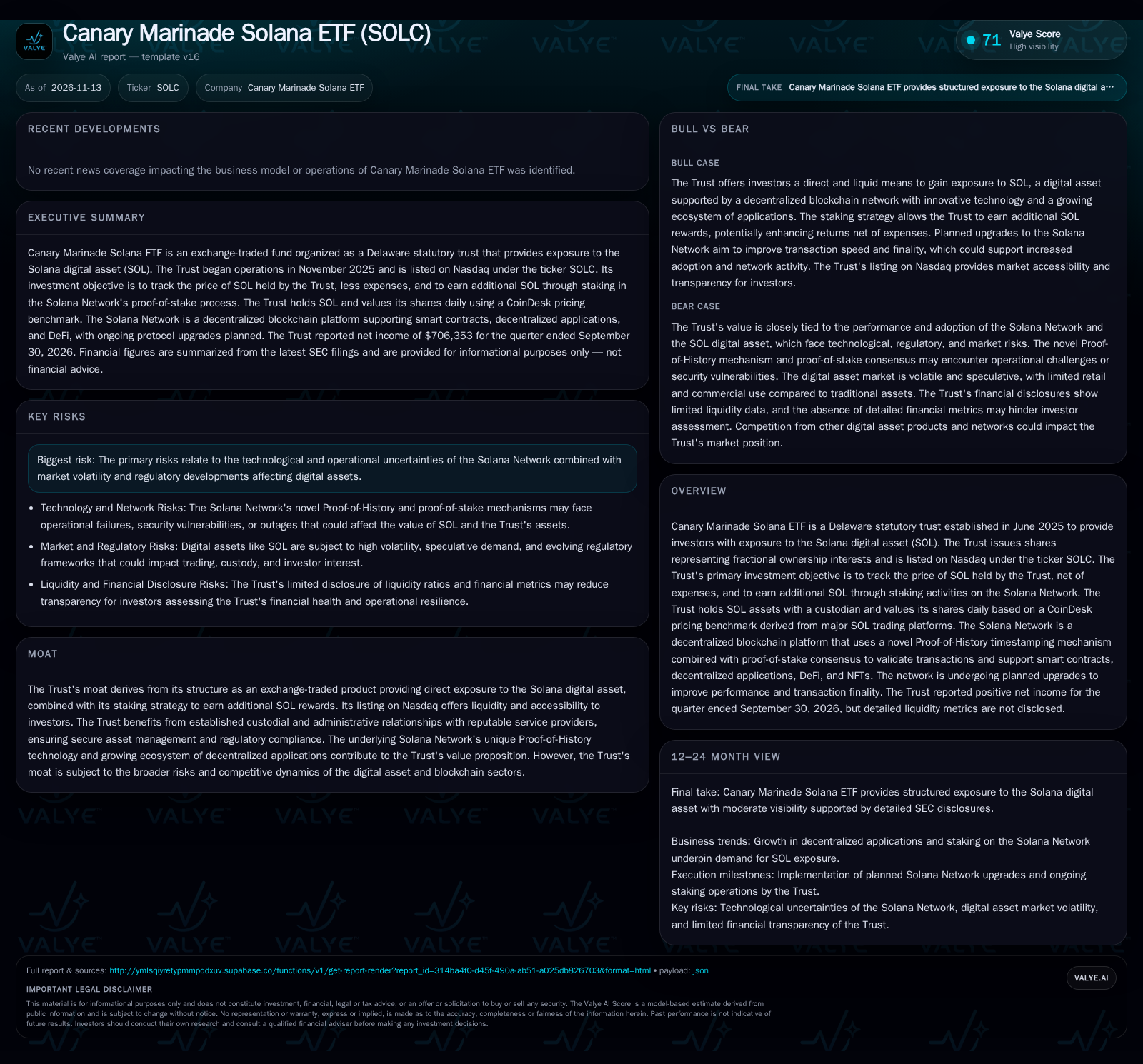
Canary Marinade Solana ETF provides fractionalized, exchange-traded access to SOL and its staking rewards, leveraging the expanding Solana ecosystem. The ETF’s performance is tightly linked to SOL’s market price, staking yields, and blockchain reliability, while competitive and regulatory uncertainties pose ongoing risks. Recent quarterly net income reflects positive early operations, but limited financial transparency remains a watchpoint for investors. [S2]
Canary Marinade Solana ETF (SOLC) seeks to provide a liquid, exchange-traded vehicle for investors to access the return profile of Solana (SOL), enhanced by staking rewards. The fund’s structure—fractionalized ownership of SOL, daily valuation, and a Nasdaq listing—targets both crypto-native and traditional investors seeking blockchain exposure without direct wallet management. Its early positive income result underscores the potential of staking as a yield enhancer, but the ETF’s fortunes are inextricably linked to Solana’s network integrity, market demand for SOL, and the broader regulatory climate. With limited financial detail disclosed, investors must weigh the appeal of staking-driven returns against the inherent volatility and operational risks of the underlying blockchain.
Recent Performance and Structural Footing: What Stands Out
Canary Marinade Solana ETF began operations in November 2025 as a Delaware statutory trust and is listed on Nasdaq under the ticker SOLC, providing exchange-traded access to the Solana (SOL) digital asset. The ETF’s quarterly net income of $706,353 for the period ending September 30, 2026, marks a positive start to operations. This net income reflects both the appreciation of SOL and the additional yield generated by staking activities on the Solana Network. The company reported cash and liquidity metrics for the period; these figures do not by themselves establish operating runway, investment capacity, financial flexibility, or financing capacity. The ETF’s structure—fractional beneficial interest, daily valuation via a widely used benchmark, and institutional-grade custody—positions it as a mainstream vehicle for SOL exposure. [S2]
How Staking and ETF Mechanics Shape Revenue Potential
The ETF’s economics are driven by two primary factors: the market value of SOL held in custody and the incremental staking rewards earned by participating in the Solana Network’s proof-of-stake consensus. Unlike traditional ETFs that may track equity or commodity indices, SOLC’s returns stem directly from the market performance of SOL, less fund expenses and liabilities. Staking provides a unique yield component—validators on Solana receive rewards funded by protocol inflation and transaction fees, with distributions typically occurring every two to three days. The Trust’s intention to stake all SOL assets may enhance net returns, provided staking yields remain attractive and operational risks (such as slashing or downtime penalties) are managed.
Operating expenses likely include custody, administration, insurance, audit, and sponsor fees, which are deducted from gross returns. The structure allows daily redemption and creation in large blocks (Baskets), supporting liquidity but also exposing the Trust to potential inflows/outflows that could affect operational efficiency. If staking yields decline or network disruptions occur, the ETF’s income generation could be materially affected.
ETF Structure Versus Competing Digital Asset Vehicles
SOLC’s competitive positioning is anchored in its ability to offer regulated, exchange-traded exposure to SOL, supplemented by staking-derived yield. This differentiates it from non-staking crypto ETFs, closed-end trusts, or direct wallet holdings that may not provide yield enhancement. However, the ETF faces competition from both within the Solana ecosystem (other Solana-focused funds or staking services) and from broader digital asset products tracking Bitcoin, Ethereum, or multi-asset baskets. The ETF’s Nasdaq listing and institutional-grade custodianship are likely to appeal to investors who prioritize regulatory compliance and operational security.
Counterforces include the ease of direct staking for crypto-native investors, the proliferation of rival staking-enabled ETFs, and the risk that regulatory changes could restrict staking or digital asset custody for registered funds. Substitution risk is heightened by the rapid innovation in decentralized finance (DeFi), where new mechanisms for yield or risk management could outcompete traditional ETF structures. The underlying Solana Network’s technological reputation—bolstered by its Proof-of-History consensus and active DApp ecosystem—may confer a temporary advantage, but this is contingent on continued network reliability and developer engagement.
If Solana Network Upgrades Unlock Adoption and Yield
A favorable trajectory for SOLC hinges on the successful implementation of planned Solana Network upgrades, such as the Alpenglow Consensus Protocol, which aim to improve transaction speed and finality. If these upgrades lead to increased network activity, expanding DApp and DeFi adoption, and higher transaction volumes, demand for SOL may rise, driving up both the asset’s price and staking rewards. The ETF’s strategy to stake all SOL could then magnify returns relative to passive holding vehicles.
Confirmation of this scenario would require evidence of sustained or rising staking yields, growing total value locked (TVL) in Solana-based DeFi platforms, and resilience of the Solana Network in the face of high transaction loads. Additional supporting signals would include increased ETF inflows, narrowing discounts (or persistent premiums) to NAV, and positive tracking error versus spot SOL performance. Falsification would occur if network upgrades are delayed, DApp growth stalls, or staking yields decline materially.
Normal Volatility, Marginal Yield: What Most Likely Plays Out
The most plausible outcome is that SOLC largely mirrors the volatility and return profile of SOL, with staking rewards providing a modest yield enhancement that is partially offset by fund expenses. The ETF’s liquidity and accessibility support steady investor participation, but the inherent volatility of digital assets and periodic network disruptions on Solana likely lead to fluctuating returns. Staking yields may trend lower over time as network inflation tapers and competition for validator rewards increases.
Confirmation of this scenario would involve stable, if volatile, ETF net asset value (NAV) tracking SOL spot prices, moderate but positive net income from staking, and no major operational failures or regulatory shocks. Persistent lack of detailed liquidity disclosure would remain a concern but may not impede basic ETF operations if redemption and creation functions remain unimpeded. Falsification would occur if staking rewards collapse, regulatory pressure mounts, or the ETF experiences significant tracking error or NAV dislocation.
When Blockchain Risks and Regulatory Shocks Converge
A negative outcome could be triggered by technological failures or security breaches on the Solana Network, which would undermine confidence in SOL and sharply reduce both price and staking rewards. Regulatory action targeting staking-as-a-service models, digital asset ETFs, or custodians could disrupt the Trust’s ability to operate or force changes to its structure. In such a scenario, the ETF could experience rapid asset outflows, widening NAV discounts, and reduced trading liquidity.
Confirmation of this downside would include evidence of Solana network outages, validator slashing incidents, or regulatory announcements restricting staking by registered investment vehicles. Falsification would require ongoing network stability, absence of major regulatory intervention, and continued investor confidence as reflected in ETF trading volumes and NAV alignment.
What Could Shift the Outlook for SOLC and Its Investors
Trends in staking yields and validator rewards on the Solana Network, as these directly impact incremental ETF returns.
The pace and success of planned Solana Network upgrades, especially improvements to consensus mechanisms and transaction finality.
Sustained growth or contraction in the number of DApps and total value locked (TVL) on Solana, which serve as proxies for ecosystem health.
ETF share creation/redemption activity and trading volumes on Nasdaq, which may signal investor sentiment and liquidity risks.
Any material tracking error or persistent NAV premium/discount relative to spot SOL, as this affects the ETF’s integrity as a proxy vehicle.
Regulatory developments regarding staking, digital asset custody, or ETF structures that could alter the Trust’s operating model.
Incidents of validator slashing, network downtime, or security breaches affecting SOL held or staked by the Trust.
Disclaimer: This is research-only, informational analysis and not investment advice. It may include AI-generated interpretation and general industry context. Always verify important details using primary sources.

Comments