
Thayer Ventures Acquisition Corp II: Countdown to Business Combination in a Tightening Liquidity Window
Thayer Ventures Acquisition Corp II, a Cayman Islands-incorporated SPAC, faces a narrowing window to consummate a business combination, with all operating value contingent on successful deal execution amid zero cash outside its Trust Account and rising cost pressures.
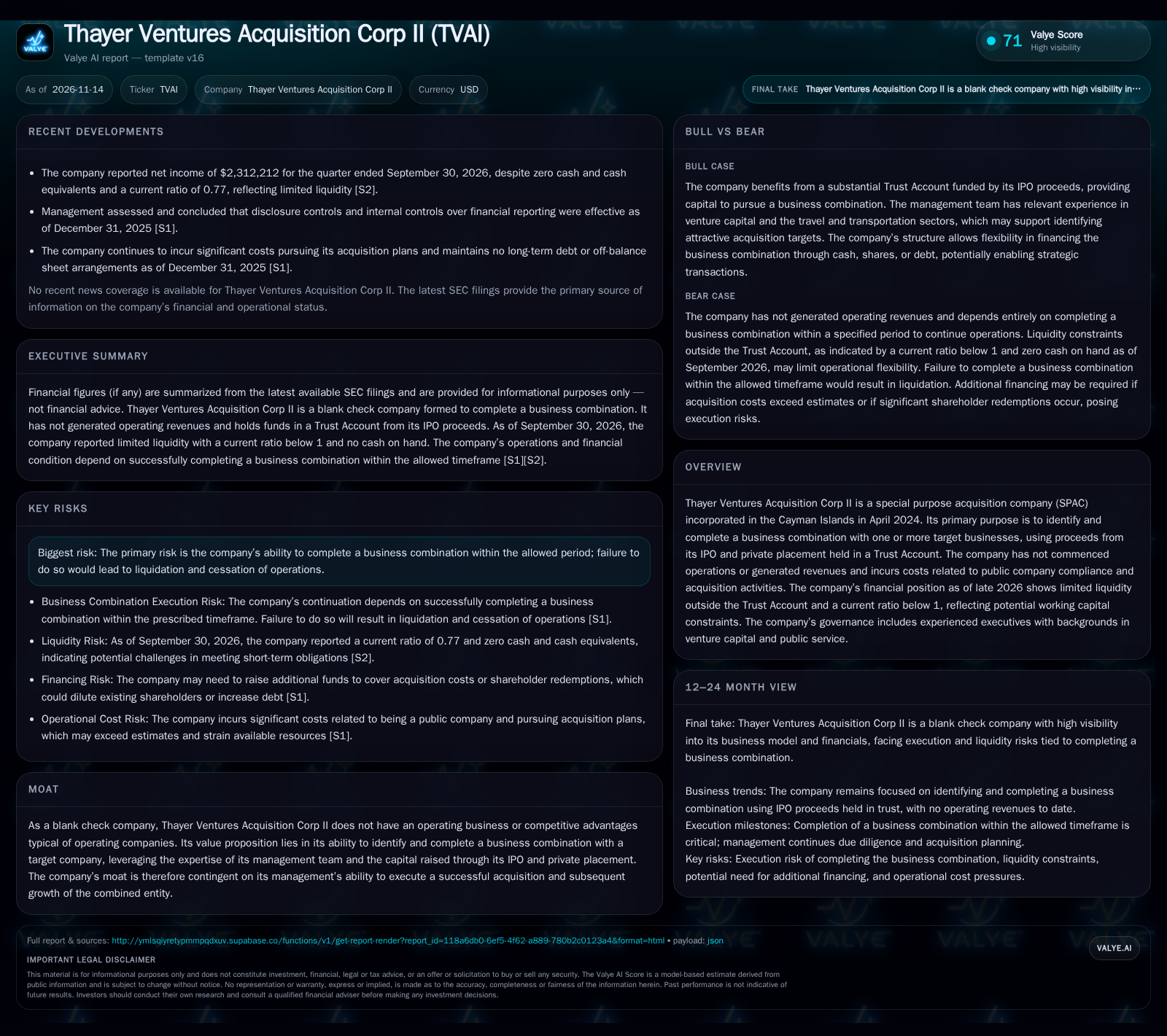
Thayer Ventures Acquisition Corp II (TVAI) is a blank check company with no operating revenues, relying entirely on its Trust Account (over $206 million as of Dec 2025) to fund a yet-to-be-identified business combination. The SPAC’s future depends on its ability to close an acquisition before the liquidation deadline, with failure resulting in dissolution and return of Trust funds to shareholders [S1] [S2].
Thayer Ventures Acquisition Corp II sits at a critical juncture, emblematic of the high-stakes binary nature of the SPAC structure. With no operating business and zero cash outside its Trust Account as of September 2026, the company’s only path to value creation lies in successfully executing a business combination before its SPAC deadline. The next quarters are decisive: deal execution or dissolution.
Liquidity Squeeze and the Business Combination Clock
Thayer Ventures Acquisition Corp II reported zero cash and cash equivalents as of September 30, 2026, and a current ratio of 0.77, underscoring a lack of working capital for ongoing expenses outside the Trust Account [S2]. The only substantive asset remains the Trust Account, which held approximately $206 million in investments at year-end 2025 [S1]. Despite this, all non-Trust funds were depleted by Q3 2026, while the company continues incurring costs related to public company compliance and acquisition efforts. Net income reported for the quarter ($2.3 million) is attributable to Trust investment earnings and tax adjustments, not to any operating activity [S2]. These facts highlight a narrowing operational runway: unless a business combination is executed within the SPAC’s prescribed timeframe, the company faces mandatory liquidation and return of Trust funds to shareholders.
SPAC Economics: Binary Outcomes and the Mechanics of Value Creation
Thayer Ventures Acquisition Corp II’s business model is fundamentally binary: it either completes a business combination (de-SPAC) and transitions to an operating company, or it liquidates and returns its Trust Account to shareholders. The economics are driven almost entirely by the fate of the Trust: until a merger, TVAI generates non-operating income from Trust investments but no operating revenue. All public company and search costs must be paid from limited non-Trust funds, which are now exhausted [S2].
Upon a successful business combination, the merged entity may access the Trust capital—subject to any redemptions by public shareholders at closing. High redemption rates, common in the current SPAC market, can sharply reduce the actual cash delivered to the target, potentially necessitating additional PIPE (private investment in public equity) financing or renegotiated deal terms. The structure creates significant leverage for shareholders at the time of deal approval, and the cash-out option can leave the post-merger company undercapitalized if not managed proactively.
Absent a merger, the only cash flows are investment income and—on liquidation—return of Trust principal to shareholders. The fixed costs of being public (legal, regulatory, diligence, and sponsor overhead) create a negative carry, making the time window to find and close a deal a material constraint.
SPAC Competition: Deal Sourcing, Redemptions, and Sponsor Reputation
In the current SPAC landscape, competition is less about traditional market share and more about sourcing attractive deals and convincing both targets and public shareholders of the transaction’s merits. TVAI’s management team has backgrounds in venture capital and public service, which could be a differentiator in sourcing targets, particularly in sectors such as travel or transportation. However, these advantages are only as valuable as the team’s network and ability to execute under time pressure.
SPACs now face heightened scrutiny and skepticism from both targets and investors due to increased regulatory attention, a glut of available SPAC capital, and a track record of high post-merger redemptions. Competing SPACs may offer more favorable terms or have deeper sponsor pockets to backstop redemptions. Potential targets have become more selective, often negotiating for higher certainty of funds and better post-merger positioning.
TVAI’s lack of long-term debt could be a modest advantage in deal flexibility, but with zero cash outside the Trust, its ability to absorb unexpected costs or offer sweeteners is constrained. Ultimately, TVAI’s competitive position will be determined by its ability to identify a willing target and to shepherd a transaction through shareholder approval with minimal redemptions.
Catalyst: Swift, High-Quality Acquisition with Low Redemptions
The most favorable outcome for TVAI is the identification and rapid execution of a business combination with a compelling, credible growth company—ideally in a sector aligned with management’s expertise. If the target is attractive to public shareholders, the redemption rate could be kept low, maximizing the Trust capital available to the combined entity. This would allow the post-merger company to emerge well-capitalized and positioned for growth, potentially generating value for both legacy SPAC shareholders and new investors.
Confirmation of this scenario would include announcement of a definitive merger agreement with a credible private company, favorable initial market reaction, and subsequent proxy filings showing strong shareholder support and low intent to redeem. Additional PIPE financing or strategic backing could further validate the deal’s prospects. Conversely, delays in deal announcement, high pre-vote redemption intent, or withdrawal by the target would falsify this upside pathway.
Most Likely Trajectory: Deal Execution with Significant Redemptions
Given current SPAC market dynamics, the most plausible scenario is that TVAI announces a business combination but faces substantial public shareholder redemptions at closing. High redemption rates are typical in the current environment, especially if the target company is perceived as speculative or the market is skeptical of its growth prospects. In this case, the deal may still close, but the post-merger entity would receive less cash from the Trust than initially projected, potentially constraining its growth plans or requiring last-minute PIPE financing.
Evidence confirming this scenario would include a definitive agreement announcement followed by proxy materials disclosing high redemption intent, or the need for PIPE/top-up financing to close the deal. Signals that would falsify this scenario include either an inability to secure a deal (leading to liquidation) or an unexpectedly low redemption rate.
Deal Failure and Liquidation: The Hard Stop
The principal risk for TVAI is failure to complete a business combination within the SPAC’s permitted timeframe, resulting in mandatory liquidation. This outcome would see the Trust Account returned to shareholders (less any permitted expenses), with sponsors losing their at-risk capital and the company ceasing to exist as a public entity. This scenario could be triggered by an inability to identify a suitable target, failed negotiations, regulatory delays, or overwhelming shareholder redemptions making the deal unviable.
Confirmation would come from missed deal deadlines, SEC filings indicating winding-up proceedings, or announcements that no suitable combination was found. Falsification would require a credible deal announcement and movement toward shareholder approval before the liquidation window closes.
Milestones That Will Determine TVAI’s Outcome
Announcement of a definitive business combination agreement—timing and target profile will provide early clarity on deal prospects.
Redemption rates at the shareholder vote—a critical determinant of how much Trust capital remains with the post-merger entity. A useful metric would be the percentage of public shares redeemed, if disclosed.
PIPE financing commitments—any supplemental capital raised alongside the deal, indicating market confidence or lack thereof.
Regulatory and SEC review timelines—delays could push the transaction past the SPAC’s permitted window for combination.
Public shareholder sentiment as reflected in proxy statements and pre-vote communications, if disclosed.
Quarterly disclosures of remaining non-Trust cash—continued zero balances would increase the urgency of deal completion.
Sponsor or insider capital infusions—if provided, could signal confidence or a need to cover rising operating costs.
Disclaimer: This is research-only, informational analysis and not investment advice. It may include AI-generated interpretation and general industry context. Always verify important details using primary sources.

Comments