
Inflection Point Acquisition Corp. VIII: Capital Structure, Execution Stakes, and the Realities of the SPAC Lifecycle
Inflection Point Acquisition Corp. VIII remains an early-stage SPAC with no operating revenue and a clear emphasis on identifying a suitable merger target.
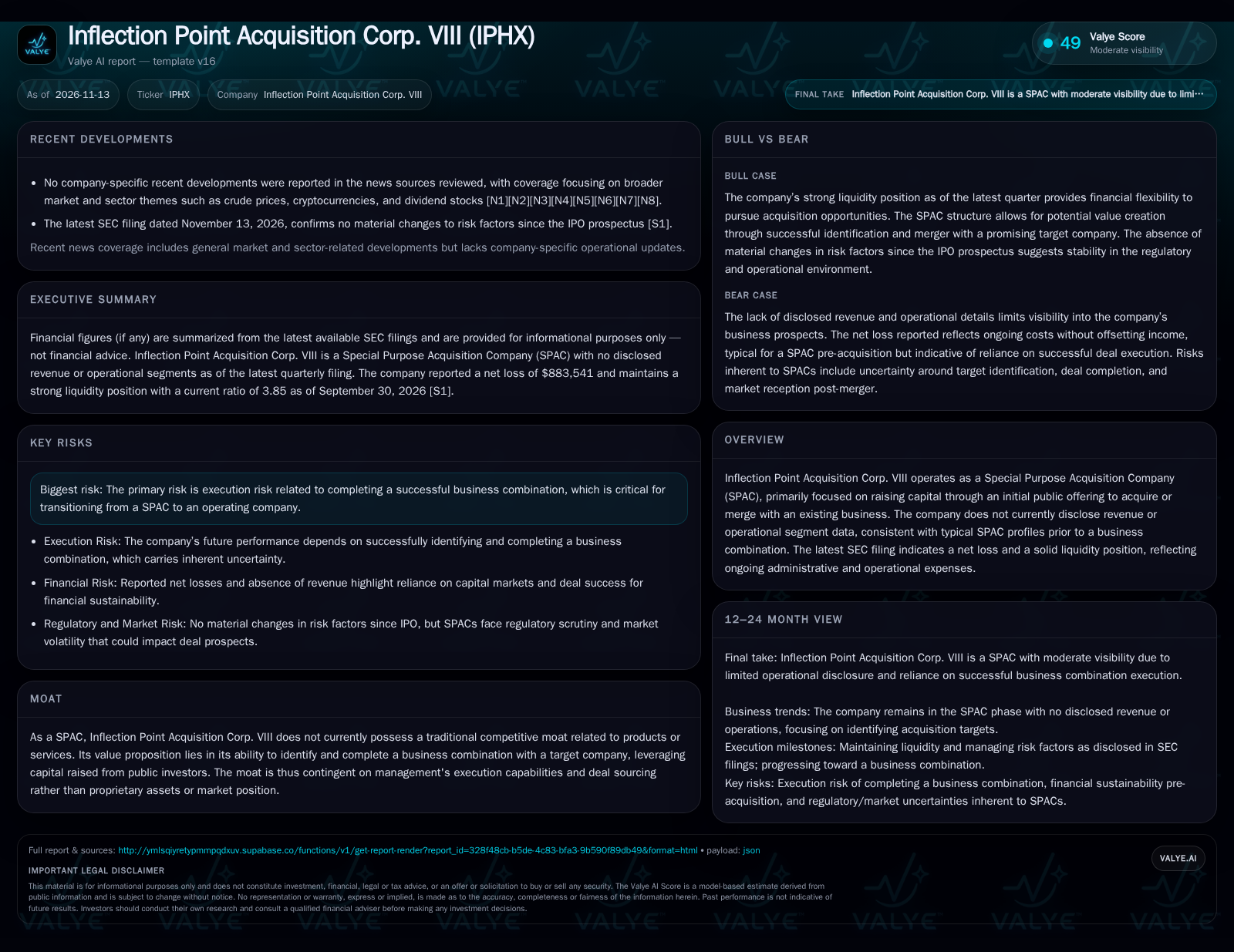
Inflection Point Acquisition Corp. VIII is a newly formed SPAC with substantial current assets and no revenue as of September 2026. Its financial position reflects typical pre-deal administrative costs and share-based compensation, but the absence of operational income underscores the criticality of executing a successful merger. The company’s future depends on target selection and deal execution within the evolving SPAC regulatory and market landscape. [S1]
Inflection Point Acquisition Corp. VIII exemplifies the archetypal SPAC at an early stage in its lifecycle: flush with cash from its recent IPO, but with no operating business or revenue-generating activities as of September 2026. Its financial statements reflect only administrative and compliance costs, punctuated by share-based compensation typical for such vehicles. The company’s entire investment thesis now pivots on a single inflection: whether management can identify, negotiate, and close a value-creating business combination before its capital base erodes or market conditions shift. [S1]
SPAC Structure and Liquidity: The State of Play for Inflection Point Acquisition Corp. VIII
As of September 30, 2026, Inflection Point Acquisition Corp. VIII reported current assets of $1,809,694 and current liabilities of $470,306, yielding a current ratio of 3.85. The company reported cash and liquidity metrics for the period; these figures do not by themselves establish operating runway, investment capacity, financial flexibility, or financing capacity. The company posted a net loss of $883,541 for the latest quarter, primarily reflecting administrative costs and share-based compensation—common for SPACs prior to a business combination. No revenue has been disclosed, which is consistent with the company’s stated purpose and lifecycle stage. Risk disclosures remain unchanged since the IPO, indicating no material shifts in the regulatory or operational backdrop. [S1]
How the SPAC Model Translates Capital Into Potential Value Creation
Inflection Point Acquisition Corp. VIII, like most SPACs, generates no operating revenue prior to a merger. Its economics are defined by the capital raised at IPO—typically placed in a trust account—and the careful management of relatively modest administrative and diligence expenses out of a separate operating account. The company’s only reported income is from interest earned on trust assets, which is generally immaterial compared to the potential scale of a post-merger business.
The primary economic event is the business combination: if management can identify and close a compelling acquisition, public shareholders may realize value through equity appreciation in the combined entity. This process embeds significant operating leverage for sponsors and shareholders, as a successful transaction can transform a cash shell into a revenue-generating public company. Conversely, failure to consummate a deal within the SPAC’s designated timeline (often 18-24 months) results in liquidation and return of trust capital to public shareholders, with sponsors and early investors absorbing the sunk costs.
Administrative costs, share-based compensation, and due diligence expenses are largely fixed until a deal is announced. Capital efficiency and the careful management of these costs are critical, as excessive pre-deal burn can erode sponsor economics and reduce the net proceeds available for a potential acquisition.
Deal Sourcing, Sponsor Credibility, and the Evolving SPAC Arena
SPACs such as Inflection Point Acquisition Corp. VIII operate in a competitive environment defined not by product innovation, but by access to attractive targets and the ability to execute transactions under heightened regulatory and market scrutiny. The primary sources of competitive advantage are sponsor reputation, sector focus, and the ability to structure deals that align incentives for both target companies and public shareholders.
The recent evolution of the SPAC market—with increased regulatory oversight and greater skepticism from institutional investors—raises the bar for successful execution. Sponsors must now contend with a crowded field of SPACs seeking a limited pool of high-quality targets, while also addressing concerns around post-merger performance and alignment. In this context, Inflection Point’s value proposition will be judged by its management team’s ability to source differentiated targets and structure deals that can withstand due diligence and deliver long-term value.
Alternative transaction structures (direct listings, traditional IPOs, private equity) and the growing sophistication of target companies further intensify competition for deals. The company’s competitive position will ultimately be tested by its ability to secure a target that meets market expectations in terms of growth, governance, and post-merger performance.
A High-Quality Target and Well-Executed Merger Unlocks Shareholder Value
The most favorable scenario for Inflection Point Acquisition Corp. VIII is the identification and acquisition of a high-growth, well-managed private company that benefits from public capital and visibility. A successful business combination could catalyze a re-rating of the SPAC’s shares, especially if the target operates in a sector with structural tailwinds (e.g., technology, healthcare, or sustainability).
Confirmation of this scenario would require a merger announcement with a credible target, robust investor interest (as evidenced by minimal redemption rates), and strong post-deal trading performance. Additional evidence would include management’s ability to articulate a clear integration plan, alignment of incentives between stakeholders, and the disclosure of pro forma financials that support the valuation.
Falsification would occur if the SPAC fails to secure a target or if post-announcement redemptions overwhelm the trust balance, eroding transaction proceeds and undermining deal economics.
SPAC Lifecycle Progresses Under Time and Regulatory Pressure
The most likely outcome is that Inflection Point Acquisition Corp. VIII continues to evaluate potential targets while incurring modest administrative losses. The company may announce a letter of intent or enter advanced negotiations, but the increasing complexity of SPAC transactions and investor scrutiny could delay or complicate deal closure.
Evidence supporting this scenario would include incremental SEC filings disclosing target engagement, extensions of the SPAC’s timeline, or additional capital raises to support ongoing operations. The scenario would be falsified if the company either announces a definitive merger agreement (moving toward the upside) or fails to secure an extension or viable target before the required liquidation date (moving toward the downside).
Deal Uncertainty, Capital Erosion, and the Risk of Liquidation
The adverse scenario for Inflection Point Acquisition Corp. VIII is one in which the company is unable to identify or complete a business combination within the allotted time. Administrative costs continue to reduce capital available for a deal, and regulatory or market headwinds may further deter potential targets.
Confirmation of this scenario would be evident if the company files for liquidation, returns trust capital to shareholders, and the sponsors’ investments are lost. High redemption rates upon deal announcement or the inability to secure shareholder approval for a merger would also support this outcome. Conversely, announcement of a strong target or successful extension of the SPAC timeline would challenge this scenario.
Milestones That Will Define Inflection Point Acquisition Corp. VIII’s Trajectory
Announcement of a letter of intent or definitive agreement with a merger target would be the primary signal of execution progress.
If disclosed, the size and sector of any potential target may indicate the likelihood of market enthusiasm and post-merger performance.
Redemption rates following a merger announcement would provide a concrete measure of investor confidence and deal viability.
SEC filings related to extensions of the SPAC’s timeline or changes in capital structure would signal pressure on deal execution.
Trends in administrative and due diligence expenses, if disclosed, would help assess capital runway and sponsor discipline.
Changes in regulatory environment or SPAC market sentiment could materially affect the feasibility and attractiveness of potential deals.
Evidence of PIPE (private investment in public equity) financing or other capital commitments would support the credibility of a proposed transaction.
The company’s ability to articulate a clear post-merger integration plan—if and when a target is announced—would be critical for long-term value realization.
Disclaimer: This is research-only, informational analysis and not investment advice. It may include AI-generated interpretation and general industry context. Always verify important details using primary sources.

Comments