
CSB Financial Inc.: Navigating Obscurity Amid Ongoing Losses and Sparse Disclosure
With a reported net loss and negative EPS for Q3 2026 but no disclosed revenue or liquidity data, CSB Financial Inc. presents a challenging case for analysis. The absence of operational transparency leaves investors with little basis for assessing business health, competitive position, or prospects for recovery.
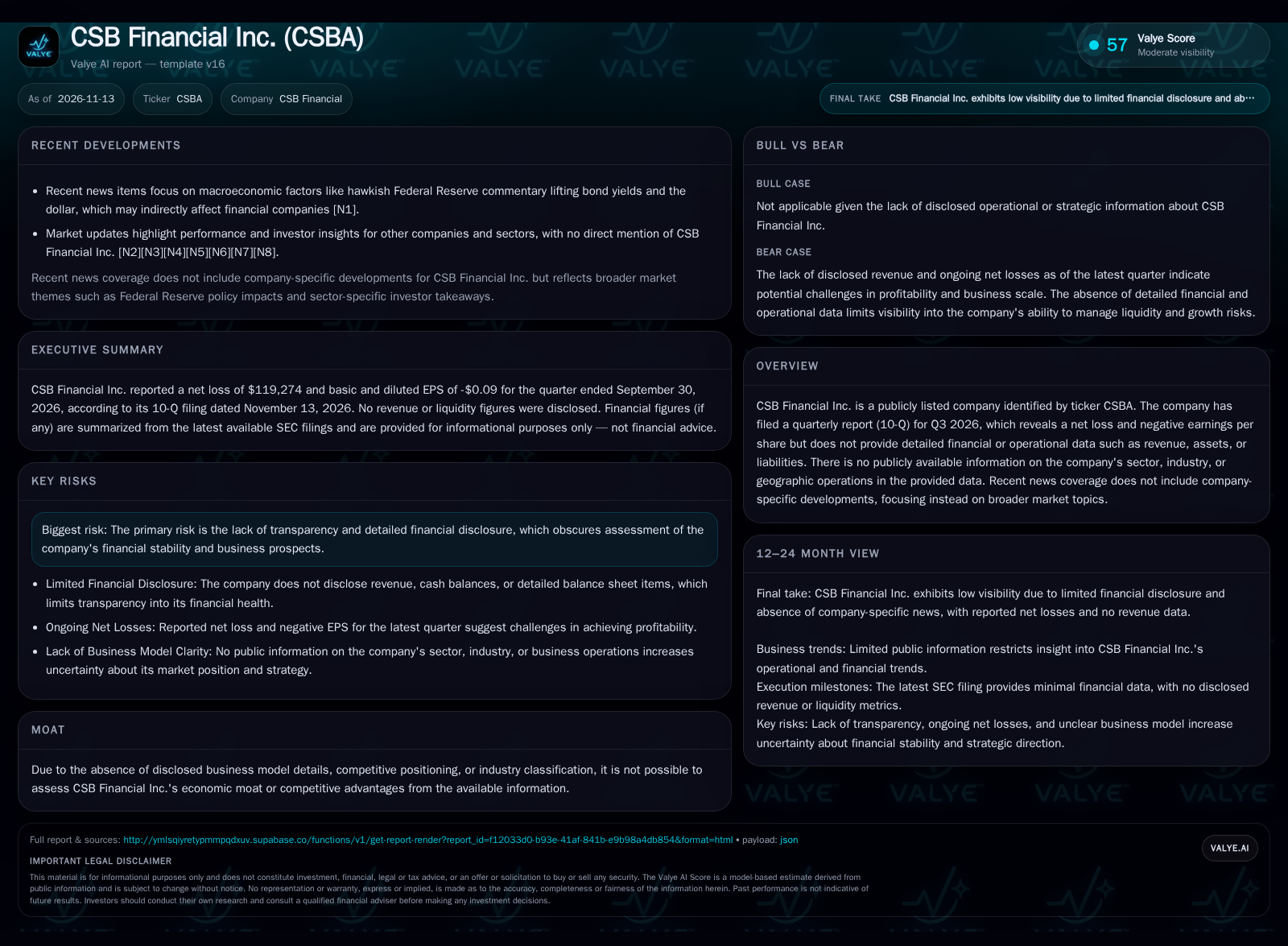
CSB Financial Inc. posted a net loss of $119,274 and EPS of -$0.09 in Q3 2026, but disclosed no revenue, asset, or liquidity data. With no sector, industry, or business model information available, investors are left with high uncertainty about the company's underlying economics, strategy, and financial stability. The lack of transparency is the central risk, and meaningful assessment hinges on future disclosures or operational clarity. [S1]
CSB Financial Inc. stands out less for what it reveals than for what it withholds. In its latest quarterly report, the company disclosed a modest net loss and negative earnings per share, but left out all critical operational and financial details such as revenue, cash, and balance sheet line items. With no information on its business model, sector, or competitive environment, CSB Financial presents a blank canvas riddled with uncertainties. The question for investors is not just whether the company can reverse its losses, but whether its fundamental business prospects can be meaningfully assessed at all given the current opacity. [S1]
Sparse Disclosure and Ongoing Losses Define the Current State
CSB Financial Inc.'s Q3 2026 SEC filing reports a net loss of $119,274 and basic/diluted EPS of -$0.09, but omits revenue, cash, and balance sheet data. No information is provided about the company's sector, industry, or operational activities. The lack of disclosure is material: without revenue figures, investors cannot assess top-line momentum or even basic viability, while the absence of liquidity data precludes any analysis of financial runway or risk of insolvency. This level of opacity is highly unusual for a public company and places investors in a position of significant uncertainty regarding the company’s health or direction. [S1]
The absence of fundamental financial data such as revenue and liquidity also hinders any meaningful assessment of the company's capital structure and funding strategy. The company reported cash and liquidity metrics for the period; these figures do not by themselves establish operating runway, investment capacity, financial flexibility, or financing capacity. This opacity complicates risk assessment, particularly regarding solvency and potential dilution from future capital raises. Furthermore, the lack of segment or geographic breakdowns prevents evaluation of exposure to macroeconomic or regulatory risks that might disproportionately affect certain markets or business lines.
Uncertain Revenue Streams and Indeterminate Cost Structure Obscure Fundamentals
With no revenue or operational data disclosed, the underlying economics of CSB Financial Inc. remain opaque. Net losses suggest that costs exceed any possible income, but without insight into revenue sources, gross margins, or expense breakdowns, it is impossible to determine whether losses are due to early-stage investment, structural inefficiency, or lack of scale. If the company is in a pre-revenue phase or pivoting business models, ongoing losses could be strategic—but if losses persist without a clear path to monetization, value erosion is likely. Until substantive disclosures are made, any discussion of pricing power, operating leverage, or capital intensity is necessarily speculative.
Examining cost structure dynamics in the absence of disclosed data requires consideration of typical cost drivers within financial services or analogous sectors. If CSB Financial operates in a capital-intensive industry, fixed costs such as technology infrastructure, regulatory compliance, and personnel could dominate expenses, implying that achieving scale is critical for profitability. Conversely, a variable cost model tied closely to transaction volumes or client acquisition would suggest different operational leverage and margin profiles. The interplay between these cost characteristics and revenue generation timing is pivotal; prolonged mismatches could exacerbate losses and strain liquidity, underscoring the need for transparent disclosure to evaluate sustainability.
The strategic implications of ongoing losses also depend heavily on the company's stage of development and market positioning. For early-stage ventures, losses may reflect deliberate investment in product development, market entry, or customer acquisition, with the expectation of future monetization. However, without clarity on milestones or timelines, investors cannot distinguish between strategic burn and structural inefficiency. Additionally, the absence of disclosed operational metrics such as customer counts, transaction volumes, or average revenue per user precludes any proxy analysis for growth potential or unit economics, which are essential for validating the business model's scalability and long-term viability.
Competitive Landscape and Moat: Impossible to Gauge Without Business Clarity
No public information is available on CSB Financial Inc.'s sector, industry, or business activities as of the latest filing, making competitive analysis infeasible. Without knowing whether CSB Financial operates in banking, fintech, asset management, or another financial services niche—or even outside finance altogether—it is impossible to identify relevant competitors, substitutes, or structural advantages. If the company were to operate in a highly regulated or commoditized sector, competitive pressures could be severe; conversely, a unique business model or proprietary technology could confer an advantage. However, in the absence of disclosed products, services, or customer relationships, any assessment of market positioning, customer switching costs, or network effects is purely hypothetical.
A Path to Recovery Requires Radical Transparency and Strategic Realignment
The most optimistic scenario for CSB Financial Inc. hinges on the company providing full operational transparency and demonstrating a credible route to revenue generation and profitability. If future filings disclose robust revenue growth, a clear business model, and evidence of customer traction or product-market fit, investor sentiment could reverse rapidly. Upside would be further confirmed by the company outlining a strategic plan, securing new funding, or announcing major partnerships. The falsification of this scenario would be continued opacity, persistent net losses, or a lack of meaningful operational milestones in future disclosures.
Persistent Uncertainty Likely to Continue Absent Material Disclosure Shifts
The most plausible outcome, given the current state of disclosure, is that CSB Financial Inc. continues to operate with limited transparency and ongoing net losses. Investors may remain sidelined due to an inability to assess the company's prospects or valuation. Confirmation of this scenario would come from further quarterly reports lacking revenue or operational metrics, ongoing losses, and no substantive news or filings clarifying the company's business activities. The scenario could be falsified if the company abruptly increases disclosure, provides audited financials, or communicates a clear business plan.
Extended Opacity and Erosion of Value Could Precede Delisting or Insolvency
The most adverse outcome would be a continuation of losses combined with persistent lack of operational disclosure, ultimately resulting in regulatory scrutiny, loss of investor confidence, or delisting from public markets. This scenario would be confirmed by ongoing absence of financial data, auditor resignations, or regulatory warnings. Any move toward voluntary delisting or bankruptcy filings would also validate this downside risk.
What Could Clarify CSB Financial Inc.'s Trajectory
Disclosure of revenue figures in future SEC filings would allow assessment of top-line momentum and business viability.
Publication of cash, short-term investments, and current liabilities would create visibility into liquidity and financial runway.
A detailed business description, including sector and core activities, would help identify relevant competitors and market dynamics.
Evidence of customer acquisition, product launches, or strategic partnerships—if disclosed—would help test for operational traction.
Announcement of new financing rounds, credit facilities, or capital raises could signal management’s ability to sustain operations.
Auditor statements or third-party validation of financials would enhance credibility and reduce perceived risk.
Regulatory communications or exchange notices regarding listing status would provide clues to potential compliance or solvency issues.
Disclaimer: This is research-only, informational analysis and not investment advice. It may include AI-generated interpretation and general industry context. Always verify important details using primary sources.

Comments