
Edgewell Personal Care: Margin Squeeze, Cost Volatility, and the Battle for Resilient Profitability
Edgewell Personal Care Co closed fiscal 2026 with nearly $2 billion in revenue but swung to a net loss, as raw material volatility, geopolitical supply shocks, and price competition challenge its ability to convert scale into profits.
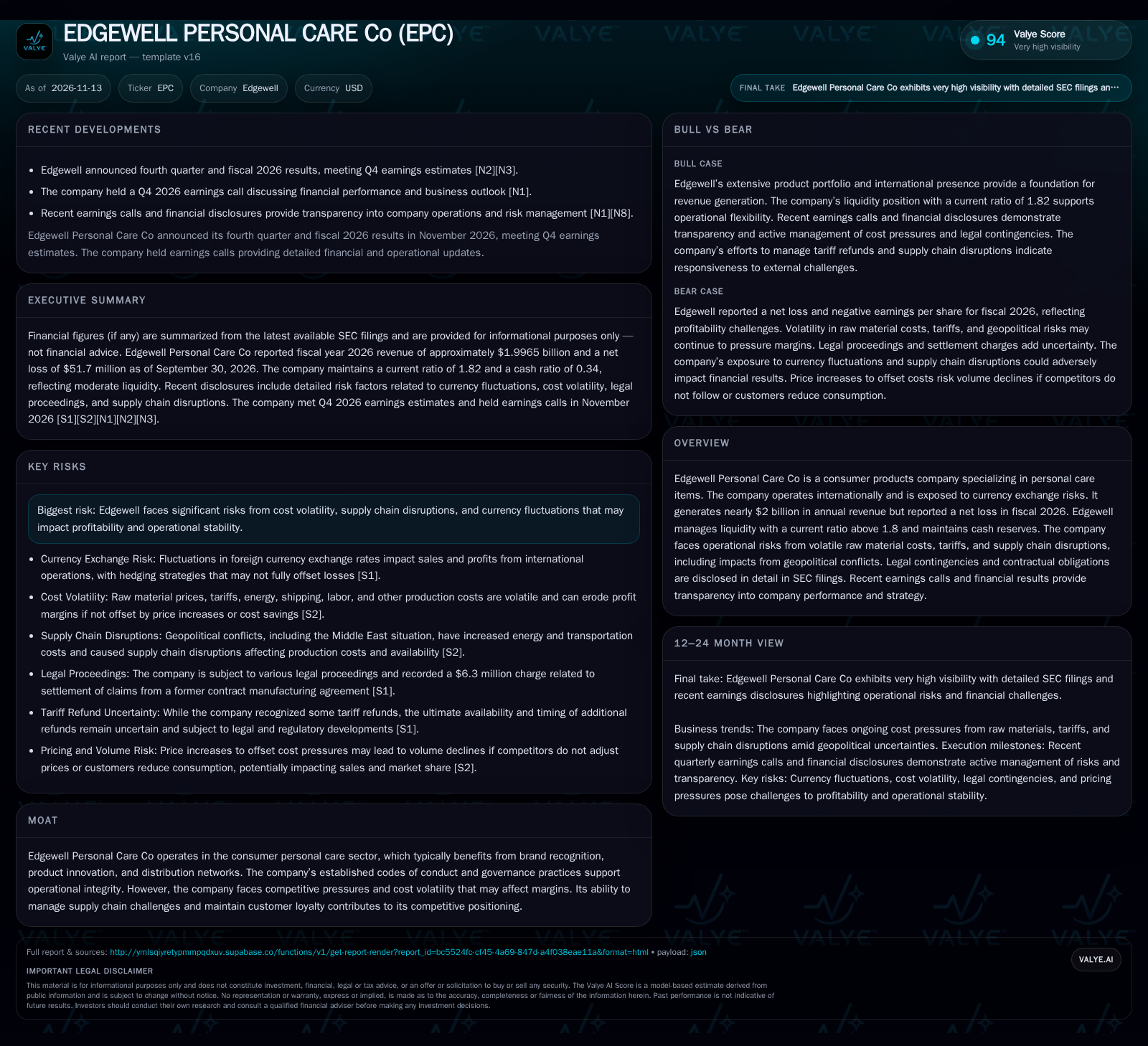
Edgewell Personal Care posted $1.9965 billion in fiscal 2026 revenue but reported a $51.7 million net loss, with negative EPS of $1.12. Margins are pressured by volatile input costs, energy, and transportation disruptions, exacerbated by global geopolitical conflict. The core strategic question is whether Edgewell can restore profitability by passing costs to consumers without eroding market share.
Edgewell Personal Care’s 2026 fiscal results underscore the fragility of margin structures in the branded consumer products sector when global cost shocks collide with intense competition. Despite approaching $2 billion in annual revenue, Edgewell swung to a net loss, as input cost inflation, energy and shipping disruptions, and legal settlements offset price increases and operational efforts.
2026 Performance: Revenue Scale Meets Margin Compression
For the fiscal year ended September 30, 2026, Edgewell Personal Care reported total revenue of $1.9965 billion but posted a net loss of $51.7 million, with both basic and diluted EPS at negative $1.12 [S1]. This reversal into the red highlights the company’s exposure to input cost inflation and operational disruptions. The company reported cash and liquidity metrics for the period; these figures do not by themselves establish operating runway, investment capacity, financial flexibility, or financing capacity. [S1] The company also recorded a $6.3 million legal settlement charge related to a former contract manufacturing agreement and recognized $8.4 million in product cost and $0.3 million in other income from tariff refunds, but the future availability of such offsets remains uncertain [S1]. The cumulative effect is a company with significant revenue scale but challenged profitability and earnings visibility.
How Edgewell’s Cost Structure and Pricing Dynamics Shape Profitability
Edgewell’s business model is typical of large personal care product companies—high fixed costs for manufacturing, branding, and distribution, with variable costs tied to raw materials, energy, labor, and logistics. Gross margins are highly sensitive to swings in commodity prices (e.g., plastics, chemicals, packaging), as well as transportation and energy costs, which have been destabilized by global geopolitical conflicts. The company’s ability to recoup these cost increases through pricing is constrained; while price hikes can offset margin pressure, they risk driving volume declines if competitors do not follow suit or if consumers trade down or delay purchases [S2].
Operating leverage can work both ways: with nearly $2 billion in sales, incremental revenue growth could quickly improve margins if fixed costs are covered. However, in a downcycle or cost inflation environment, negative leverage amplifies losses, as seen in fiscal 2026. Capital needs are driven by ongoing working capital, debt service, and investment to maintain product quality and innovation. The tension between protecting volume and restoring margin will define Edgewell’s near-term economic performance.
A critical dimension of Edgewell’s cost structure is the interplay between its fixed and variable expenses, which influences its operating leverage. In periods of stable or declining input costs, the company’s fixed cost base—encompassing manufacturing facilities, marketing campaigns, and distribution networks—can be leveraged to enhance profitability as incremental revenues contribute disproportionately to the bottom line. However, when raw material prices surge unpredictably, the inability to immediately adjust fixed costs creates a margin squeeze. This dynamic underscores the importance of flexible cost management strategies, such as variable labor arrangements or scalable marketing spend, which could mitigate the impact of cost shocks. Moreover, the timing lag between cost increases and price adjustments can exacerbate margin pressure, highlighting the need for agile pricing mechanisms and real-time cost monitoring systems.
Another aspect shaping profitability is the sensitivity of consumer demand to price changes in Edgewell’s categories. Given the commoditized nature of many personal care products, price elasticity tends to be significant, especially in economic downturns or inflationary environments where consumers prioritize essential spending. This means that even modest price hikes intended to offset cost inflation might lead to disproportionate volume declines if consumers switch to private labels or reduce consumption frequency. Consequently, Edgewell’s pricing strategy must balance the imperative to protect margins with the risk of eroding market share. Employing targeted promotions, product tiering, or innovation-driven premiumization could help segment the market and preserve volume among less price-sensitive consumers, but these approaches require investment and carry execution risk.
Brand, Shelf, and Pricing: Edgewell’s Place in a Crowded Marketplace
Edgewell competes in personal care—a sector characterized by powerful incumbent brands, private label competition, and low switching costs for many product categories. While brand equity and shelf presence in mass retail and pharmacy channels offer some defense, they are not impenetrable moats, especially in commodity-like categories where consumers are price sensitive. Distribution relationships and product breadth can help defend share, but they do not guarantee pricing power in the face of widespread inflation or promotional activity by peers.
Competitors include both global consumer product conglomerates and private label/store brands, many of which are equally exposed to input cost volatility but may have greater scale or more diversified portfolios. Substitution risk is significant: consumers can easily switch to lower-priced alternatives if Edgewell’s price increases are not matched across the aisle. The decisive question is whether Edgewell’s brands and innovation pipeline are strong enough to justify premium pricing and maintain volume in a challenging macro environment.
Margin Recovery Through Synchronized Pricing and Cost Management
A favorable scenario for Edgewell involves successful price increases that are matched by peers, allowing the company to recapture lost margin without significant volume attrition. If input cost pressures ease—whether through stabilization in raw material, energy, or transportation markets—incremental margin gains could flow directly to the bottom line given the company’s fixed cost base. Operational efficiency improvements, successful legal risk management, and additional tariff refunds could further boost earnings.
Evidence that would confirm this scenario includes: positive trends in gross margin, stable or growing volumes in core categories despite price increases, and peer companies also reporting successful price realization. Signs of easing input costs in earnings calls or financial disclosures, coupled with a return to positive net income and improved operating cash flow, would falsify the bear thesis and signal a durable recovery.
Profitability Restoration Remains a Gradual, Uncertain Process
The most plausible outlook is one of gradual margin rebuilding, with continued volatility in both input costs and consumer demand. Edgewell may be able to pass some costs through via price increases, but will likely face ongoing volume headwinds, requiring careful management of promotional strategy and cost structure. Legal settlements and tariff refund uncertainty will continue to create earnings noise.
Confirmation would come from sequential improvement in margin metrics, stable volumes, and evidence in disclosures or calls that supply chain disruptions are moderating. Falsification would be persistent net losses, ongoing negative operating leverage, or signs of material share loss to private label or aggressive competitors unwilling to match price hikes.
Volume Erosion and Stubborn Cost Inflation Threaten Further Losses
A negative scenario could unfold if Edgewell’s price increases are not matched by competitors, leading to consumer switching and significant volume declines. If cost inflation persists—driven by ongoing geopolitical conflict, energy shocks, or labor constraints—while volumes fall, the company could experience deeper operating losses and further cash burn.
Additional downside risk comes from adverse legal developments, the absence of further tariff refunds, or new regulatory costs.
In a prolonged adverse scenario, persistent cost inflation coupled with volume erosion could trigger a vicious cycle of margin deterioration and diminished investment capacity. As profitability declines, the company might face pressure to cut marketing and innovation budgets, which are critical for maintaining brand relevance and consumer engagement in the competitive personal care sector. Reduced investment could weaken Edgewell’s differentiation and pricing power over time, accelerating share loss to more agile or better-capitalized competitors. This scenario underscores the importance of proactive cost containment, diversified supply sourcing, and robust scenario planning to navigate extended periods of market stress.
What Will Determine Edgewell’s Margin Trajectory and Competitive Resilience?
Gross margin and operating margin trends in quarterly and annual disclosures—improvements or further compression will signal success or ongoing stress in cost pass-through and efficiency.
Volume trends and market share data in core product categories (if disclosed), especially in the wake of price increases or major promotional campaigns.
Peer pricing behavior—evidence from competitor earnings or trade publications that rivals are following Edgewell’s price hikes, or instead maintaining lower pricing and taking share.
Updates on raw material, energy, and shipping cost trends—earnings call commentary or cost-of-goods-sold breakdowns that indicate whether cost pressures are easing or intensifying.
Legal and regulatory developments—new settlement charges, adverse litigation outcomes, or updates on tariff refund availability.
Supply chain and geopolitical commentary in management disclosures—signals that disruptions are resolving or worsening, affecting cost structure and product availability.
Disclaimer: This is research-only, informational analysis and not investment advice. It may include AI-generated interpretation and general industry context. Always verify important details using primary sources.

Comments