
NorthStrive Acquisition Corp I: SPAC-Stage Uncertainty Meets Nuclear Technology Ambition
NorthStrive Acquisition Corp I is a SPAC aiming to merge with Nuclea Energy, a development-stage nuclear technology venture.
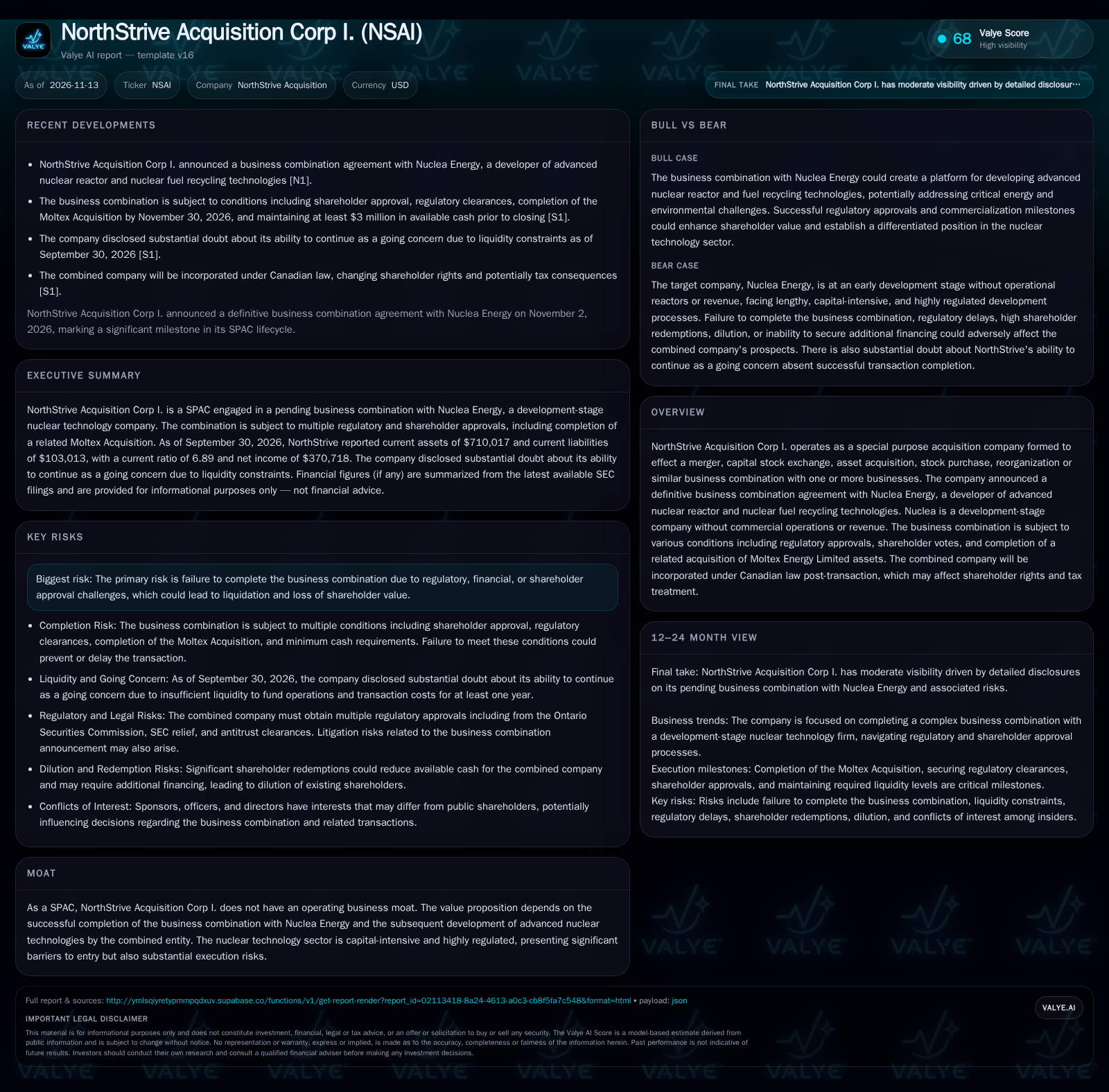
NorthStrive Acquisition Corp I is a SPAC aiming to merge with Nuclea Energy, a development-stage nuclear technology venture. The deal’s completion depends on regulatory and shareholder approvals, a related Moltex asset acquisition, and maintaining minimum cash. The combined company would be Canadian-incorporated, altering shareholder rights and tax implications. The thesis pivots on regulatory execution, redemptions, and whether Nuclea’s nuclear ambitions can translate from concept to commercial reality. [S1]
NorthStrive Acquisition Corp I sits at the intersection of speculative capital and next-generation energy ambition. As a SPAC, its sole near-term purpose is to consummate a merger with Nuclea Energy—a company seeking to develop advanced nuclear reactors and fuel recycling but which remains pre-revenue and pre-criticality. The transaction is subject to a gauntlet of conditions, including regulatory and shareholder approvals, completion of a related Moltex asset acquisition, and the maintenance of a minimum cash threshold. While NorthStrive’s current ratio appears strong, the company itself has flagged substantial doubt about its ability to continue as a going concern, underscoring the fragility of the pre-merger platform. The outcome will hinge on both deal execution and the long, capital-intensive arc of nuclear technology commercialization. [S1]
Deal Progress, Liquidity Doubt, and the Conditional Path Forward
NorthStrive Acquisition Corp I’s most material current facts concern the conditional state of its proposed business combination and its own liquidity warnings. The company entered into a definitive agreement on October 30, 2026, to merge with Nuclea Energy, contingent on several hurdles: shareholder approval, regulatory clearances, completion of a Moltex asset acquisition by November 30, 2026, and a requirement to hold at least $3 million in available cash at closing. As of September 30, 2026, NorthStrive reported $710,017 in current assets and $103,013 in current liabilities, yielding a current ratio of 6.89. The company reported cash and liquidity metrics for the period; these figures do not by themselves establish operating runway, investment capacity, financial flexibility, or financing capacity. These facts set a backdrop where the entire thesis is contingent on successful deal closing and subsequent capital access. [S1]
SPAC and Nuclear Tech: Cash Burn, Dilution, and the Economics of Early-Stage Ambition
NorthStrive as an entity is not a cash-generating business—its economics are defined by its SPAC structure: raising capital through an IPO, parking it in trust, and seeking a high-upside deal. Any income prior to a merger comes from interest on trust assets, not operations. Post-merger, the economics would hinge entirely on Nuclea Energy, which is still pre-revenue, has no working reactor, and has not achieved criticality. This means the initial years will be dominated by R&D and regulatory approval expenses, with no offsetting cash inflow from commercial operations. Nuclear technology development is profoundly capital-intensive, typically requiring hundreds of millions, if not billions, of dollars and multi-year timelines before revenue generation. The need to maintain at least $3 million in available cash prior to closing only highlights the razor-thin margin for error. High shareholder redemptions could further erode the cash base, potentially triggering further fundraising and dilution. The combined company’s cost structure will likely be dominated by fixed costs (engineering, licensing, early procurement) long before any variable economics from fuel recycling or electricity sales come into play.
Barriers, Differentiation, and the Harsh Realities of Nuclear Innovation
While advanced nuclear technology offers theoretical moats—high regulatory barriers, specialized know-how, and long development cycles—the sector is notorious for execution risk and capital intensity. Nuclea’s focus on advanced reactor and fuel recycling technologies could, if successful, position it within a niche of next-generation nuclear innovators. However, it will compete for capital, regulatory attention, and technical talent with established nuclear engineering firms, well-capitalized energy conglomerates, and other advanced reactor startups. The sector’s regulatory hurdles can serve as both a barrier to entry and a brake on progress, with timelines often stretching beyond initial projections. Customer incentives are largely driven by the need for reliable, zero-carbon baseload power, but actual adoption by utilities or governments will depend on demonstrated safety, cost-effectiveness, and regulatory approval. Until Nuclea achieves meaningful technical or commercial milestones, its competitive position will remain speculative and entirely dependent on future execution.
If the Deal Closes and Nuclea Delivers: A Path to Strategic Differentiation
The most favorable scenario sees NorthStrive closing the merger with Nuclea, retaining enough cash to fund initial milestones, and Nuclea achieving key technical breakthroughs—such as demonstration of working reactor prototypes, successful regulatory submissions, or early-stage commercial contracts. This could attract additional capital, strategic partners, or government support, validating the platform and setting up a differentiated position in the nuclear sector. Confirmation of this scenario would come from announced technical milestones, new funding rounds, or signed MOUs with utilities or state entities. Conversely, delays in regulatory approvals, failure to secure additional post-merger financing, or negative technical results would quickly falsify the bull case.
Most Likely Trajectory: Deal Uncertainty and Prolonged Pre-Revenue Development
The plausible middle path is a drawn-out process: NorthStrive and Nuclea navigate a complex regulatory and shareholder approval gauntlet, possibly with some delays or renegotiations. If the deal closes, the combined entity faces the typical challenges of a pre-revenue nuclear technology company—substantial cash burn, ongoing fundraising needs, and a heavy reliance on positive regulatory and technical milestones to maintain investor confidence. Shareholder redemptions may reduce available cash, leading to further dilution or bridge financing. Progress is likely to be incremental, with operational or technical setbacks possible given the industry’s complexity. Evidence for this scenario would include update filings on deal progress, adjusted deal terms, or bridge capital announcements. Falsification would require either a failed deal or an unexpectedly rapid achievement of technical or commercial breakthroughs.
Deal Collapse or Capital Shortfall: The Liquidation and Dilution Spiral
The adverse scenario materializes if NorthStrive fails to satisfy any of the closing conditions—particularly if high shareholder redemptions deplete cash below the $3 million threshold, if regulatory or shareholder approvals are not secured, or if the Moltex acquisition cannot be completed. In this scenario, the SPAC could be forced to liquidate, returning remaining funds to shareholders, likely at a loss after expenses. Alternatively, a partial deal or renegotiation could lead to significant dilution for remaining shareholders and a severely undercapitalized post-merger entity. Confirmation would come from deal termination announcements, liquidation filings, or disclosures of insufficient cash or unresolved regulatory issues. Falsification would require clear, positive disclosures of all closing conditions being met and sufficient cash on hand.
Milestones That Will Define Whether NorthStrive’s Nuclear Bet Pays Off
Progress on the Moltex asset acquisition and confirmation of its completion by the stated November 30, 2026, deadline.
Regular updates on regulatory and shareholder approval processes; evidence of unexpected delays or material changes would be critical.
Disclosure of shareholder redemption rates and the actual cash available at closing; high redemptions could jeopardize the deal.
Post-merger funding announcements, including bridge financing or equity raises, to ensure the combined entity can fund multi-year development.
Technical milestones from Nuclea—such as first reactor criticality or successful regulatory submissions—if disclosed, would help test the commercialization thesis.
Evidence of dilution, including terms of any new capital raised or changes to share structure post-combination.
Material litigation or regulatory challenges arising from the business combination or related transactions.
Disclaimer: This is research-only, informational analysis and not investment advice. It may include AI-generated interpretation and general industry context. Always verify important details using primary sources.

Comments