
Canary Staked TRX ETF: Crypto Exposure Within a Regulated Framework
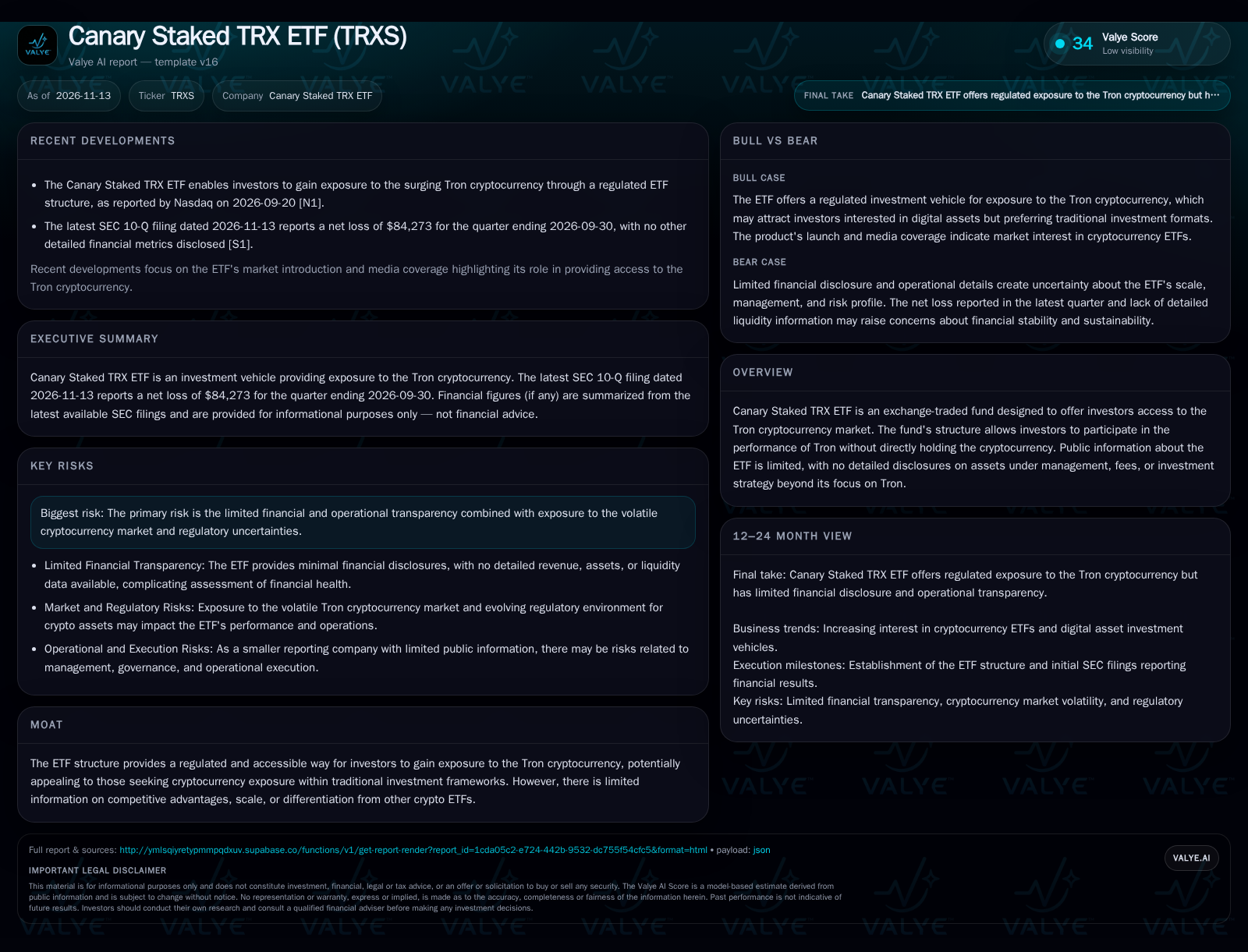
Canary Staked TRX ETF offers investors access to the Tron cryptocurrency via a traditional ETF structure, but sparse financial disclosure, a reported quarterly net loss, and unclear operational mechanics leave the fund’s true economics and risk profile uncertain.
Canary Staked TRX ETF provides a pathway for investors to gain exposure to Tron without directly holding crypto assets. The ETF reported a net loss of $84,273 for the quarter ending September 2026, with no further financial metrics disclosed. Its appeal hinges on regulated access to digital assets, but limited transparency, unclear fee structures, and the inherent volatility of Tron raise questions about sustainability and competitive positioning.[S1]
Canary Staked TRX ETF represents an increasingly common bridge between traditional finance and the digital asset world, giving investors regulated exposure to the Tron blockchain’s native currency. While this structure appeals to those seeking crypto upside without assuming custody or direct exchange risk, the ETF’s limited financial transparency and a reported net loss in the latest quarter mean its economics, competitive edge, and resilience to market and regulatory shocks remain largely opaque. The core question is whether regulated access alone can compensate for the lack of detail on cost, scale, and operational robustness as the crypto ETF market matures.[S1]
Current Landscape Marked by Sparse Disclosure and Net Losses
The most material recent fact is the ETF’s reported net loss of $84,273 for the quarter ending September 2026, per its latest 10-Q filing.[S1] No additional financial metrics—such as assets under management, fee income, or cash position—are disclosed. This lack of detail leaves investors with an incomplete picture of the fund’s scale, cost structure, and revenue potential. The ETF’s classification as a Smaller Reporting Company and omission of risk factors further limit insight into operational and financial health. In the context of the volatile Tron cryptocurrency, the absence of transparency heightens uncertainty about the fund’s ability to absorb shocks or scale sustainably.
The lack of granular financial disclosure also impedes a comprehensive risk assessment framework essential for institutional investors. The company reported cash and liquidity metrics for the period; these figures do not by themselves establish operating runway, investment capacity, financial flexibility, or financing capacity. Additionally, the absence of operational transparency obscures potential counterparty risks embedded in custody arrangements or staking mechanisms, which could materially affect fund stability. In regulated environments, such opacity may deter risk-averse investors who prioritize robust governance and clear contingency protocols.
Revenue Model Anchored in Fees Amid Crypto Market Volatility
In principle, a cryptocurrency ETF’s economics typically revolve around management fees levied as a percentage of assets under management (AUM), with costs accruing from custody, compliance, and administrative overhead. The ETF’s income potential therefore depends on AUM, which itself is a function of investor inflows and the underlying price of Tron. Without disclosed AUM or fee structure, it is unclear whether the fund’s scale is sufficient to cover fixed costs or generate positive operating leverage.
The ETF reported a net loss for the quarter, suggesting that revenues from fees (if any) are currently insufficient to offset expenses.[S1] This could be typical for early-stage or low-scale funds, where fixed costs dominate until a critical mass of AUM is reached. In the crypto ETF context, volatility in Tron’s price could further amplify swings in both AUM and fee income, making sustainable profitability elusive unless the ETF achieves significant scale or charges above-average fees. The absence of liquidity or cash data also complicates assessment of runway and operational flexibility.
Further complicating the revenue model is the interplay between fee structure and investor behavior under volatile market conditions. If the ETF employs a fixed fee percentage, declining Tron prices could compress AUM and fee income simultaneously, exacerbating revenue shortfalls. Conversely, a tiered or performance-based fee model might better align incentives but introduce earnings volatility. The fund’s cost base likely includes fixed compliance and technology expenses that do not scale down proportionally, thereby creating operational leverage challenges. Understanding these dynamics is critical, as sustained negative operating leverage could undermine long-term viability absent significant capital inflows or cost restructuring.
Challenges in Attracting Capital Amid Differentiation and Substitution Risks
Canary Staked TRX ETF’s core competitive proposition is providing regulated, exchange-traded exposure to Tron—a value proposition for investors who avoid direct crypto custody or unregulated exchanges. This structure can attract traditional asset managers, retirement accounts, and retail investors seeking simplicity and regulatory oversight.
However, the ETF faces competition from other crypto ETFs offering exposure to major tokens, as well as from direct crypto exchanges and decentralized finance platforms, which may offer lower fees or more flexible staking/yield options. In addition, the fund’s lack of disclosed scale or unique features makes it difficult to discern any clear moat versus peers. The risk is that, unless the ETF can build meaningful AUM or offer operational or cost advantages, it may struggle to attract flows in a crowded and rapidly evolving market.
The ETF’s differentiation strategy must also contend with evolving investor preferences toward decentralized finance (DeFi) protocols offering staking rewards or yield farming, which can provide enhanced returns albeit with higher risk and complexity. In this context, the Canary Staked TRX ETF’s value proposition hinges on balancing regulatory safety and ease of access against potentially lower yields and fees. The fund’s ability to articulate and demonstrate this trade-off will be pivotal in attracting and retaining capital. Furthermore, the competitive landscape may shift rapidly if incumbent financial institutions launch rival products with greater scale or integrated services, intensifying pressure on Canary’s market positioning.
Growth and Profitability Opportunities If Tron and Crypto ETFs Gain Traction
The most favorable scenario would unfold if investor demand for crypto ETFs accelerates and Tron’s price appreciates materially. This would drive inflows into the ETF, expanding AUM and, by extension, fee revenue. If the ETF’s cost base is largely fixed, operating leverage could turn net losses into profits as scale is achieved.
Key evidence that would confirm this scenario includes public disclosure of rising AUM, positive net inflows, and a shift from net losses to net income in future filings. Additional signs of success would be increased trading volumes, tighter bid-ask spreads, and any indications of the ETF attracting institutional mandates or partnerships. Conversely, if future filings show stagnant AUM, continued net losses, or material redemptions, the upside scenario would be undermined.
Ongoing Uncertainty Limits Scale While Losses and Volatility Persist
The most plausible near-term scenario is that the ETF remains a niche product, with modest AUM and ongoing net losses, while providing regulated access to Tron for a small subset of investors. Without clear evidence of scale, the fund may not achieve the operational leverage needed to break even, especially if fixed administrative and compliance costs remain elevated relative to fee income.
This scenario would be confirmed by continued lack of AUM disclosure, repeated net losses in subsequent filings, and the absence of publicized partnerships or distribution growth. If the ETF manages to maintain operations despite these headwinds, it may serve as a proof-of-concept for regulated crypto access rather than a scalable profit engine. Any improvement in disclosure, fee transparency, or investor engagement could shift the base case toward a more robust outlook.
Risk of Declining AUM and Sustainability Concerns Under Low Demand
On the downside, a sharp decline in Tron’s price, negative sentiment toward crypto ETFs, or regulatory tightening could trigger investor outflows, shrinking AUM and fee income. If fixed costs remain high and redemptions accelerate, the ETF could face mounting losses and potentially be forced to consider closure or restructuring.
This adverse scenario would be confirmed by future filings showing declining AUM (if disclosed), growing net losses, or explicit warnings about operational viability. Regulatory actions or delistings would also reinforce the downside case. Conversely, stabilization of AUM and narrowing losses would suggest resilience even in a challenging environment.
Factors That Could Illuminate Canary Staked TRX ETF’s Future Direction
Disclosure of assets under management (AUM) would provide a concrete measure of scale and investor interest—critical for understanding fee revenue potential.
If disclosed, net inflow and outflow data would indicate whether the ETF is gaining or losing investor traction relative to Tron’s market moves.
Publication of the ETF’s fee schedule and expense ratio would clarify the revenue model and margin outlook.
Future filings showing a shift from net losses to net income would signal achievement of scale or cost discipline.
Any announced partnerships, institutional mandates, or distribution agreements would suggest growing market acceptance.
Evidence of regulatory changes—positive or negative—affecting crypto ETF products should be monitored for impact on demand and compliance costs.
A useful metric would be the average trading volume and bid-ask spread, as these reflect liquidity and investor engagement.
Material changes in the price of Tron itself will remain a primary external driver of AUM and business performance.
Disclaimer: This is research-only, informational analysis and not investment advice. It may include AI-generated interpretation and general industry context. Always verify important details using primary sources.

Comments