
CoJax Oil & Gas: Liquidity Constraints Overshadow Modest Operating Gains
With minimal public disclosure and no clear operational roadmap, the company’s ability to weather sector volatility or fund even basic working capital needs remains uncertain.
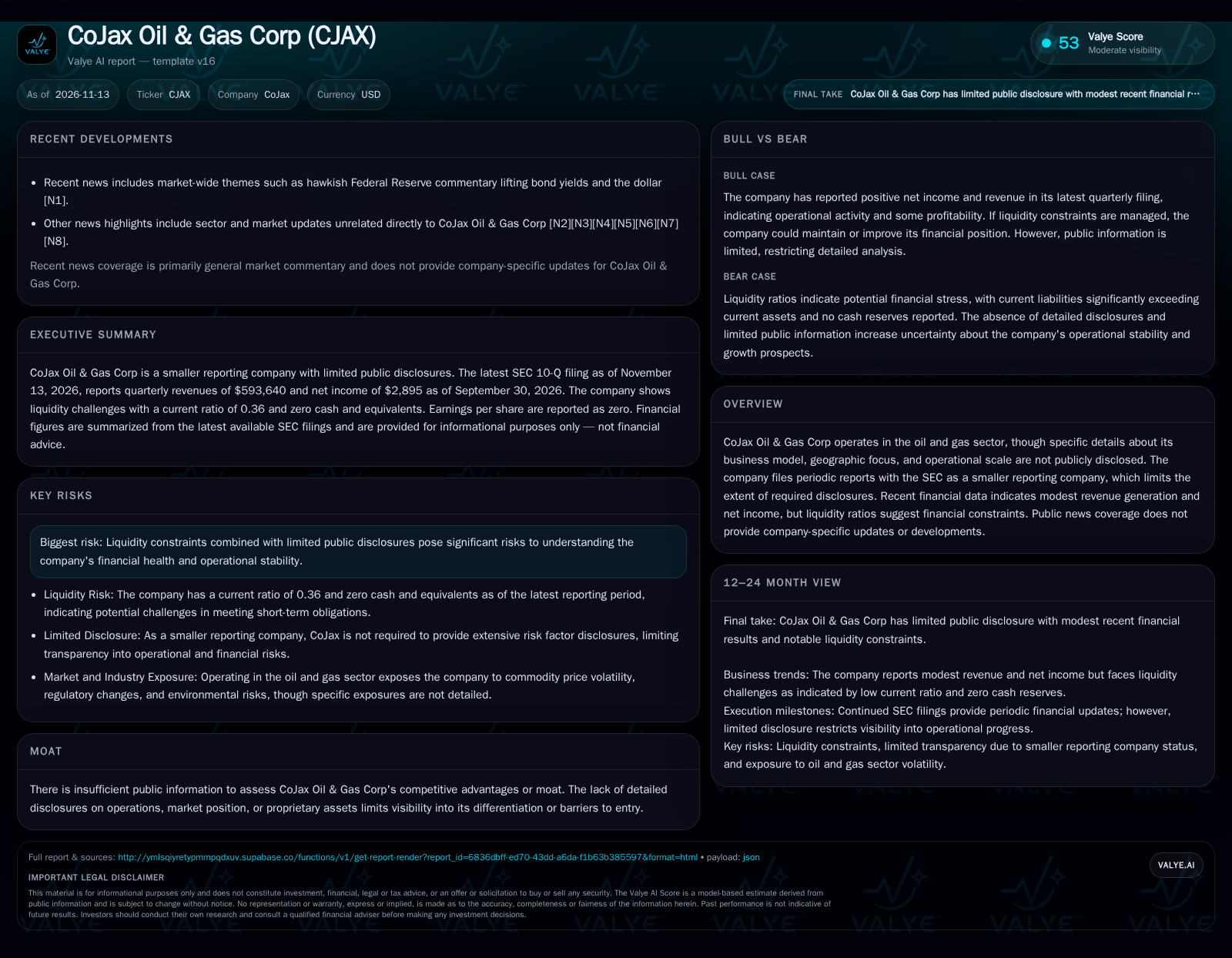
Limited public disclosure and no recent company developments leave its operational stability and ability to fund ongoing needs in question.
With minimal public disclosure and no clear operational roadmap, the company’s ability to weather sector volatility or fund even basic working capital needs remains uncertain. The central question for CoJax is not whether it can grow, but whether it can sustain operations without a significant injection of liquidity or a material change in its cost structure.
Recent Financials Highlight Operational Tension and Liquidity Stress
CoJax Oil & Gas Corp reported revenues of $593,640 and a net income of $2,895 for the quarter ended September 30, 2026, indicating ongoing operations and a slim profit [S2]. However, the company’s liquidity position is precarious: it had zero cash and cash equivalents at the end of the prior fiscal year, and current assets of $600,789 are dwarfed by current liabilities of $1,684,120, resulting in a current ratio of just 0.36 and a cash ratio of zero [S2]. Basic and diluted earnings per share for the quarter were also reported as zero, underscoring the negligible value creation for shareholders [S2]. As a smaller reporting company, CoJax is not required to provide detailed risk or operational disclosures, compounding the challenge of assessing its ongoing viability [S1] [S2].
Revenue Generation versus Working Capital Reality: The Economics of Survival
The company’s modest top-line revenue and razor-thin profitability suggest it is operating at a subsistence level, likely producing from mature or marginal oil and gas assets. In the upstream sector, fixed costs (lease operating expenses, regulatory compliance, minimal overhead) can be high relative to variable production costs, especially for small operators. This creates a narrow operating margin and limited flexibility—any drop in production volumes or commodity prices can quickly erode profitability.
The company reported cash and liquidity metrics for the period; these figures do not by themselves establish operating runway, investment capacity, financial flexibility, or financing capacity. This structure is inherently risky: suppliers and creditors may tighten terms, and the company may struggle to fund ongoing field operations, regulatory requirements, or even G&A expenses if external financing is unavailable. The absence of disclosed capital expenditure or development activity suggests little room for organic growth unless new funding is secured.
In the absence of cash reserves, even modest capital or maintenance needs could force asset sales, dilutive equity raises, or debt financing, each with its own set of risks and costs. The company’s basic economics currently reflect low financial resilience and highly limited reinvestment capacity.
Competitive Standing: Navigating a Fragmented, Volatile Sector with Limited Disclosure
CoJax operates in the intensely competitive upstream oil and gas sector, where scale, asset quality, and access to capital typically determine survival. Larger peers benefit from diversified asset bases, better hedging options, and lower per-barrel costs, while small independents like CoJax are vulnerable to commodity price swings, regulatory changes, and operational hiccups.
Without public details on reserves, production rates, or operational geography, it is impossible to assess whether CoJax holds any material competitive advantage—such as unusually low-cost assets, niche plays, or proprietary technology. The company’s limited disclosures and modest financials suggest a lack of significant scale or differentiation. In this environment, switching costs for counterparties are low, and customer (offtaker) relationships are typically transactional, not recurring or sticky.
The absence of disclosed debt facilities, joint ventures, or long-term sales contracts further clouds visibility into any strategic positioning. The plausible scenario is that CoJax is a price-taker with little leverage over suppliers or buyers, making it highly sensitive to sector-wide headwinds and local operational disruptions.
What Would It Take for a Turnaround? Pathways to Stabilization and Growth
A favorable scenario for CoJax hinges on a rapid restoration of liquidity and/or a step-change in operating efficiency. This could occur if the company secures a capital infusion—via new equity, asset sales, or a strategic partnership—that addresses short-term obligations and funds minimal growth or maintenance capital.
Upside evidence would include a reported financing event, disclosed asset monetization, or a surge in operating cash flow that moves the current ratio above 1 and restores positive cash balances. New disclosures about reserve growth, production increases, or cost reductions would further support a stabilization narrative. Confirmation might also come from new partnerships or offtake agreements that lock in price or volume visibility.
Falsification would be straightforward: continued negative operating cash flow, persistent zero cash balances, or creditor actions would undermine any turnaround thesis.
Sustaining Operations under Persistent Constraint: The Most Likely Trajectory
The most plausible outlook is one of ongoing operational fragility. CoJax may continue to generate modest revenue and scrape a thin profit, but with liquidity pressures limiting any reinvestment or growth. The company could persist in a holding pattern—paying suppliers slowly, deferring non-essential maintenance, and avoiding new commitments until working capital is restored or sector conditions improve.
This scenario would be confirmed by flat or declining revenue, continued zero or near-zero cash balances, and the absence of capital expenditure or new asset development. Earnings per share would likely remain negligible, and any operational setbacks (equipment failure, regulatory fines, or commodity price dips) could tip the company into losses. Without a step-change in funding or margin, CoJax remains at risk of forced asset sales or creditor intervention, but may avoid outright insolvency if sector conditions remain benign.
Liquidity Crunch Triggers Disruption or Restructuring
In an adverse scenario, CoJax’s liquidity constraints worsen, leading to missed payments, creditor actions, or operational shutdowns. Suppliers may shorten payment terms or demand prepayment, while the inability to fund maintenance or regulatory compliance could prompt production declines or asset impairments. Without external funding or a sudden improvement in cash flow, the company may be forced to pursue distress asset sales—potentially at a discount—or seek protection through restructuring proceedings.
Concrete evidence of this scenario would include new disclosures of accounts payable in arrears, lawsuits or liens, auditor going-concern warnings, or a rapid drop in reported production/revenue. Persistent negative working capital, rising short-term liabilities, or signals of management seeking emergency financing would further confirm downside risks.
Testing the Survival Thesis: Operational and Financial Benchmarks for CoJax
Reported cash and cash equivalents in future filings—an increase above zero would be a critical sign of improved liquidity.
Changes in current assets and current liabilities—movement in the current ratio toward or above 1 would signal reduced short-term stress.
Disclosure of any external funding, asset sales, or strategic partnerships—these would indicate management is addressing liquidity constraints.
Revenue and production trends (if disclosed)—declines may suggest operational stress or asset depletion.
Operating cash flow (if disclosed)—positive and growing cash flow would support a stabilization or turnaround case.
Any auditor commentary regarding going-concern status or financial risk.
Evidence of creditor actions, lawsuits, or regulatory penalties, which would confirm heightened distress.
Disclaimer: This is research-only, informational analysis and not investment advice. It may include AI-generated interpretation and general industry context. Always verify important details using primary sources.

Comments