
Gesher Acquisition Corp. II: Countdown to Business Combination and the Strategic Stakes for Israeli Tech SPACs
With its IPO proceeds secured in trust and a sector-focused mandate, Gesher Acquisition Corp. II faces a narrowing window to identify and close a business combination. The SPAC’s ultimate value hinges on management’s ability to execute in a competitive target environment, manage dilution risks, and deliver a compelling deal before the deadline.
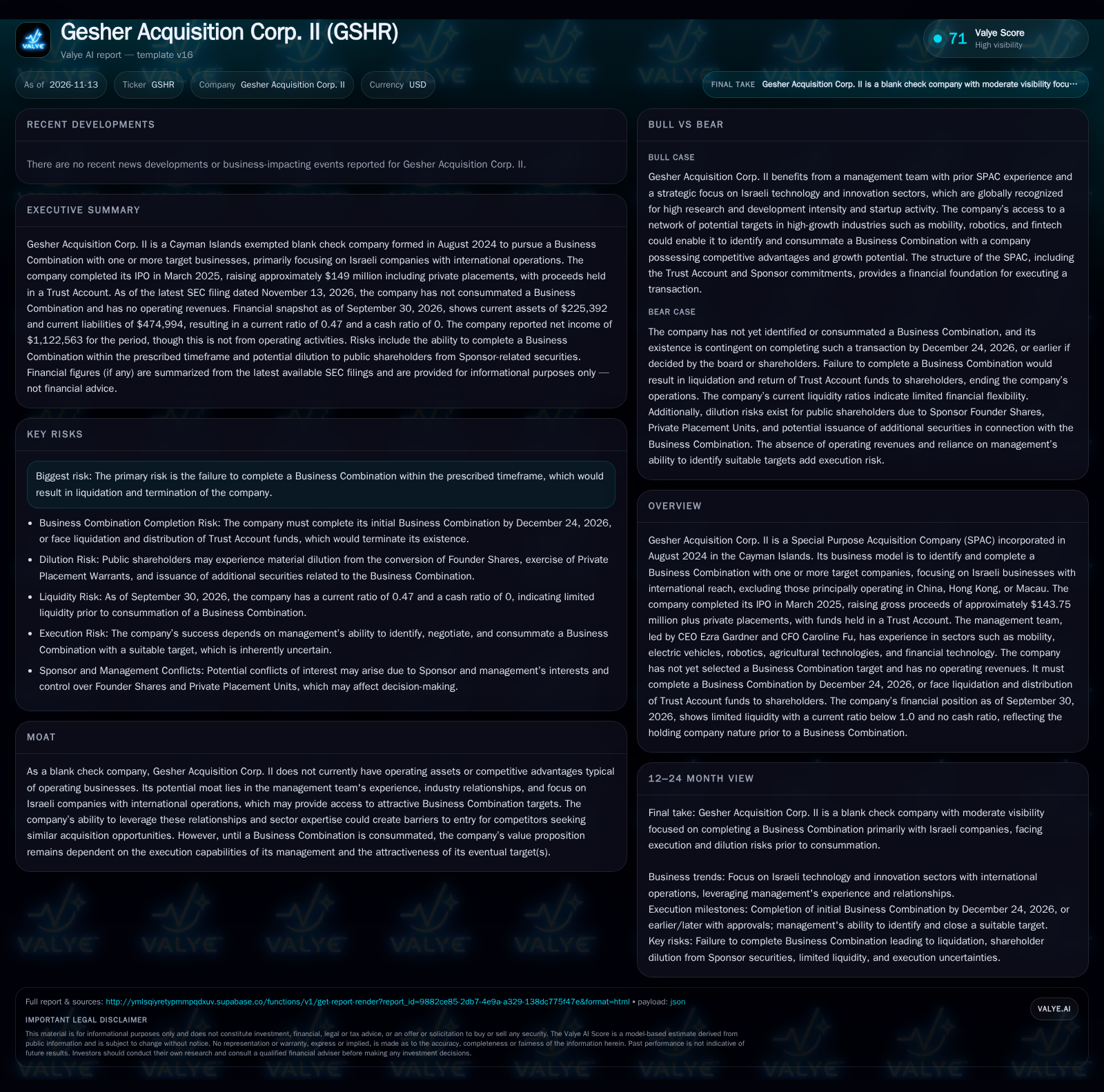
Gesher Acquisition Corp. II is a SPAC formed in 2024, targeting international Israeli tech businesses for acquisition. It raised $143.75 million in its 2025 IPO, but has not identified a target and must close a deal by December 24, 2026, or liquidate. Current financials show reported liquidity position outside the trust, while public shareholders face potential dilution from sponsor securities. The investment thesis now rests squarely on the management’s ability to source and negotiate an attractive transaction amid intensifying sector competition and a ticking clock. [S2]
Gesher Acquisition Corp. II stands at a critical juncture common to late-stage SPACs: flush with trust proceeds but yet to announce a business combination, it faces a fixed deadline and intensifying market competition for high-quality targets. With $144 million in trust and a mandate to acquire an Israeli company with international operations—primarily in high-growth sectors like mobility, robotics, agtech, and fintech—the SPAC’s fate will be determined by management’s ability to source, negotiate, and close a deal that justifies dilution and delivers value to public shareholders. The next 12 months are decisive, with execution risk and deal quality now front and center. [S2]
Gesher II’s Financial and Strategic Position Entering the Final Year
Gesher Acquisition Corp. II has completed its IPO and private placement, accumulating $144.18 million in a U.S. trust account as of March 2025. As of September 30, 2026, the company has not announced or closed a business combination and holds only $225,392 in current assets outside the trust, with current liabilities of $474,994. The company reported cash and liquidity metrics for the period; these figures do not by themselves establish operating runway, investment capacity, financial flexibility, or financing capacity. The SPAC must complete a business combination by December 24, 2026, or be forced to liquidate—returning trust funds to shareholders. No target has been identified or announced, and the structure includes founder shares and private placement units that could result in significant dilution to public shareholders upon a deal. The management team, led by CEO Ezra Gardner and CFO Caroline Fu, brings sector experience but now faces a rapidly narrowing execution window. [S2]
SPAC Economics: Trust Fund, Dilution Mechanics, and the True Cost of a Deal
A SPAC’s pre-acquisition economics are atypical: it earns no operating revenue, incurs administrative and diligence expenses, and is entirely dependent on trust proceeds for its ultimate transaction. Gesher II’s $144 million trust is the main asset; interest on these funds is typically minimal and earmarked for taxes and redemptions. The company’s operating costs until a deal are funded by minimal outside-the-trust cash, as reflected in the reported current ratio and cash ratio. Upon a successful business combination, the economics shift dramatically. Public shareholders can elect to redeem their shares for trust value, often leaving the post-deal company with less cash than headline proceeds suggest. The sponsor’s founder shares and private placement units, which convert to equity at the time of a deal, are a source of significant dilution—potentially reducing public shareholders’ percentage ownership materially. Additional share issuances or PIPE investments to fund the transaction or meet minimum cash conditions could exacerbate dilution further. SPACs often negotiate earnouts, warrants, or other sweeteners to bridge valuation gaps, but these further complicate post-merger cap tables. The fundamental economic question is whether the acquired target can justify this dilution and support a valuation above trust value, especially in a competitive market for high-growth Israeli tech assets.
Competing for Targets: Israeli Tech Focus and the Global SPAC Squeeze
Gesher II’s focus on Israeli companies with global operations in sectors like mobility, EVs, robotics, agtech, and fintech places it in direct competition with other SPACs, private equity, and strategic acquirers seeking similar assets. Israeli tech, renowned for its innovation and deal flow, has seen increased attention from global investors, driving up target valuations and making proprietary sourcing and sector relationships critical. SPACs face additional competition from direct listings and late-stage venture capital, which can offer alternative liquidity pathways and sometimes less dilution for founders. Gesher’s differentiator is its management’s network and sector expertise, but this advantage is untested until a target is identified and a deal is struck. The exclusion of targets in China, Hong Kong, or Macau narrows the universe but also sidesteps geopolitical risk. Ultimately, the SPAC’s ability to source a compelling, willing target—not just any target—will determine whether it can deliver value over trust redemption.
If Gesher II Secures a High-Quality Target: What a Value-Accretive Deal Looks Like
The best-case outcome is that Gesher II leverages its sector relationships to identify a high-growth Israeli tech company with clear international expansion prospects and a compelling business model. Such a target would have strong fundamentals, attractive growth metrics, and a credible path to public-market scrutiny. If the management can negotiate favorable terms, limit public redemptions, and structure the deal to minimize dilution (potentially via a significant PIPE investment at premium terms), the post-merger entity could trade above trust value, delivering returns to both public and sponsor shareholders. Confirmation of this scenario would include a deal announcement with a recognized, well-regarded target, low anticipated redemption rates, PIPE participation from reputable institutional investors, and guidance on post-merger growth and profitability. Falsification would be a lack of target announcement, a deal with a distressed or low-visibility asset, or excessive dilution that erodes public shareholder value.
Most Likely Trajectory: Deal Pressure Mounts, Dilution Rises, and Outcome Is Mixed
The most plausible scenario is that Gesher II announces a business combination in the coming quarters, likely under time pressure as the deadline approaches. The target may be a mid-tier or earlier-stage company in one of the focus sectors, possibly with some international traction but unproven at scale. To bridge valuation gaps and meet minimum cash conditions, the deal could require substantial redemptions and additional equity issuance, resulting in significant dilution to public shareholders. The post-merger entity may struggle to trade above trust value, and the return profile for public investors could be marginal or negative, especially if the underlying business lacks near-term profitability or clear competitive advantages. Evidence confirming this scenario would be a late-stage deal announcement, high redemption rates, and a complex post-merger cap table. Falsification would be either a high-quality, low-dilution deal or a failure to announce any transaction before the deadline.
Failure to Close: Liquidation Risk and the Cost of Inaction
If Gesher II fails to identify and close a business combination by December 24, 2026, the SPAC will be forced to liquidate, returning trust funds (less expenses) to public shareholders and rendering founder and private placement shares worthless. The risk of this scenario rises as the deadline approaches without a deal and as competition for attractive targets intensifies. Liquidation would likely result in a modest loss for public shareholders who purchased above trust value and a total loss for sponsors. Confirmation of this scenario would be a continued absence of target announcements, extensions without progress, or a failed shareholder vote on a proposed combination. Falsification would be a timely and credible deal announcement and successful closing before the deadline.
Milestones and Metrics That Will Determine Gesher II’s Outcome
Announcement of a definitive business combination agreement with a named target, including valuation, sector, and geographic details.
Level of public shareholder redemptions at deal closing—if disclosed—which will determine actual cash available to the post-merger company.
Details on PIPE financing or other concurrent capital raises, indicating external investor confidence and deal structure.
Nature and magnitude of dilution from sponsor shares, private placement units, and any additional share issuances tied to the deal.
Timeline updates or requests for extensions, which signal either deal progress or potential execution delays.
Communications or proxy filings outlining the target’s business model, growth metrics, and financial projections—if disclosed.
Changes in management alignment or sponsor lock-up terms, which could affect incentives and post-merger governance.
Any regulatory or shareholder vote hurdles that could impede deal completion or affect transaction timing.
Disclaimer: This is research-only, informational analysis and not investment advice. It may include AI-generated interpretation and general industry context. Always verify important details using primary sources.

Comments