
Apogee Acquisition Corp: Countdown to Business Combination and the Structural Stakes of the SPAC Lifecycle
With a fixed deadline of July 8, 2027 to close a business combination or face liquidation, Apogee Acquisition Corp’s financial position and internal control challenges shape both its opportunity and its existential risk. The outcome will hinge on its ability to identify and execute a credible deal amid persistent industry and regulatory headwinds.
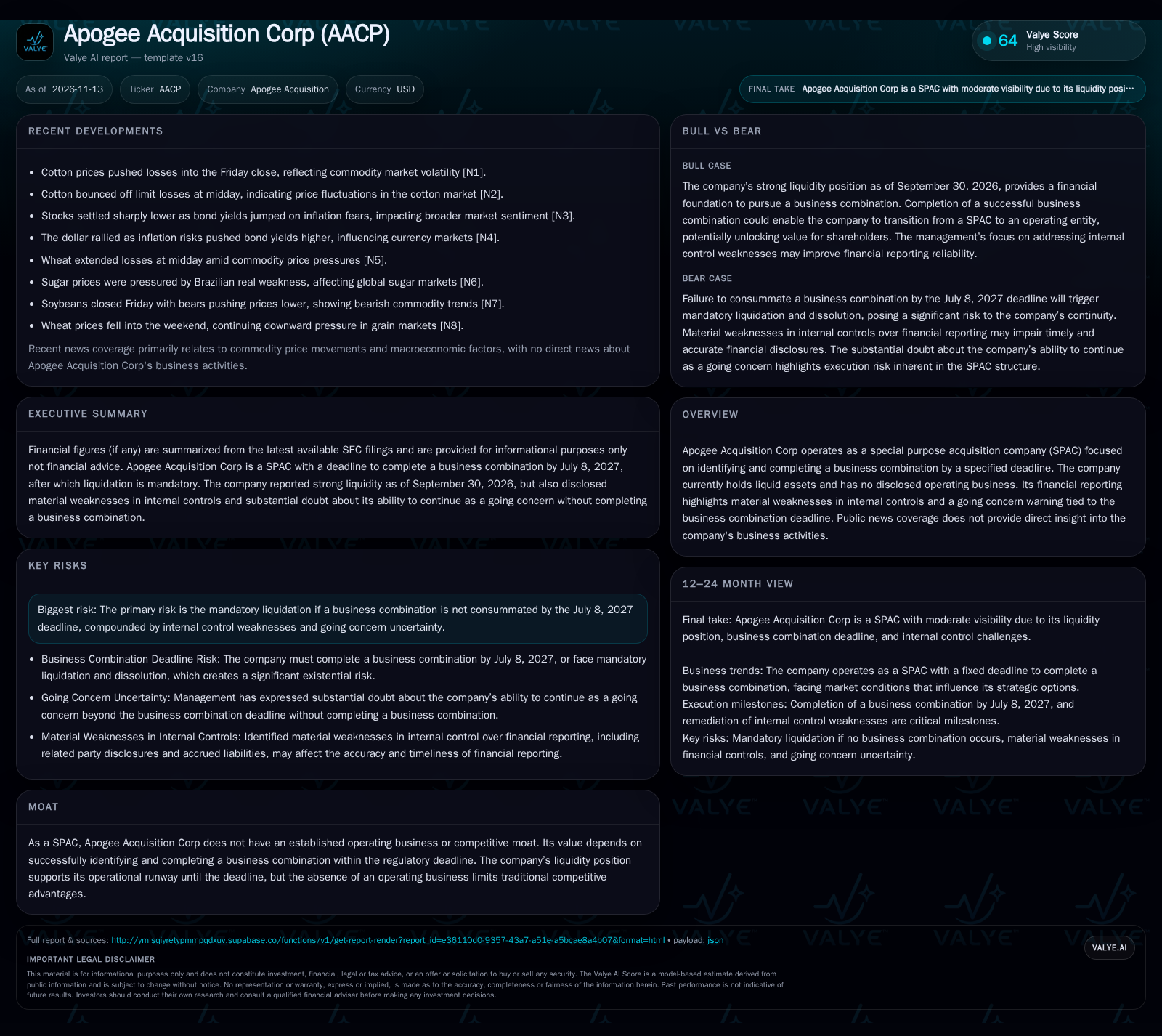
Apogee Acquisition Corp is a SPAC with a July 2027 deadline to complete a business combination or liquidate. The thesis will pivot on execution, deal quality, and remediation of governance issues, with the clock ticking toward mandatory dissolution if no transaction is consummated. [S1]
Apogee Acquisition Corp is approaching a critical juncture in its lifecycle as a special purpose acquisition company (SPAC). With the clock ticking toward a July 8, 2027 deadline to complete a business combination, Apogee’s financial disclosures reveal both a reported liquidity position and worrisome internal control deficiencies. The absence of any operating revenue and the existential risk of mandatory liquidation if no deal is closed leave the company entirely dependent on its ability to source, negotiate, and consummate a credible transaction. The next 18 months will determine whether Apogee can overcome governance headwinds and market challenges to deliver value or become another SPAC forced into dissolution.
Deadline Pressure, Liquidity Snapshot, and Governance Weaknesses Define the Present
Apogee Acquisition Corp is a SPAC with a hard deadline of July 8, 2027 to finalize a business combination, failing which it must liquidate and return remaining funds to shareholders. As of September 30, 2026, the company reports current assets of $421,626 and current liabilities of $29,895, giving it a current ratio of 14.1. While this ratio signals reported liquidity position, the figure is modest relative to the scale of most SPAC trust accounts and underscores the absence of operating revenue. More concerning, the company identified material weaknesses in its internal controls over financial reporting, particularly around related party transactions and accrued liabilities. Finally, management has expressed substantial doubt about Apogee’s ability to continue as a going concern if it does not secure a deal before the deadline, and there is currently no approved plan to extend this window. [S1]
How a SPAC Makes and Loses Money: Economics, Incentives, and the Deal Imperative
A SPAC like Apogee does not generate any operating revenues prior to completing a business combination. Its only income derives from interest on funds held in trust, which are generally invested in short-term securities. The economics are binary: if a business combination is consummated, the SPAC transitions to an operating company and may realize value for sponsors and public shareholders depending on the deal’s quality and post-merger performance. If no deal is completed, the company is liquidated, with shareholders typically receiving a pro-rata share of the trust account, minus certain expenses. The sponsor’s capital is at risk and, absent a deal, is largely forfeited.
The cost structure is highly fixed in the pre-deal phase—legal, accounting, regulatory, and search expenses are incurred regardless of deal outcome. If a transaction is consummated, the economics shift dramatically, with value creation (or destruction) hinging on the acquired business’s earnings power, growth prospects, and capital needs. A successful deal can deliver significant upside to sponsors via founder shares and warrants, but a poor deal or one struck under deadline pressure can destroy value for public shareholders. The presence of material internal control weaknesses adds further potential cost, both in terms of direct remediation and reputational risk that could complicate negotiations or regulatory approval.
Deal Sourcing in a Crowded Field: Apogee’s Position Relative to Other SPACs
Apogee faces competition from a large pool of SPACs and private equity vehicles all seeking attractive acquisition targets, especially in technology and advanced industries. The lack of a defined operating business or proprietary sourcing advantage means Apogee’s competitive position is determined by its sponsor network, deal-making reputation, and ability to move quickly on credible targets. The company’s stated focus on advanced technologies—spanning software, hardware, automation, and engineered materials—broadens the universe of potential targets but also exposes it to sectors with high valuations and significant diligence risk.
Material weaknesses in internal controls could put Apogee at a disadvantage compared to more robustly governed SPACs, as acquisition targets may prefer partners with clean audit trails and fewer regulatory complications. The clock is also a competitive threat: as the July 2027 deadline approaches, the risk of a suboptimal, ‘last-minute’ deal increases, while attractive targets may command higher premiums or be siphoned off by faster-moving or better-positioned acquirers. In this environment, the ability to remediate governance issues and maintain flexibility in deal structuring is critical for Apogee to compete effectively.
Unlocking Value Through a High-Quality Business Combination
The most favorable outcome for Apogee would be the identification and consummation of a business combination with a high-growth, well-governed technology or industrial platform. Success would require not only sourcing a credible target but also negotiating terms that align sponsor and public shareholder interests. Remediation of internal control weaknesses before deal close would improve credibility with both targets and public investors, potentially lowering the risk premium demanded in negotiations.
Confirmation of this scenario would come from a public announcement of a definitive merger agreement with a quality target, accompanied by improved internal control disclosures and positive proxy feedback from shareholders. Additional signs would include the ability to raise a PIPE (private investment in public equity) at favorable terms, positive media or analyst commentary on the deal’s strategic rationale, and regulatory filings that indicate a clean path to closing.
Most Likely Outcome: Deal Execution Under Pressure and a Compromise Transaction
The most plausible scenario is that Apogee pursues a business combination under increasing time pressure as the July 2027 deadline approaches. In this context, the company may close a deal with a target that is credible but not best-in-class, reflecting the reduced bargaining power and potential need to accept less favorable terms. Internal control weaknesses may be partially remediated, but not fully resolved prior to deal announcement, which could introduce additional disclosure risk or regulatory scrutiny in the merger process.
Evidence supporting this scenario would include a late-stage LOI (letter of intent) or merger agreement with a mid-tier target, disclosures indicating ongoing efforts to strengthen governance, and proxy materials reflecting some shareholder skepticism but eventual approval. Signs that would falsify this scenario include either a complete failure to announce a deal by the deadline or, conversely, the successful close of a transaction with a clearly market-leading target and robust governance.
Deal Failure, Governance Drag, and the Road to Liquidation
The downside scenario materializes if Apogee is unable to identify or consummate a business combination before the July 2027 deadline. This could result from several factors: continued or worsening internal control failures that deter quality targets, inability to secure shareholder or regulatory approval, or unfavorable market conditions that limit viable acquisition opportunities. In this outcome, the company would commence mandatory liquidation and return remaining trust proceeds to public shareholders, with sponsors forfeiting their at-risk capital.
Confirmation of this scenario would come from a lack of substantive deal announcements as the deadline approaches, worsening internal control disclosures, or formal SEC filings indicating preparations for liquidation. Shareholder communications expressing lack of confidence in management’s ability to execute, or public news of failed negotiations with potential targets, would also support the downside case.
Milestones That Will Shape Apogee’s Fate in the SPAC Lifecycle
Announcement of a letter of intent or definitive agreement with an acquisition target would be the clearest sign of strategic progress.
Remediation status of internal control weaknesses, especially in related party transactions and accruals, as disclosed in future SEC filings, will directly impact deal credibility.
Shareholder vote outcomes on any proposed business combination will be a key test of market confidence.
SEC or regulatory feedback on deal filings, particularly regarding internal controls and disclosure sufficiency, could accelerate or block transaction progress.
If disclosed, PIPE financing commitments or other third-party capital raised in conjunction with a deal would signal external validation.
Progress—or lack thereof—toward extending the business combination deadline if a deal is not imminent by mid-2027 would affect the risk of liquidation.
Quarterly updates on trust account balance and any material changes in cash position would help assess the company’s capacity to fund ongoing operations and deal costs.
Public communications from management regarding the deal pipeline, target sectors, or remediation efforts would provide visibility into execution and priorities.
Disclaimer: This is research-only, informational analysis and not investment advice. It may include AI-generated interpretation and general industry context. Always verify important details using primary sources.

Comments