
K2 Capital Acquisition Corp: Pursuing Physical AI and Advanced Energy Opportunities in a Challenging SPAC Market
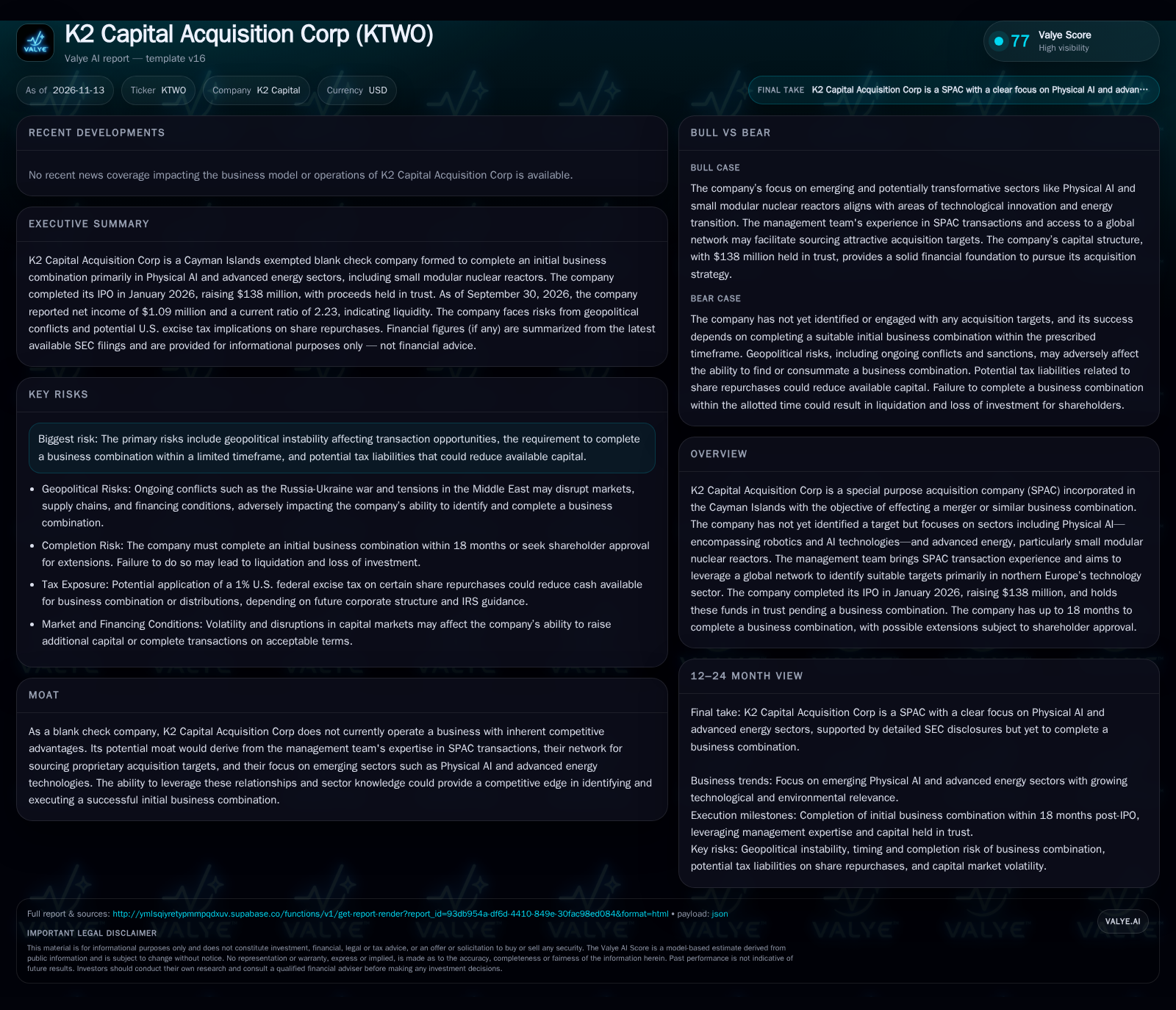
K2 Capital Acquisition Corp, a Cayman Islands-based SPAC, is targeting mid-market technology and energy businesses in northern Europe, with $138 million in trust and a mandate to complete a business combination within 18 months post-IPO. With no target identified as of late 2026, the firm’s prospects hinge on management’s execution in a competitive, geopolitically uncertain landscape.
K2 Capital Acquisition Corp is a newly formed SPAC with $138 million in trust, aiming to acquire a company in Physical AI or advanced energy (notably small modular nuclear reactors) by mid-2027. No target has been identified, and success will depend on deal sourcing, market conditions, and execution within the required timeline. Geopolitical risk and potential tax liabilities could complicate the process as the deadline approaches. [S2]
K2 Capital Acquisition Corp stands at a familiar SPAC crossroads: flush with $138 million in trust, an 18-month deadline ticking down, and a management team signaling intent but with no business combination target in sight as of November 2026. Its strategic focus on Physical AI and small modular nuclear reactors is timely, given industry momentum in automation and energy transition. However, the absence of a deal, heightened geopolitical risks, and the realities of the current SPAC market mean that K2’s ultimate trajectory will be determined less by sector tailwinds and more by execution, timing, and the ability to secure a differentiated, value-creating transaction before the clock runs out. [S2]
IPO Funds Are Secured, but Acquisition Targets Have Yet to Materialize
K2 Capital Acquisition Corp completed its IPO on January 30, 2026, securing $138 million in gross proceeds, all of which remain in trust pending the identification and consummation of a business combination. As of September 30, 2026, the company has not commenced any operating activities, nor initiated substantive discussions with any acquisition targets. The current asset base stands at approximately $887,454 against current liabilities of $397,351, reflecting a current ratio of 2.23. The company reported net income for the quarter of $1.09 million, driven entirely by interest income on trust assets, with no operating revenue. The 18-month acquisition window, extendable only by shareholder approval, is now more than halfway elapsed, increasing the pressure to identify and execute a qualifying transaction. [S2]
Economic Dynamics Shaping K2 Capital’s Potential Acquisition Outcomes
K2 Capital’s business model is typical of SPACs: raise capital via IPO, park proceeds in trust, and search for a private business to acquire. Until a business combination occurs, the company generates only nominal income from interest on trust assets, while incurring ongoing public company expenses. If a target is successfully acquired, the economics shift dramatically—K2 would become the parent of an operating business, with revenue, expenses, and cash flows determined by the acquired entity’s performance.
The company’s stated focus on Physical AI and small modular nuclear reactors suggests a preference for capital-intensive, high-growth sectors where valuation multiples can be attractive but integration and execution risks are significant. Acquisition targets are expected to have enterprise values below $750 million, indicating a mid-market focus. The economics post-combination will depend on the acquired company’s revenue growth, gross margins, and capital needs. If a deal is not consummated within the allotted time (or extensions), K2 will liquidate, returning trust proceeds to shareholders—typically with minimal yield after expenses.
Operating leverage is not present at the SPAC stage, but could become relevant post-merger if the chosen target has scalable technology or recurring revenue streams. The capital structure, with $138 million in trust, gives K2 meaningful capacity to finance a significant minority or control investment, but the final size and structure of the deal will depend on target valuation, additional PIPE (private investment in public equity) funding, and any redemptions by SPAC shareholders.
K2 Capital’s Position Within a Competitive SPAC and Technology Acquisition Arena
K2 Capital faces stiff competition from other SPACs, private equity, and strategic acquirers, particularly in the technology and energy sectors. The Physical AI and advanced energy verticals are attracting significant investor attention due to their innovation potential and relevance to global trends in automation and decarbonization. However, the SPAC market has grown more crowded and discerning, with many vehicles chasing a limited pool of high-quality, ready-to-list targets.
K2’s edge, if any, will derive from its management team’s SPAC track record and its stated global network, which may offer access to proprietary deal flow in northern Europe’s tech ecosystem. Targeting companies with differentiated technology, operational maturity, and sub-$750 million enterprise values could help avoid bidding wars with larger strategics or late-stage venture funds. Still, the lack of an identified target as of late 2026 underscores both the challenge of finding suitable candidates and the risk that K2 may be forced into a less attractive deal or face liquidation.
Potential substitute vehicles for targets include direct listings, traditional IPOs, or sales to private equity—each of which may offer a different risk/reward profile and execution certainty. The advanced energy sector, especially SMRs, also faces regulatory, capital, and geopolitical hurdles, which could deter some targets from opting for a SPAC route.
Value Creation Potential from Select Tech or Energy Acquisitions
The favorable scenario for K2 Capital hinges on sourcing a high-quality target in Physical AI or advanced energy that is both ready for public markets and undervalued relative to its long-term growth potential. If management leverages its network to secure proprietary access to a business with proven technology, strong revenue momentum, and a credible path to profitability, K2 could unlock significant value for shareholders. Such a deal could benefit from a scarcity premium, especially if capital markets reward exposure to automation or clean energy themes.
Confirmation of this scenario would come from the announcement of a signed business combination agreement with a credible, growth-stage tech or energy company, ideally with robust historical financials, visible revenue backlog, and a clear competitive moat. Additional PIPE commitments or non-redemption agreements would further validate market confidence in the deal. Falsification would be signaled if the company struggles to find a willing target, faces repeated shareholder extensions, or is forced to pursue a marginal or distressed asset.
The Expected Path: Completing a Standard Deal Under Time Constraints
The most plausible outcome is that K2 Capital identifies a business combination target in the Physical AI or advanced energy space within the original or extended deadline, but the deal is shaped by market realities—potentially requiring concessions on valuation, deal structure, or target quality. Given the competitive environment and the time constraint, K2 may need to settle for a target that is solid but not transformational, possibly with modest growth prospects or execution risks.
Evidence supporting this scenario would include the announcement of a letter of intent or merger agreement within the next 6-12 months, followed by regulatory and shareholder review. Signs of a base-case outcome would also include PIPE fundraising at moderate discounts, or some SPAC shareholder redemptions, reflecting the current market climate. If the company is unable to secure a deal before the initial window closes, but receives shareholder approval for an extension, that would also fit a base-case progression.
Risks Include Failed Deals, Liquidation, or Forced Transaction Losses
The negative scenario is that K2 Capital fails to identify or consummate a suitable business combination within the required timeframe, leading to mandatory liquidation and the return of trust proceeds to public shareholders (less expenses), resulting in opportunity cost and potential sponsor loss. Alternatively, under deadline pressure, K2 could execute a suboptimal deal with a lower-quality or distressed target, leading to post-merger share price declines and limited long-term value creation.
Confirmation of the downside would come from the absence of any announced target as the deadline approaches, failed extension votes, or the announcement of a deal with limited transparency, weak financials, or negative market reaction. A spike in SPAC redemptions or inability to raise additional PIPE capital would also signal eroding confidence. Geopolitical or regulatory shocks affecting the energy or tech sector could further complicate deal execution or post-merger performance.
Key Developments and External Influences Impacting K2 Capital’s Future
Announcement of a letter of intent or definitive agreement with a Physical AI or advanced energy company, with details on valuation, sector focus, and financial profile.
Shareholder votes on potential extensions beyond the initial 18-month window, and the level of support or dissent among public holders.
PIPE (private investment in public equity) commitments and terms, if disclosed, as indicators of institutional confidence in the chosen target and deal structure.
Levels of SPAC shareholder redemptions at deal announcement and closing, which will determine the capital available for the transaction.
Disclosure of target company financials, revenue growth, margins, and backlog, if available, to assess the quality and sustainability of the acquired business.
Updates on regulatory, geopolitical, or tax developments—especially those affecting cross-border deals, energy technology, or the application of the U.S. excise tax on redemptions.
If disclosed, ongoing involvement and operational integration plans by the K2 management team post-merger, to assess governance and execution risk.
Disclaimer: This is research-only, informational analysis and not investment advice. It may include AI-generated interpretation and general industry context. Always verify important details using primary sources.

Comments