
Canary Litecoin ETF: Structure, Exposure Mechanics, and the Leverage—and Limits—of a Single-Asset Crypto Trust
Canary Litecoin ETF offers investors direct, regulated exposure to Litecoin via a transparent trust structure, but its success is tightly coupled to the volatile, evolving crypto asset and the operational realities of single-asset ETPs. The interplay between protocol upgrades, market demand, and structural risk will define its future relevance.
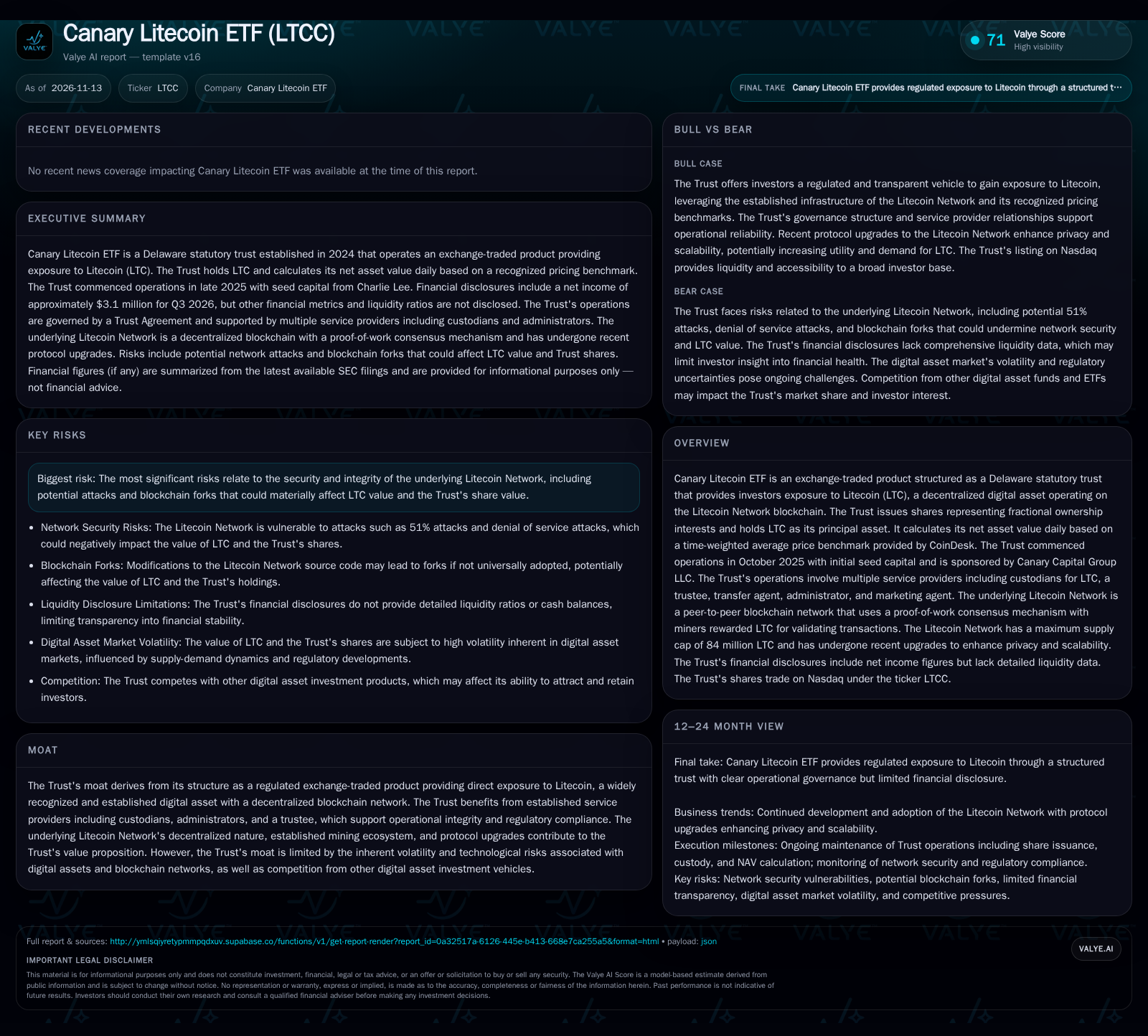
Canary Litecoin ETF is a Nasdaq-listed trust offering exposure to Litecoin, with Q3 2026 net income of $3.1 million but limited financial transparency. Its economics are fundamentally tied to Litecoin’s price and the trust’s asset base, while structural risks—both technical and competitive—may drive substantial future volatility. Protocol upgrades and network security pose key variables for long-term viability. [S1] [S2]
Canary Litecoin ETF embodies the promise and precariousness of regulated crypto exposure. As a Delaware statutory trust listed on Nasdaq, it gives investors a direct route to Litecoin ownership without the technical hurdles of wallets or exchanges. Yet, this simplicity masks a complex risk profile: the trust’s economics hinge on the price and integrity of Litecoin itself, which faces both technical evolution and existential threats common to the crypto sector. With recent protocol upgrades and a $3.1 million Q3 net income, the ETF’s structure delivers operational clarity but leaves open questions around liquidity, transparency, and long-term differentiation in an increasingly crowded digital asset market. [S1] [S2]
Latest Facts: Net Income, Launch Milestones, and Asset Ties
As of Q3 2026, Canary Litecoin ETF reported net income of $3,109,068 USD, providing an initial glimpse into the trust’s scale and operating flow. [S2] The ETF began operations in October 2025, seeded with $1 million by Litecoin creator Charlie Lee, who purchased 40,000 shares at $25 each and acted as statutory underwriter. [S1] The ETF’s investment objective is to track the price of Litecoin, with daily NAV set using CoinDesk’s time-weighted LTC price index. [S1] Notably, liquidity ratios, cash, and current asset details were not disclosed as of September 30, 2026. [S2] These facts underscore both the trust’s direct exposure mechanics and the limits of current financial transparency.
How the ETF Earns: Fee Structure, Asset Growth, and Embedded Leverage
The economics of Canary Litecoin ETF are fundamentally driven by two levers: the total value of Litecoin held and the trust’s fee structure. Like most single-asset crypto ETPs, the trust likely earns revenue primarily through management fees charged as a percentage of assets under custody—though the explicit rate is not disclosed in the available filings. [S1] This creates a business model where revenue scales with Litecoin’s price and with net inflows from investors seeking exposure.
Operating costs—custody, administration, trustee, and marketing—are largely fixed or semi-variable, so the ETF’s operating leverage should improve as AUM grows. However, the trust’s cost base is exposed to crypto-specific factors such as custody security premiums and regulatory compliance expenses. Inflows and outflows (via creation and redemption of shares in 10,000-share baskets) may also drive intermittent operational friction and affect realized income.
Because the ETF does not engage in lending, staking, or derivative strategies, its primary risk and return channels are tightly linked to Litecoin’s spot price. This structural simplicity is attractive to transparency-focused investors, but it constrains the trust’s ability to generate incremental yield or diversify away from LTC price shocks.
ETF Structure Versus Alternatives: Where Canary Litecoin ETF Stands Out—and Where It Doesn’t
Canary Litecoin ETF competes in a field of single-asset crypto ETPs, including products linked to Bitcoin, Ethereum, and other major digital assets. Its main advantage lies in providing regulated, exchange-traded exposure to Litecoin—a network with a decade-long history, significant liquidity, and growing protocol features like MimbleWimble privacy and LitVM smart contracts. [S1]
However, this niche is not impregnable. Competing ETFs or trusts linked to other cryptocurrencies may offer greater scale, liquidity, or lower fees, and multi-asset crypto funds can provide built-in diversification. Direct crypto ownership via exchanges or self-custody wallets remains an alternative for tech-savvy investors, often at lower ongoing cost. The trust’s reliance on third-party custodians (Coinbase Custody and BitGo) is standard for the sector but does not confer a unique moat.
Ultimately, Canary’s differentiation depends on Litecoin’s continued relevance and its ability to attract investors who prefer regulated vehicles over direct digital asset management. Any structural fee or liquidity disadvantages versus peer funds could erode its appeal over time.
If Litecoin Gains Broader Adoption, ETF AUM and Fee Revenue Could Accelerate
A favorable scenario unfolds if recent Litecoin protocol upgrades—such as MimbleWimble’s privacy enhancements and LitVM’s smart contract capabilities—spark renewed developer and user interest, leading to increased LTC transaction volume and price appreciation. As Litecoin’s perceived utility rises, institutional and retail demand for regulated exposure could drive significant inflows into the ETF.
If this occurs, Canary’s AUM would climb, amplifying fee revenue and improving operating leverage as fixed costs are spread over a larger base. Confirmation would come from accelerating share issuance (creation of new baskets), rising NAV per share, and growing trading volume on Nasdaq. Disclosures of higher AUM, increased net income, or reduced expense ratios (due to scale) would further validate this upside.
Conversely, if protocol upgrades fail to attract meaningful adoption or if competing networks outpace Litecoin in features or ecosystem growth, the ETF’s asset base and revenue potential would stagnate—a key falsification point for the bullish thesis.
A Tether to Litecoin’s Fate: ETF Performance Mirrors the Asset’s Price Swings
Absent a dramatic shift in Litecoin’s adoption or protocol risk, the most plausible outcome is that Canary Litecoin ETF’s scale and income will continue to track Litecoin’s market cycles. Net income will fluctuate with LTC price movements and investor flows, while the trust’s operational structure remains stable but unexceptional.
ETF share liquidity on Nasdaq should provide routine entry and exit for investors, but the lack of detailed financial disclosure—particularly around liquidity and asset composition—may cap appeal among institutional allocators. Fee income will rise and fall with AUM, and the trust will remain exposed to the same risks and volatility that define the broader crypto asset class.
Evidence confirming this scenario would include stable or moderately fluctuating AUM, net income tracking LTC price charts, and no major changes to disclosed fee or expense structures. Falsification would require either a significant protocol event (fork, attack, or breakthrough) or a competitive disruption from new product entrants or regulatory shifts.
Network Shocks or Regulatory Disruption Could Trigger Rapid Outflows and Erode Trust Utility
A negative scenario materializes if the Litecoin Network suffers a major technical setback—such as a 51% attack, critical vulnerability, or contentious blockchain fork. Such an event could undermine confidence in LTC and trigger a sharp decline in its price, directly impairing ETF NAV and potentially prompting mass redemptions or reduced trading liquidity. [S1]
Alternatively, a sudden regulatory clampdown on crypto ETPs or on Litecoin itself could limit the trust’s ability to operate or force changes in custody, listing, or disclosure practices. The absence of detailed liquidity data may exacerbate market stress if investors question the ETF’s ability to meet redemption or operational obligations. [S2]
Downside evidence would include abrupt NAV declines, surging redemptions, trading halts, or adverse regulatory actions. A persistent lack of financial transparency could amplify reputational and operational risk in such a scenario.
How Canary Litecoin ETF’s Future Will Be Tested: Operational, Market, and Network Milestones
Net asset value (NAV) per share trends—particularly deviations from underlying LTC price or peer ETFs—would help test the trust’s efficiency and tracking accuracy.
Aggregate assets under management (AUM), if disclosed, would clarify the ETF’s scale and investor traction over time.
Share creation and redemption activity (basket flows), if reported, would reveal investor sentiment and liquidity dynamics.
Expense ratio and management fee disclosures, if provided, would illuminate the trust’s cost competitiveness versus alternatives.
Major Litecoin protocol developments (e.g., network upgrades, forks, security incidents) will directly impact the ETF’s asset base and investor confidence.
Regulatory announcements affecting crypto ETPs or Litecoin’s legal status could reshape operational risk and market access.
Operational incidents at custodians (Coinbase Custody, BitGo) or service providers would test the trust’s resilience and the reliability of its infrastructure.
Improved transparency in quarterly or annual filings—especially regarding liquidity, asset breakdowns, and risk management—would help assess ongoing financial stability.
Disclaimer: This is research-only, informational analysis and not investment advice. It may include AI-generated interpretation and general industry context. Always verify important details using primary sources.

Comments