
Cingulate’s Regulatory Setback Resets the Clock: ADHD Pipeline Economics and the Road to Viability
Cingulate’s lead ADHD candidate, CTx-1301, faces renewed regulatory delays after an FDA Complete Response Letter in June 2026. As the company burns cash with no revenue, future value will hinge on resolving manufacturing issues, securing new funding, and ultimately breaking into a competitive ADHD therapeutics market.
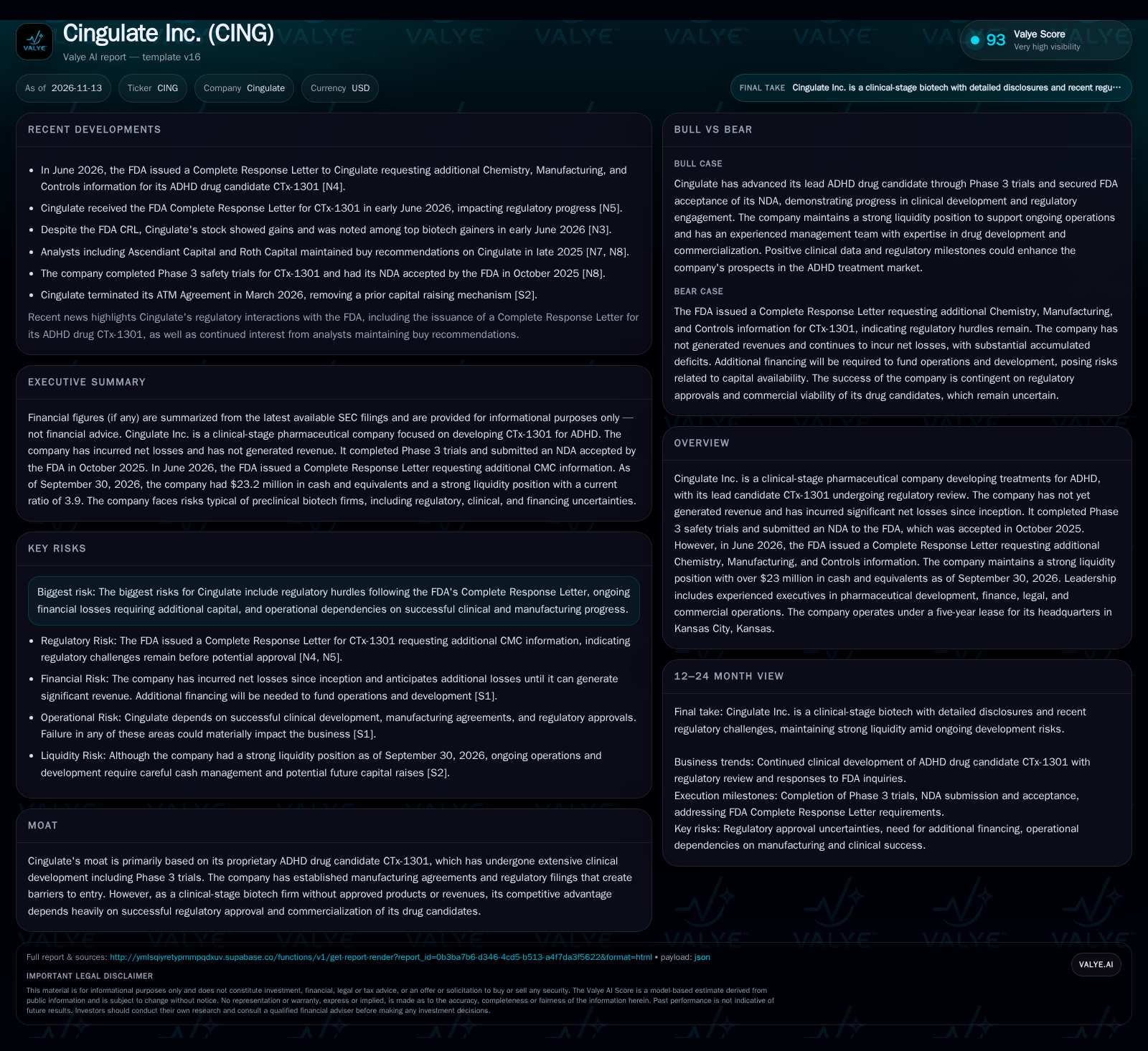
Cingulate remains a pre-revenue, clinical-stage biotech with its fortunes tied to CTx-1301 for ADHD. Following the June 2026 FDA Complete Response Letter requesting additional manufacturing data, near-term commercial progress is on hold. The next inflection point will be Cingulate’s ability to resolve regulatory issues, secure additional capital, and demonstrate progress toward approval.
Cingulate’s story is emblematic of clinical-stage biotechs: substantial scientific ambition, but no commercial revenue and a heavy reliance on external capital. The June 2026 FDA Complete Response Letter for lead ADHD candidate CTx-1301 has pushed back the company’s hoped-for inflection point, forcing a renewed focus on regulatory compliance and manufacturing validation.
Regulatory Hurdles Dominate the Near-Term Outlook
Cingulate’s most significant recent development is the FDA’s issuance of a Complete Response Letter (CRL) in June 2026 for its lead ADHD candidate, CTx-1301. The CRL specifically requested additional Chemistry, Manufacturing, and Controls (CMC) information, signaling that the agency’s concerns are rooted in the manufacturing and quality assurance processes rather than the clinical efficacy or safety of the product [N4] [N5]. This setback delays Cingulate’s regulatory timeline and, by extension, its pathway to revenue generation.
Financially, Cingulate ended the September 2026 quarter with $23.2 million in cash and cash equivalents, current assets of $25.3 million, and current liabilities of $6.5 million, resulting in a current ratio of 3.9 [S2]. However, the company continues to operate at a loss, reporting a net loss of $7.7 million for the third quarter of 2026 and accumulated losses of $132.4 million as of December 2025 [S1] [S2].
On the operational side, Cingulate has committed approximately $7.0 million to Bend Bioscience for manufacturing process validation batches of CTx-1301, highlighting a focused effort to address the regulatory deficiencies identified by the FDA [S1].
The nature of the FDA’s concerns centered on Chemistry, Manufacturing, and Controls (CMC) underscores the complexity and criticality of manufacturing consistency in pharmaceutical approvals. Unlike clinical efficacy or safety data, which often involve patient outcomes and trial results, CMC issues require demonstrating that the product can be reliably produced at scale with consistent quality attributes. This entails rigorous process validation, analytical method development, and stability testing. Failure to meet these standards can delay approval indefinitely, as regulators prioritize patient safety and product reliability over expedited timelines. Thus, the manufacturing validation phase becomes a pivotal bottleneck, with significant implications for operational planning and investor confidence.
Pipeline Economics: Cash Burn, Capital Needs, and Future Revenue Leverage
As a clinical-stage biotech, Cingulate’s current economic profile is defined by persistent cash burn, heavy R&D and regulatory spending, and no product revenue. [S2]
The cost structure is predominantly fixed in the near term, driven by ongoing clinical development, regulatory filings, and manufacturing scale-up—exemplified by the $7 million process validation contract with Bend Bioscience [S1]. Variable costs (such as royalties, sales force, and COGS) will only become relevant if and when CTx-1301 gains approval and launches commercially.
If CTx-1301 is eventually approved, the business model would likely shift to high-margin branded drug sales, with significant operating leverage as revenue scales faster than incremental fixed costs. However, the upfront capital intensity and the risk of additional regulatory setbacks mean that Cingulate’s ability to achieve positive cash flow is still highly speculative and dependent on future financing rounds.
Given the fixed nature of much of Cingulate’s current cost base, the company faces a critical inflection point where the timing and scale of future financing rounds will directly influence its ability to sustain operations through regulatory resolution. If capital markets become less receptive or if financing terms deteriorate, the company may be forced to curtail R&D activities or delay manufacturing investments, which could further prolong the approval timeline. Conversely, successful capital raises at favorable valuations would not only extend the runway but also provide optionality to accelerate scale-up and commercial preparations. This dynamic highlights the interdependence between clinical progress, regulatory milestones, and capital market conditions in shaping the company’s financial trajectory.
ADHD Therapeutics: Barriers, Substitutes, and the Challenge of Differentiation
The ADHD pharmaceutical market is highly competitive, dominated by established stimulants (such as amphetamine salts and methylphenidate generics) and several branded, extended-release formulations. Cingulate’s CTx-1301 aims to compete by offering differentiated pharmacokinetics or improved adherence, but faces entrenched prescribing habits and payer cost-containment pressures.
Barriers to entry in this space are substantial: regulatory approval, manufacturing scale-up, and commercial distribution all require significant execution. While Cingulate’s manufacturing agreements and regulatory filings may provide some short-term moat characteristics, the absence of commercial relationships or proprietary delivery technologies with proven market traction limits defensibility at this stage.
Generic substitution, payer formulary restrictions, and the presence of non-stimulant alternatives (such as atomoxetine or guanfacine) create additional headwinds. To carve out meaningful share, Cingulate’s product must demonstrate clear clinical or economic value relative to these entrenched options.
Resolving Regulatory Gaps and Accelerating Toward Approval
A favorable outcome for Cingulate would follow a causal chain in which the company rapidly addresses the FDA’s CMC concerns—leveraging its manufacturing partnership with Bend Bioscience to generate the requested data and resubmitting a robust dossier. If the regulatory agency accepts the new submission and grants approval within the next review cycle, Cingulate could transition to commercial-stage operations within 12-18 months.
Confirmation of this scenario would come from timely FDA acceptance of a resubmitted application, positive feedback on manufacturing data, and, potentially, partnership or licensing deals that validate the product’s commercial potential. Additional non-dilutive financing or strategic investment would further strengthen the bull case, as would early prescriber interest or payer formulary wins post-approval.
This path would unlock operating leverage from existing fixed costs, allow Cingulate to begin generating revenue, and potentially justify its ongoing R&D investments in additional pipeline programs.
Incremental Progress Amid Ongoing Capital Constraints
The most plausible path for Cingulate is one of incremental progress but continued financial pressure. The company may succeed in addressing the FDA’s CMC requirements, but the process is likely to take multiple quarters and could require iterative feedback or further investment in manufacturing validation. During this time, cash burn will persist, and the need to secure new funding—either through equity, debt, or partnerships—will become more acute.
This scenario would be confirmed by sequential disclosures of regulatory progress (such as FDA meetings, submission acceptances, or manufacturing milestones), accompanied by one or more capital-raising events. However, delays or additional FDA requests would indicate ongoing friction, while slow progress on commercial partnerships would suggest limited external validation.
If Cingulate is able to eventually secure approval and begin commercial launch, it is likely to do so with limited market share and under significant competitive pressure, requiring additional investment in sales infrastructure and post-marketing studies.
Prolonged Regulatory Delays and Capital Shortfall Threaten Viability
The downside scenario is characterized by protracted regulatory delays, repeated FDA requests for additional data, or unforeseen manufacturing challenges that prevent timely resubmission or acceptance of CTx-1301.
Evidence of this scenario would include negative updates on the regulatory process (such as additional CRLs), continued cash burn without new sources of funding, or public disclosures regarding going-concern risks. Failure to attract partnership interest or secure non-dilutive capital would further exacerbate the threat to ongoing viability.
In this outcome, Cingulate could be forced to halt development, pursue asset sales, or enter restructuring if it cannot bridge the gap to regulatory approval and revenue generation.
Milestones That Will Define Cingulate’s Next Act
Timeline and content of Cingulate’s resubmission to the FDA addressing CMC deficiencies for CTx-1301.
Updates on manufacturing process validation progress and whether Bend Bioscience delivers required batches on schedule and within budget; a useful metric would be cost and timeline adherence, if disclosed.
Announcements of new financing, partnerships, or licensing deals—especially those that are non-dilutive or signal commercial validation.
FDA acceptance and review timeline for the resubmitted CTx-1301 application; speed of review and absence of further major queries would support the bull case.
Any changes in the competitive landscape, such as new ADHD drug approvals, generic market entries, or payer formulary shifts, which could affect Cingulate’s future addressable market.
Disclosures of management or board changes, which may signal strategic pivots or responses to operational setbacks.
Disclaimer: This is research-only, informational analysis and not investment advice. It may include AI-generated interpretation and general industry context. Always verify important details using primary sources.

Comments