
GBank Financial: Concentration, Differentiation, and the Competitive Tension in Regional Banking
GBank Financial Holdings combines high-touch service and niche lending expertise with sector and geographic concentration risks, as recent financial results highlight the balance between growth initiatives and exposure to economic cycles.
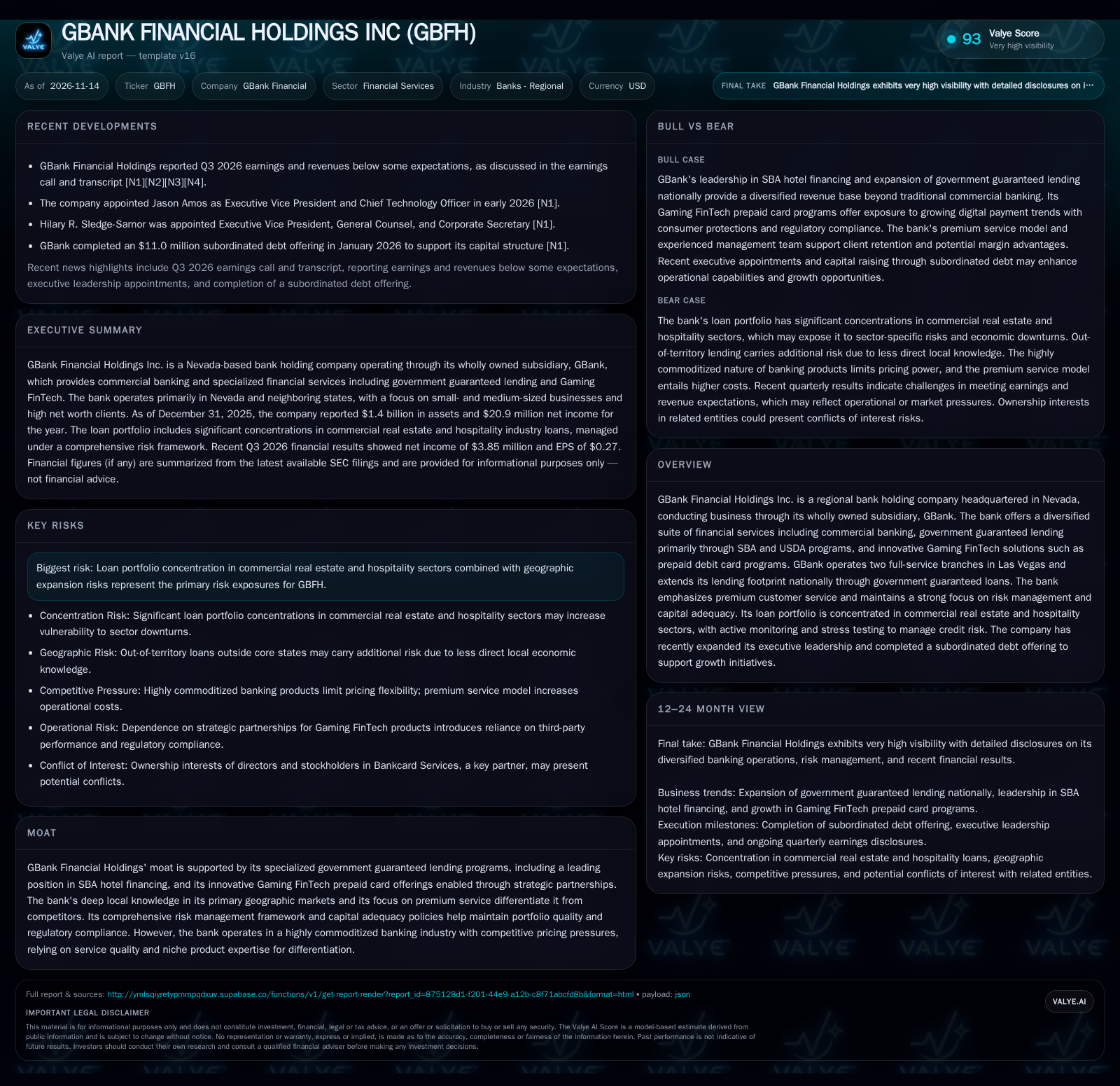
GBank Financial Holdings stands out for its leadership in SBA hotel financing, focus on Gaming FinTech, and premium client service model. Its most recent quarterly income and earnings per share fell short of some expectations, underscoring the ongoing challenge of managing outsized exposures to commercial real estate and hospitality lending. The bank’s strong capital ratios and government-guaranteed lending capabilities offer both resilience and growth avenues, but sustained performance will depend on managing concentration risks and competitive pressures in an industry where differentiation is difficult to maintain. [S1] [S2] [N1] [N2] [N3] [N4]
GBank Financial Holdings Inc. is a Nevada-based regional bank that has carved out a strong niche in government-guaranteed hotel lending and innovative Gaming FinTech payment solutions. Its strategy of high-touch service and specialization in select verticals has enabled outsized returns and growth relative to many peers. However, the bank’s concentrated exposure to commercial real estate and hospitality—sectors prone to cyclical swings—poses material downside risk, a concern that has come into sharper relief after recent earnings missed some expectations. The next phase for GBank will be defined by its ability to balance differentiated growth with prudent risk management in a commoditized and rapidly evolving banking landscape.
Recent Performance and Portfolio Exposures Shape the Risk-Reward Equation
GBank Financial reported net income of $3.85 million and EPS of $0.27 for Q3 2026, coming in below some analyst expectations and marking a period of earnings volatility. [S2] [N1] [N2] [N3] [N4] As of December 31, 2025, the bank’s total assets stood at approximately $1.4 billion, with $949.4 million in loans primarily funded by $1.1 billion in deposits. [S1] The loan book remains heavily concentrated: regulatory commercial real estate (CRE) loans represent 325% of unimpaired capital and surplus (UCS), hospitality loans 299% of UCS, and SBA/USDA unguaranteed loans 211% of UCS. [S1] GBank maintains a robust Tier 1 leverage ratio of 12.90%, providing a capital buffer against sector shocks. [S1] These facts highlight a business model that has delivered strong historical returns—13.61% ROE in 2025 [S1]—but is now facing increased scrutiny as sector and earnings volatility rise.
How GBank Monetizes Specialization and Service in a Commoditized Market
GBank generates revenue from a mix of interest income on loans and investments, fee income from loan servicing and sales, and service charges. [S1] Its economics differ from many regional peers by leveraging two distinct levers: first, a national reach in government-guaranteed lending—particularly SBA hotel loans—and second, a suite of Gaming FinTech prepaid products. The government-guaranteed lending business can offer relatively stable fee income and lower credit risk on the guaranteed portion, but often at thinner margins due to competition and regulatory pricing constraints. Gains on sale of the guaranteed portion of loans can be meaningful, though they may introduce quarter-to-quarter variability as origination volumes fluctuate.
The Gaming FinTech segment, through prepaid debit card programs, brings non-interest income potential and some insulation from traditional banking cycles. However, the economics of these programs depend on scale, interchange revenue, and the cost-sharing arrangements with Bankcard Services and other partners. Since the bank offers premium service—including rapid loan decisions and personalized onboarding—operating costs may run higher than those of lower-touch, digital-first competitors. Fixed costs are relatively modest due to limited branch footprint, but growth ambitions in FinTech and government lending may require periodic investment in technology, compliance, and talent. GBank’s capital needs are currently manageable given its strong leverage ratio, but any material portfolio losses or step-changes in regulatory capital requirements could constrain future growth.
Differentiation Through Niche Lending and FinTech: Advantages and Vulnerabilities
GBank’s competitive edge comes from its expertise in government-guaranteed lending—where it ranks #11 nationally in SBA 7(a) loans—and its early move into Gaming FinTech prepaid solutions. [S1] These niches allow the bank to attract clients less accessible to mass-market competitors and to command some relationship-driven pricing power, especially in hospitality lending. Its premium service model, with rapid loan decisions and personalized attention, further supports retention among small businesses and high net worth individuals.
However, the broader regional banking industry is intensely commoditized. Larger banks and digital-native players can compete aggressively on price, technology, and convenience. GBank’s concentration in hospitality and CRE increases vulnerability to sector downturns and regulatory scrutiny, while its FinTech offerings are dependent on third-party partnerships—introducing both operational dependencies and conflict of interest risks. The durability of GBank’s competitive position rests on continued success in these niches, prudent risk management, and its ability to adapt as digital banking and alternative lenders continue to reshape the landscape.
Unlocking Value Through Niche Expansion and FinTech Scaling
A favorable outcome for GBank would involve continued national expansion in government-guaranteed lending, especially if regulatory tailwinds or economic recovery drive increased SBA/USDA loan demand. As a top-tier SBA hotel lender, GBank could deepen relationships with hospitality operators and gain share in adjacent verticals. If the Gaming FinTech segment achieves scale—either through new prepaid programs, expanded partnerships, or technological enhancements—non-interest income could become a more material contributor, reducing reliance on traditional lending spreads.
This scenario would be confirmed by sustained double-digit ROE, growth in fee and non-interest income as a percentage of revenue, and further improvement in asset quality metrics despite concentration risks. Evidence for this pathway would include new strategic partnerships, successful launches of differentiated FinTech products, and regulatory or industry recognition of GBank’s expertise in government-backed lending.
Balancing Growth and Risk in a Cyclical, Competitive Environment
The most plausible trajectory for GBank is one of moderate asset growth, continued leadership in SBA hotel lending, and incremental scaling of its Gaming FinTech offerings. Net interest margins may compress gradually as competition intensifies and funding costs fluctuate, but fee income and gains on loan sales help buffer top-line volatility. Operating leverage remains constrained by the need for premium service and ongoing compliance investments, while portfolio concentration in hospitality and CRE will require vigilant risk management amid evolving economic conditions.
This scenario would be validated by stable or slightly improving asset quality metrics, Tier 1 capital ratios comfortably above regulatory minimums, and mid-single-digit annual earnings growth. Falsification would come from a sharp rise in non-performing assets, regulatory intervention due to concentration breaches, or persistent earnings misses relative to peers.
Sector Exposure and Partnership Risks Drive Potential for Earnings Disruption
A negative outcome could be triggered by a downturn in the commercial real estate or hospitality sectors, leading to elevated credit losses within GBank’s concentrated loan book. Deterioration in hotel performance—due to economic slowdown, overcapacity, or external shocks—would directly impact both traditional and SBA portfolios. If Gaming FinTech partners experience operational or regulatory setbacks, fee income and client acquisition could stall or reverse, exposing the bank’s dependence on external parties.
Downside evidence would include a spike in non-performing loans, declining capital ratios toward regulatory minimums, negative trends in fee/non-interest income, or loss of key FinTech partnerships. Any regulatory action related to concentration limits or conflicts of interest would further exacerbate the risk profile.
Thesis Testing: Lending Mix, FinTech Momentum, and Risk Controls in Focus
Quarterly updates on loan portfolio concentrations by sector and geography—especially CRE and hospitality—as a percentage of unimpaired capital and surplus.
Trends in non-performing assets, charge-offs, and delinquency rates, disaggregated by loan type where possible.
Growth rates and revenue contribution from Gaming FinTech prepaid programs and associated non-interest income, if disclosed.
Magnitude and composition of loan sales/gains from government-guaranteed lending, including volume, fee income, and pricing trends.
Tier 1 capital and leverage ratios relative to regulatory minimums and peer benchmarks.
Updates on the nature, scale, and terms of strategic partnerships with Bankcard Services and other FinTech collaborators.
Management commentary or regulatory disclosures regarding conflicts of interest, especially related to directors’ and stockholders’ external holdings.
Evidence of investment in technology, compliance infrastructure, or new product launches that could impact operating leverage and competitive positioning.
Disclaimer: This is research-only, informational analysis and not investment advice. It may include AI-generated interpretation and general industry context. Always verify important details using primary sources.

Comments