
Talon Capital Corp.: Blank-Check Formation, Financial Position, and the Strategic Stakes of a Still-Uncommitted SPAC
Talon Capital Corp. is a special purpose acquisition company (SPAC) with nearly $250 million gross IPO proceeds and no operating business to date. Its positive net income and ample current assets reflect interest income and prudent cash management, but the absence of a business combination or identified target leaves the company’s long-term value and risk profile almost entirely dependent on future deal execution.
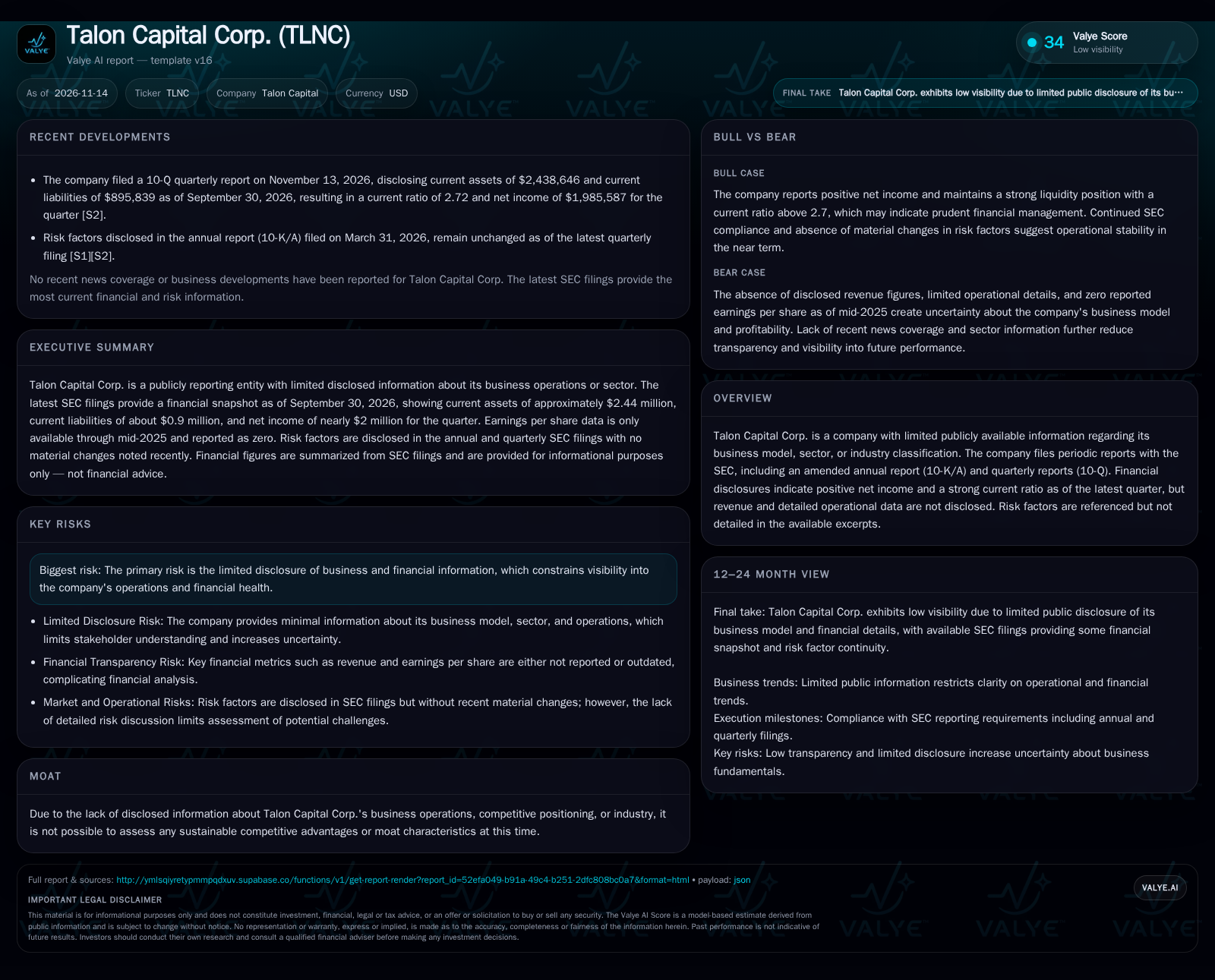
Talon Capital Corp. is a blank-check company formed to pursue a business combination, with $2.4 million in current assets and positive net income as of September 30, 2026. No operating revenues or acquisition targets have been disclosed, and all financial results to date reflect non-operating interest income on IPO proceeds. The company’s future value hinges on its ability to identify and close a compelling acquisition, particularly in the energy and power sectors, while managing the ticking clock and investor expectations inherent to SPAC structures. [S2]
Talon Capital Corp. represents the classic blank-check SPAC archetype: flush with IPO proceeds, publicly traded, and yet to consummate a business combination. Its current financials, showing a positive net income and liquidity coverage, mask the reality that all reported earnings are derived from interest on trust assets, not from business operations. With the clock ticking on its post-IPO acquisition window and no target yet identified, the company’s future is defined less by its present balance sheet and more by the execution risks and strategic decisions that will determine whether it creates lasting shareholder value or faces the costly consequences of an unsuccessful deal process.
Financial Snapshot Reflects SPAC Trust Management, Not Operating Momentum
As of September 30, 2026, Talon Capital Corp. reported current assets of $2,438,646 and current liabilities of $895,839, producing a current ratio of 2.72. Net income for the quarter was $1,985,587. However, these figures do not reflect operating activities, as the company has not commenced any business operations or generated revenue. Instead, the net income derives from interest income on IPO trust proceeds. The company’s SEC filings confirm its status as a blank-check company with no identified acquisition target and no material changes in risk disclosures [S2].
The absence of revenue and operational detail underscores that Talon remains in the pre-deal SPAC stage, with financial results driven by trust asset management rather than business execution.
SPAC Economics: Interest Income, Fee Burden, and the Binary Nature of Future Value
Talon Capital’s current financial profile is typical for a SPAC in its pre-deal phase. With IPO proceeds held in trust, the company generates non-operating income from interest—potentially meaningful in a higher-rate environment. However, these earnings are offset by ongoing public company costs, including legal, compliance, and administrative expenses.
The economics fundamentally change only upon completion of a business combination. At that point, the company’s future revenue, margin structure, and capital needs would depend entirely on the acquired operating business. Until then, capital preservation and expense discipline are paramount.
SPACs are also subject to a fixed timeline, typically 18-24 months post-IPO, to identify and close an acquisition, or else return funds to shareholders (minus certain expenses). This creates a ticking clock that can impact negotiating leverage with targets and potentially pressure sponsors to pursue less attractive deals as deadlines approach.
The interplay between interest income generation and ongoing operational expenses creates a delicate financial balancing act for SPACs like Talon Capital. While higher interest rates can temporarily boost income from trust assets, this advantage is inherently transient, as the principal amount is fixed and must be preserved for eventual distribution or investment. Consequently, the sustainability of net income in the pre-deal phase is limited, emphasizing the importance of cost controls. Moreover, the fee structure, including underwriter fees and sponsor promote arrangements, can materially affect the net proceeds available for acquisition, thereby influencing the economics of any potential deal. Understanding these dynamics is crucial to assessing the SPAC’s runway and the incentives driving sponsor behavior.
SPAC Market Dynamics and the Challenge of Sourcing Quality Deals
Talon Capital enters a fiercely competitive SPAC landscape, where hundreds of blank-check companies vie for a limited pool of attractive acquisition targets. While Talon’s filings state an intent to focus on energy and power, the mandate is broad and not sector-constrained [S2].
SPAC sponsors compete not only among themselves but also against private equity, strategic buyers, and increasingly, direct listings. The ability to secure a compelling deal often hinges on sponsor reputation, target access, and alignment of interests. In the current environment, regulatory scrutiny and market skepticism toward SPAC structures further complicate the path to value creation.
The absence of a disclosed target means Talon’s relative positioning is undefined—the company’s future competitive stance will be determined entirely by the quality and execution of its eventual business combination.
Value Creation Hinges on Securing and Executing a High-Quality Acquisition
The optimistic scenario for Talon Capital is straightforward: the company identifies and closes an acquisition with a fundamentally strong, scalable business—ideally in the energy or power sectors where deal flow and growth opportunities remain robust. A well-vetted target with clear revenue, profitability, and growth levers could drive significant upside for SPAC shareholders if the deal is structured favorably and market sentiment is supportive.
Confirmation would come from a public announcement of a signed business combination agreement with detailed target financials, sector fit, and projected synergies. Early investor enthusiasm, a positive market reaction, and clear guidance from management on integration and value-creation plans would further validate the upside case.
Falsification would occur if the company fails to secure a target or if the announced deal is met with skepticism due to valuation, execution, or governance concerns.
Most Likely Course: Prolonged Target Search Amid Rising Investor Scrutiny
Given the competitive SPAC environment and lack of a disclosed target, the most plausible scenario is a continued search for a suitable acquisition—potentially with incremental operating expenses and declining interest income as trust funds are gradually depleted by public company costs.
Confirmation would come from ongoing SEC filings with no material developments, continued positive but diminishing net income from non-operating sources, and possibly shareholder pressure for updates or extensions as the SPAC’s deadline approaches.
Falsification of this scenario would occur if Talon unexpectedly announces a business combination or, conversely, signals the return of funds to shareholders due to an unsuccessful search.
Deal Failure, Redemption Pressure, or Poor-Quality Target Selection
The principal risks for Talon Capital are endemic to the SPAC model. The most adverse scenario would see the company unable to identify or close a suitable business combination before its mandated deadline, forcing a liquidation and return of trust proceeds to shareholders—potentially after the deduction of expenses and fees.
Alternatively, under deadline pressure, the company could pursue a suboptimal acquisition, resulting in high shareholder redemptions, post-merger stock declines, or value-destructive dilution. The quality of due diligence, deal structure, and post-merger governance are critical variables.
Confirmation of downside would be an SEC filing announcing liquidation, a high redemption rate on deal announcement, or negative market reaction to a low-quality or highly dilutive transaction.
Milestones and Disclosures That Will Shape Talon Capital’s Next Chapter
Announcement of a definitive agreement for a business combination, including target details, sector, and financials, would be the primary inflection point.
Updates on the SPAC’s trust account balance and evolving net interest income, as disclosed in future SEC filings, would help gauge capital preservation and runway.
Extension or amendment proposals to the SPAC’s acquisition deadline would signal either progress or challenges in the deal process.
Shareholder redemption rates at the time of a deal announcement or extension vote would provide insight into investor confidence and dilution risk.
Disclosure of any material changes in risk factors or litigation would indicate shifts in the company’s risk profile.
Appointment of new directors, advisors, or key personnel—especially those with sector or transaction experience—could suggest imminent deal activity.
If disclosed, breakage fees, deal termination penalties, or material expense accruals would clarify the downside risk in the event of deal failure.
A useful metric would be the per-share trust value net of anticipated expenses, to assess liquidation value and downside protection for public shareholders.
Disclaimer: This is research-only, informational analysis and not investment advice. It may include AI-generated interpretation and general industry context. Always verify important details using primary sources.

Comments