
Opaque Structure, Positive Net Income: Dissecting Canary Staked SUI ETF’s Business Prospects
With a reported quarterly net income of $13.2 million but minimal transparency into its underlying assets or staking mechanics, Canary Staked SUI ETF presents a paradox of visible profitability and deep opacity. Investors must weigh the allure of blockchain-linked returns against the risks of limited disclosure and uncertain structural resilience.
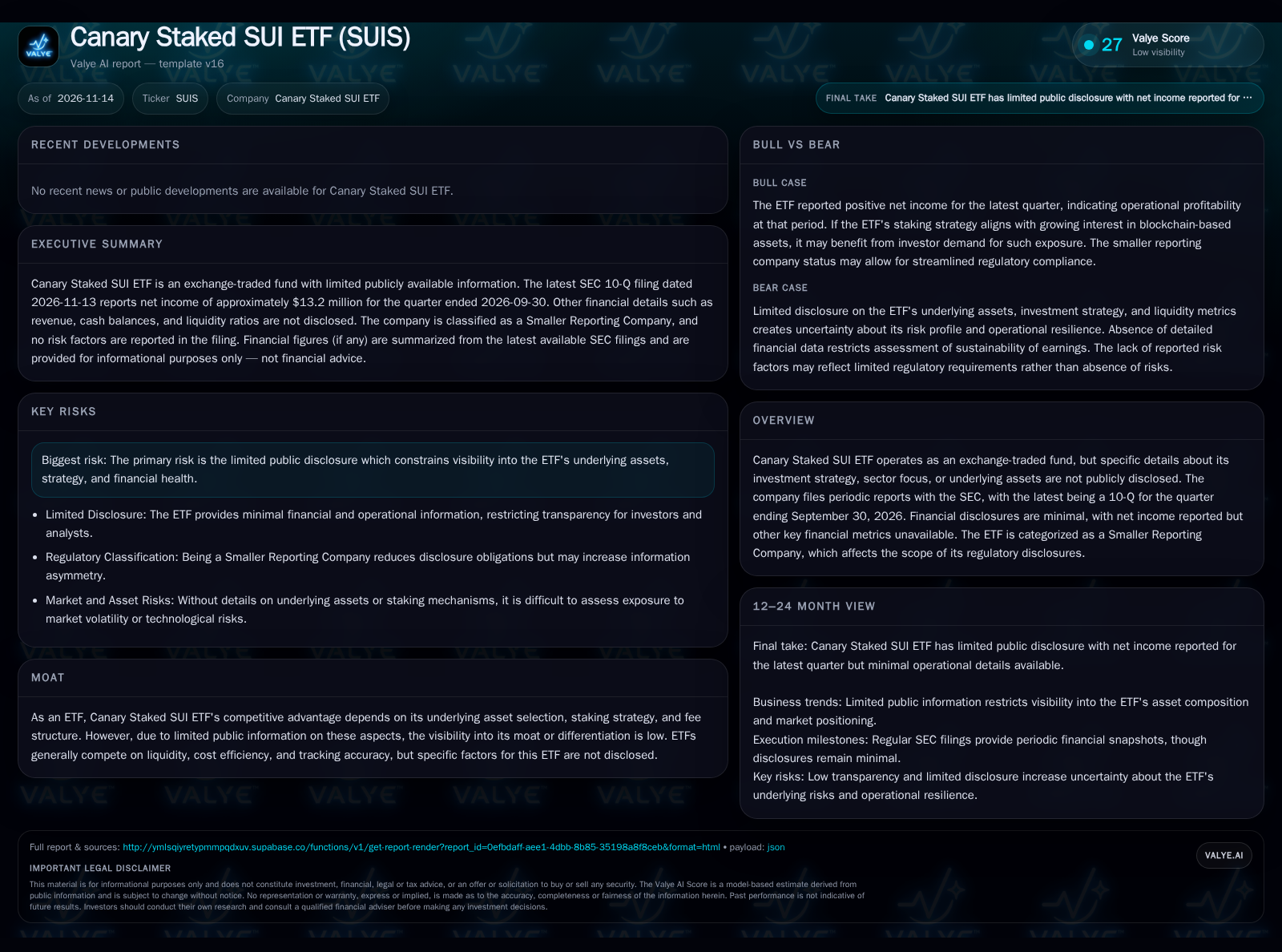
Canary Staked SUI ETF reported $13.2 million in net income for the quarter ended September 30, 2026, but offers little public detail about its investment strategy, underlying assets, or liquidity. The ETF’s profitability is notable, yet the lack of transparency around its staking approach and risk exposures complicates any thesis on its sustainability or competitive edge [S1].
Canary Staked SUI ETF stands out for its reported $13.2 million net income in the latest quarter, a rare sign of profitability among blockchain-linked investment vehicles. However, this financial snapshot is accompanied by a pronounced lack of transparency: investors receive no insight into the ETF’s underlying assets, staking strategy, or liquidity position. The combination of positive earnings and minimal public disclosure creates a challenging environment for fundamental analysis, forcing investors to navigate potential opportunities and risks largely in the dark. Understanding how value could be created—or eroded—requires a deeper dive into the mechanics, incentives, and structural uncertainties unique to this ETF’s model.
Profitability Without Transparency: The Paradox at Canary Staked SUI ETF
The most material current fact is the ETF’s reported net income of $13,196,495 for the quarter ended September 30, 2026 [S1]. This level of profitability is unusual for blockchain-linked ETFs, which often face volatile returns and operational drag. However, the SEC filing discloses no further financial metrics—omitting details such as assets under management, cash position, revenue sources, or expense structure. The fund is classified as a Smaller Reporting Company, which entitles it to reduced disclosure obligations and results in no risk factors being published in the 10-Q filing [S1]. The upshot is a business that appears profitable on paper, but whose underlying economic drivers remain largely invisible to outside observers.
How Value May Be Generated: Staking, Fees, and Blockchain Yield Dynamics
As an ETF likely centered on SUI blockchain assets and staking, Canary Staked SUI ETF’s economics would plausibly depend on capturing staking yields and passing a portion of these returns to shareholders, net of management fees. In typical staked-asset ETFs, revenue is derived from staking rewards earned on held crypto assets, which can be volatile and subject to blockchain network conditions, validator performance, and protocol rules. The ETF could also generate income from lending or other ancillary yield-generating activities, but this is speculative in the absence of disclosure.
Operating leverage in such structures is typically high: fixed administrative and custody costs are spread over a potentially growing asset base, while variable costs are relatively modest. The fee structure—whether a flat management fee or a performance-linked charge—directly impacts net returns to investors and the fund’s own profitability. Without detailed expense data, it is difficult to assess the sustainability of the reported net income. Furthermore, the ETF’s capital needs are likely limited, aside from working capital—unless it employs leverage, which is not disclosed in the available filings. The company reported cash and liquidity metrics for the period; these figures do not by themselves establish operating runway, investment capacity, financial flexibility, or financing capacity.
Competing for Blockchain-Linked Flows: Advantages and Uncertainties
ETFs in the blockchain or staking space generally compete on three axes: yield (net of fees), tracking accuracy to underlying asset performance, and liquidity. If Canary Staked SUI ETF is able to consistently deliver net income and attractive staking yields, it could attract flows from investors seeking blockchain exposure without the technical complexity of self-custody. However, the absence of public information on its fee schedule, asset mix, or staking protocols makes it impossible to benchmark its competitiveness versus peers.
The competitive landscape includes other staking-focused ETFs, crypto trusts, and direct staking platforms. Substitution risk is elevated: investors can opt for direct staking if the ETF’s fees or tracking error are perceived as too high. Furthermore, the ETF’s moat—if any—would depend on proprietary staking infrastructure, superior validator relationships, or regulatory clarity. None of these potential advantages are established by current disclosures. The fund’s Smaller Reporting Company status may allow it to operate with lower compliance costs, but also reduces investor confidence due to information asymmetry.
If Staking Yields and Blockchain Demand Outpace Risks
A favorable scenario would see Canary Staked SUI ETF continue to capitalize on robust staking yields from SUI blockchain assets, with net returns to investors staying ahead of both competing funds and direct staking alternatives. This could drive asset inflows, increasing scale, reducing per-unit costs, and potentially boosting net income further. If the ETF’s fee structure is competitive and its staking operations are efficient, it could build a reputation as a go-to vehicle for SUI exposure.
What would confirm this scenario? Disclosure of steadily rising assets under management (AUM), consistently positive net income, and competitive fee ratios would all support the thesis. Evidence of low tracking error to SUI price or yield benchmarks, as well as high secondary-market liquidity, would further validate the ETF’s positioning. Conversely, signs that net income is a temporary anomaly—such as a sharp drop in staking rewards or a surge in redemptions—would falsify the upside.
Sustained Profitability, but Persistent Opacity Limits Investor Confidence
The most plausible middle path is that Canary Staked SUI ETF continues to generate positive net income from staking or related blockchain-linked activities, but does so under a persistent shroud of limited disclosure. Investors may tolerate this opacity if returns remain attractive, but the lack of transparency could cap institutional adoption and leave the fund vulnerable to abrupt outflows if sentiment shifts or operational issues surface.
This scenario would be confirmed by regular, albeit minimal, SEC filings showing continued profitability and no material adverse events—but would be falsified by a sudden drop in net income, regulatory intervention demanding more disclosure, or negative press regarding liquidity or asset composition. The ETF’s ability to maintain a stable investor base without greater transparency is a key uncertainty.
Structural Risks Surface: Opacity Masks Volatility or Operational Weakness
A negative outcome could result if the limited transparency conceals material risks—such as concentrated exposure to illiquid or volatile SUI assets, staking protocol changes that slash yields, or operational failures in custody or redemption mechanics. In such a scenario, net income could rapidly deteriorate, triggering redemptions and liquidity pressures that further erode investor confidence.
Evidence supporting this scenario would include a sharp reversal in reported net income, regulatory scrutiny over disclosure practices, or market rumors about asset quality or redemption delays. If the ETF is forced to provide additional transparency under duress, the discovery of structural weaknesses could accelerate outflows and depress its market standing.
What Needs to Be Disclosed to Assess Canary Staked SUI ETF’s True Risk-Reward
Disclosure of underlying asset composition—what percentage is staked SUI versus other assets or cash equivalents—would help evaluate concentration and diversification risk.
Assets under management (AUM) trends, if disclosed, would show whether the ETF is attracting or losing investor capital.
Fee structure details (management, performance, and other charges) would clarify the net yield available to investors and the sustainability of profits.
Staking yield realized versus theoretical yield benchmarks would illuminate operational efficiency and the reliability of income sources.
Any disclosure of counterparty, custody, or smart contract risks would be vital for assessing operational resilience.
Regulatory developments or changes in reporting requirements could force greater transparency or introduce new compliance burdens.
Material changes in SUI blockchain protocol, staking rules, or validator economics would directly impact the ETF’s core business model.
Disclaimer: This is research-only, informational analysis and not investment advice. It may include AI-generated interpretation and general industry context. Always verify important details using primary sources.

Comments