
21Shares Hyperliquid ETF: Token-Linked ETF Mechanics, Staking Leverage, and the Stakes of Regulatory Uncertainty
A newly launched ETF offers regulated, exchange-traded exposure to the HYPE token and its staking rewards, but its prospects hinge on token adoption, staking economics, and evolving regulatory frameworks.
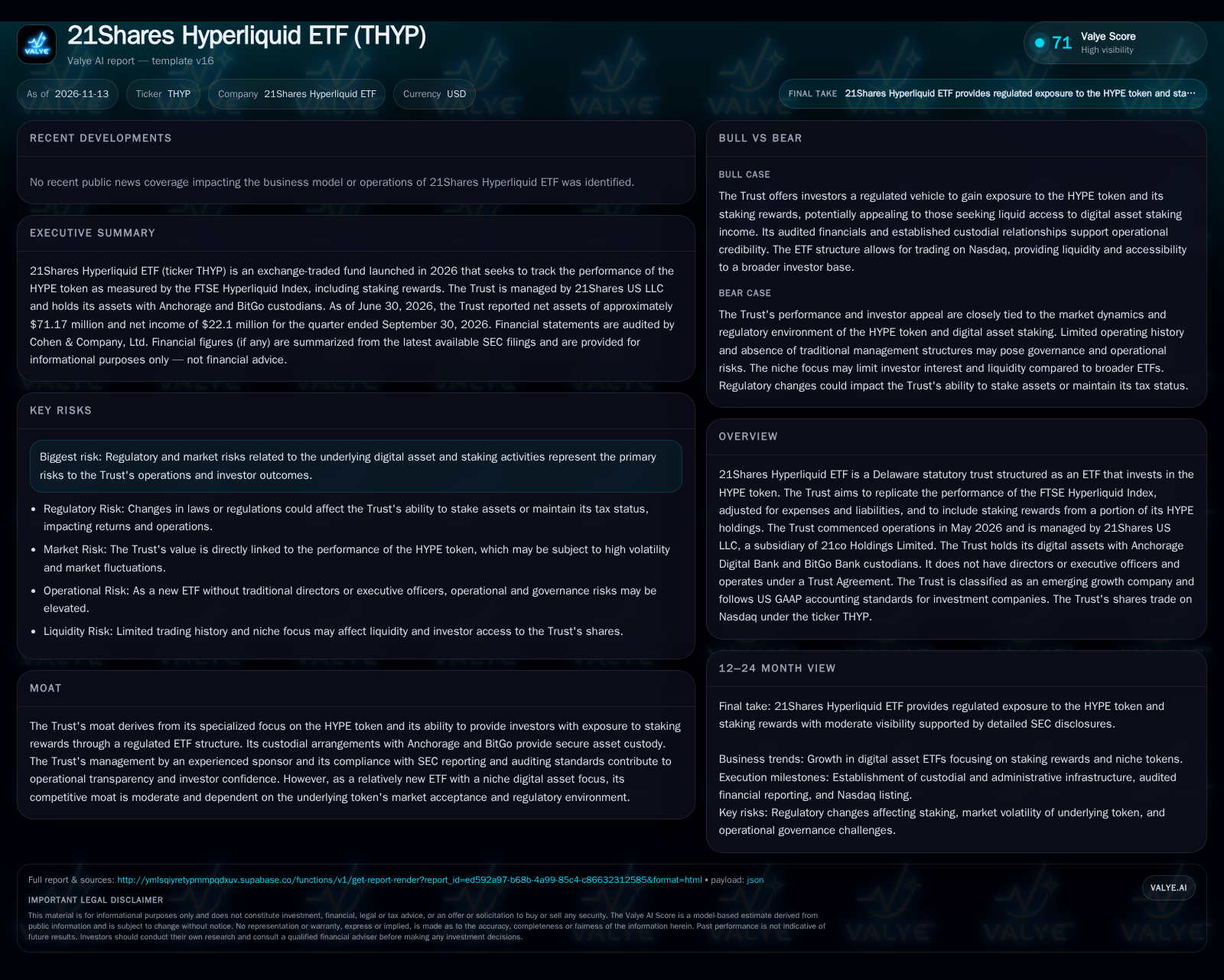
21Shares Hyperliquid ETF (THYP) is a Nasdaq-listed fund structured to track the FTSE Hyperliquid Index via direct HYPE token holdings, with nearly all assets staked to generate additional rewards. With $71.17 million in net assets and $22.1 million in net income for its first reported quarter, the ETF delivers transparent, audited access to digital asset yield—but faces concentrated market, regulatory, and operational risks, with future scale and resilience tied to both the HYPE token’s trajectory and the regulatory stance on staking activities. [S2]
21Shares Hyperliquid ETF (THYP) has quickly established itself as a regulated, exchange-traded vehicle for investors seeking exposure to both the price movement and staking rewards of the HYPE token. With net assets of $71.17 million and a notable $22.1 million in net income for its first reported quarter, the fund’s structure delivers transparency and institutional-grade custody. However, its narrow focus on a single digital asset and dependence on staking economics place it at the crossroads of market enthusiasm and regulatory scrutiny. The next phase will test whether THYP’s model can scale and endure as the digital asset landscape evolves. [S2]
How the ETF’s Structure and First-Quarter Results Frame Its Strategic Stakes
21Shares Hyperliquid ETF began trading in May 2026 and holds $71.17 million in HYPE tokens as of June 30, 2026. Nearly all tokens (94.43%) are staked, generating $125,025 in staking rewards over a 3.5-month period. For the quarter ended September 30, 2026, the Trust reported $22.1 million in net income. These numbers are material for two reasons: first, they demonstrate that staking rewards are a meaningful revenue component; second, they highlight the ETF’s immediate sensitivity to HYPE token valuation and staking yield dynamics. The ETF’s assets are held with regulated custodians (Anchorage and BitGo), which supports operational security but does not insulate the Trust from token-specific or regulatory risks. [S2]
Mechanics of Value Creation: Price, Yield, and Expense Drag in a Token-Staking ETF
The ETF’s business model is straightforward: it tracks the FTSE Hyperliquid Index by holding HYPE tokens, and maximizes returns by staking nearly all holdings to capture additional yield. Income for shareholders is driven by two main factors: (1) the price appreciation (or depreciation) of HYPE, and (2) staking rewards, which function like a dividend but are subject to blockchain protocol terms and validator economics.
Operating costs are relatively low and transparent, with sponsor and staking fees totaling around $60,000 for the period ending June 30, 2026. The principal variable expenses are sponsor fees (management fees) and any staking-related costs. Because most operational functions are outsourced (custody, administration), the Trust’s fixed cost base is low, and there is little operating leverage beyond scale benefits from asset growth. However, all cash flows and reported income remain fundamentally dependent on HYPE’s market price and staking yield, exposing the ETF to sharp swings in net asset value and income—even with efficient cost controls. [S2]
Unlike traditional ETFs that may diversify across sectors or asset classes, THYP’s economics are tightly coupled to a single token’s fate. This design creates a high-risk, high-potential-return profile, where the ETF’s income and growth prospects rise and fall with the fortunes of the underlying protocol.
Can a Single-Token Staking ETF Carve Out a Durable Niche?
THYP’s competitive edge stems from offering regulated, exchange-traded access to HYPE and its staking rewards—features not universally available in the digital asset space. The ETF’s custodial partnerships with Anchorage and BitGo lend credibility, and its audit trail via Cohen & Company supports transparency.
However, the moat is moderate and contingent. The ETF faces competition from other single-token and multi-asset crypto ETFs, as well as from direct token ownership and staking by sophisticated investors. If HYPE fails to maintain relevance or if staking yields decline, the ETF’s differentiated value diminishes. Additionally, broader crypto ETFs or future entrants offering lower fees, broader diversification, or enhanced staking mechanisms could erode THYP’s appeal.
Switching costs for investors are low in the ETF and digital asset space. The ETF’s liquidity and Nasdaq listing help, but do not guarantee resilience if HYPE interest wanes or if regulatory headwinds increase.
What Could Unlock Structural Growth and Premium Valuation for THYP?
A favorable pathway hinges on several reinforcing factors: (1) HYPE token adoption and price appreciation, (2) sustained or rising staking yields, (3) regulatory clarity supporting staking within ETF wrappers, and (4) increasing institutional and retail demand for regulated, easy-access crypto yield products.
If HYPE becomes a leading blockchain with rising usage, and staking yields remain attractive relative to traditional fixed income, THYP could see rapid asset inflows as investors seek both yield and price exposure. The ETF’s transparent structure and custody could become a selling point for cautious institutional investors. Confirmation would come from consistently rising assets under management (AUM), strong secondary-market trading volumes, and persistent net inflows—even during periods of broader crypto volatility. Disclosures of new institutional holders or partnerships could also support the bull thesis.
Sustained Volatility, Episodic Growth, and the Realities of Token-Linked ETFs
The most plausible outcome is that THYP’s performance will closely mirror the HYPE token’s price cycles and the ebb and flow of staking returns. In this scenario, the ETF experiences periods of AUM expansion during crypto bull markets and contractions during risk-off or regulatory events. Staking rewards provide a modest yield buffer, but income and investor interest remain highly volatile.
Operationally, the ETF continues to deliver audited reports, maintain secure custody, and manage expenses. However, growth is episodic, tied to HYPE’s popularity, and subject to sharp reversals. Evidence supporting this scenario would include AUM and trading volumes that move in step with HYPE price action, and fee income that remains a small fraction of total returns.
How Regulatory Shifts or Token Weakness Could Undermine the Model
The main adverse chain involves either a material drop in HYPE’s value, a collapse in staking yields, or a regulatory intervention restricting staking or ETF eligibility for digital assets. In this scenario, the ETF’s NAV and income could fall sharply, with secondary-market liquidity drying up and net outflows accelerating.
Operationally, the ETF could face higher costs if new compliance or security requirements are imposed, or if custodial arrangements are disrupted. Investor confidence could erode if the regulatory environment turns hostile or if HYPE suffers a technical or reputational setback. Confirmation would come from declining AUM, widening bid-ask spreads, or changes to staking policies or ETF eligibility announced by regulators or the sponsor.
Milestones That Will Test the ETF’s Staking Yield Model and Market Relevance
AUM growth or contraction relative to HYPE price movements—persistent net inflows during market dips would suggest differentiated demand.
Sustained percentage of HYPE holdings staked—if disclosed, any reduction could indicate regulatory constraints or changing yield economics.
Quarterly staking rewards relative to total income—would help test the significance and stability of yield as a component of returns.
Sponsor fee and expense ratio trends—rising costs could erode net yield or signal operational challenges.
Secondary-market trading volumes and bid-ask spreads—reduced liquidity could precede investor exit or loss of relevance.
Any public disclosure of regulatory investigations, rule changes, or restrictions impacting staking or ETF eligibility.
Shifts in custodial arrangements or security incidents involving Anchorage or BitGo—would be material for operational risk assessment.
Announcements of new ETF competitors targeting HYPE or similar staking strategies—would help gauge the durability of THYP’s niche.
Disclaimer: This is research-only, informational analysis and not investment advice. It may include AI-generated interpretation and general industry context. Always verify important details using primary sources.

Comments