
ITHAX Acquisition Corp III: The Clock Ticks for Value Creation in a Classic SPAC Structure
The company’s economics, opportunity, and risk profile are defined not by operations, but by the pursuit and outcome of a single, transformative deal.
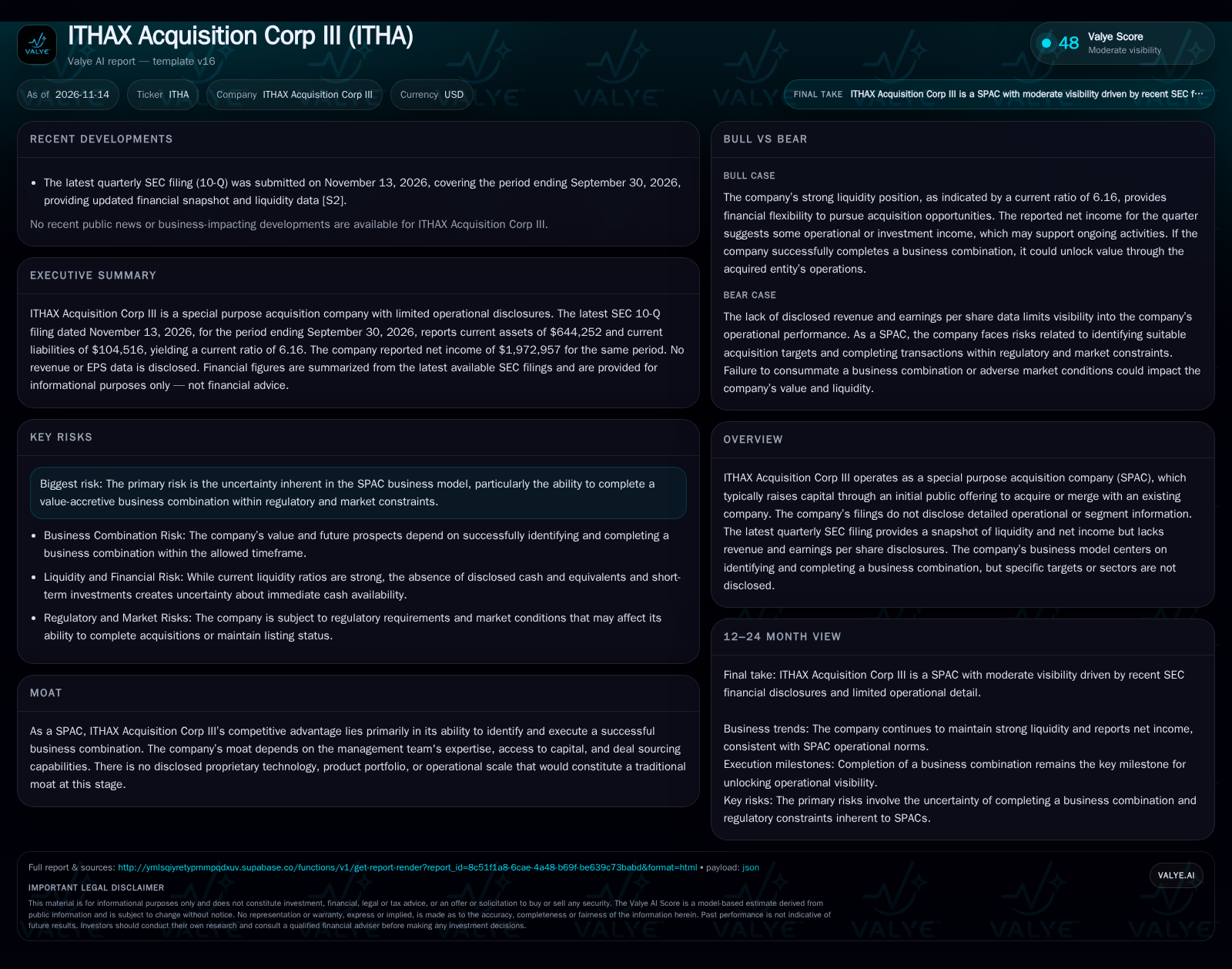
ITHAX Acquisition Corp III’s financials reflect the typical SPAC lifecycle: no operating revenue, net income driven by trust interest, and a reported current ratio. The company’s fate hinges on sourcing and closing a business combination within the regulatory window, with capital preservation and deal quality as central variables. Failure to execute a transaction would result in liquidation and capital return to shareholders, while a successful merger could unlock operational value.
ITHAX Acquisition Corp III stands as a textbook special purpose acquisition company (SPAC), defined less by its operations and more by its capital structure and looming regulatory deadlines. With no operating revenue and net income entirely from interest on its trust account, the company’s current financial health is clear but its future is binary: either it completes a business combination and transitions into an operating entity, or it liquidates and returns capital to investors. This dynamic puts a premium on management’s dealmaking skill, timing, and access to attractive targets in a crowded and often challenging SPAC market.
Financial Snapshot Highlights Classic SPAC Profile and Imminent Decision Point
ITHAX Acquisition Corp III’s latest 10-Q, covering the period ending September 30, 2026, reveals a current asset base of $644,252 against current liabilities of $104,516, producing a current ratio of 6.16. This reflects reported liquidity position, typical for SPACs prior to deal execution [S2]. The company reported net income of $1,972,957 for the quarter, derived entirely from interest earned on assets held in trust, with no operating revenue or earnings per share data disclosed [S2]. The trust account, initially funded with $230 million from the December 2025 IPO and private placement, remains the company’s core asset and the financial lever for any future business combination.
These facts matter because they underscore the absence of ongoing operations and the binary nature of the SPAC’s future: either a successful business combination will deploy this capital, or regulatory deadlines will force liquidation and capital return to shareholders. The lack of disclosed acquisition targets or sector focus means that the company’s prospects remain entirely contingent on management’s ability to source and close a deal within the prescribed timeframe.
SPAC Economics: Yield on Trust, Fee Drag, and the All-Or-Nothing Deal Variable
ITHAX Acquisition Corp III’s economics are driven by the SPAC lifecycle rather than operating metrics. Until a merger is completed, the company earns interest income on its trust account (over $2 million in the last quarter), while incurring general and administrative expenses, including ongoing legal, regulatory, and diligence costs [S2]. These costs are modest relative to the size of the trust, but represent a drag on capital that accumulates over time.
The true economic inflection point comes with the business combination. If a suitable target is found and the merger is consummated, the SPAC deploys its trust capital—often alongside additional financing—to acquire or merge with an operating business. If the deal is well-structured, the resulting entity may offer public investors exposure to growth and operational cash flows. If no deal is reached within the regulatory window, the trust is liquidated and returned to shareholders, less expenses and deferred underwriting fees.
The capital structure is highly efficient in the pre-deal phase but exposes investors to deal quality and execution risk. The economics are further complicated by potential redemptions at the time of merger, which can reduce the cash available for the target and affect the post-combination capital base.
Deal Sourcing and Sponsor Reputation Drive Competitive Edge—Until Operations Begin
In the SPAC market, competitive advantage is defined by the ability to source, negotiate, and close attractive deals rather than by traditional operational or technological moats. ITHAX Acquisition Corp III’s edge, if any, resides in its sponsor network, dealmaker reputation, and relationships with financial intermediaries. The absence of a disclosed sector focus or proprietary sourcing platform means the company’s pipeline is opaque, and its ability to outcompete other SPACs for quality targets is unproven.
SPACs face competition both from other blank-check companies—many of which are also seeking targets under regulatory deadlines—and from private equity and strategic buyers. Target companies may prefer buyers that offer more certainty, operational synergies, or higher valuations. Additionally, recent market dynamics have seen increased scrutiny of SPAC deal quality, higher redemption rates, and tighter regulatory oversight, all of which increase the execution hurdle.
Until a business combination is completed, ITHAX Acquisition Corp III’s position is defined by its financial resources, sponsor credibility, and speed to deal. After a merger, its competitive set and business prospects will be determined by the acquired company’s industry and strategic posture.
Unlocking Value Through a High-Quality Acquisition: The Bullish Chain of Events
The most favorable outcome for ITHAX Acquisition Corp III is a timely identification and execution of a business combination with a high-quality, scalable target. This would require the management team to leverage its network and reputation to access a proprietary or undervalued opportunity, negotiate favorable terms, and execute the transaction before the regulatory deadline.
If the acquired company demonstrates strong operational prospects, public market appeal, and limited redemptions, the post-merger entity could benefit from increased investor interest, capital inflows, and a premium valuation. Confirmation of this scenario would be signaled by a definitive merger announcement with a well-regarded operating business, low redemption rates at the shareholder vote, and positive post-deal trading performance.
Falsification would occur if the company announces a deal with a marginal or highly speculative target, faces high redemption rates, or fails to close the transaction within the required timeframe.
Most Likely Trajectory: Extended Search and Deadline-Driven Dealmaking
The most plausible course for ITHAX Acquisition Corp III is an extended search for a suitable target, followed by an announcement and attempted consummation of a business combination as the regulatory deadline approaches. This path is typical for SPACs, as competitive pressure and deal scarcity often delay target identification and negotiation.
In this scenario, the company may face elevated redemption rates, especially if market sentiment is cautious or if the target is not perceived as high quality. The trust account provides a clear floor for investor downside, but also limits the upside unless the deal is well-received and operational execution post-merger is strong.
Evidence confirming this scenario would include a merger announcement in the final quarters before deadline, a standard shareholder vote, and redemption rates consistent with recent SPAC averages. Falsification would be a failure to announce any deal, or the announcement of a highly differentiated, in-demand target that materially lowers redemption rates.
Deal Failure or Liquidation: The Risks of Missed Timelines and Adverse Market Conditions
The principal risk for ITHAX Acquisition Corp III is the failure to close a business combination before the regulatory deadline, resulting in the liquidation of the trust and return of funds to shareholders, minus costs and fees. This scenario could arise from an inability to find a suitable target, excessive redemptions that drain the trust, or regulatory or market disruptions that derail the deal process.
Additional downside scenarios include the announcement of a deal with a distressed or low-quality target, leading to high redemptions, negative market reaction, and limited value creation for remaining shareholders. Confirmation would come from missed or delayed deal milestones, persistent lack of target disclosure, or explicit liquidation announcements.
Falsification of the downside would require the company to announce and close a deal with minimal redemptions and positive market reception.
Milestones and Metrics That Will Define ITHAX Acquisition Corp III’s Endgame
Announcement of a definitive business combination agreement, including target identity, sector, and transaction structure.
Redemption rates at the shareholder vote—high rates may signal weak deal quality or investor skepticism; a useful metric would be percentage of shares redeemed versus total public shares.
Timing of deal announcement relative to the regulatory deadline; late-stage deals may face increased execution risk.
Level of additional financing (PIPE or other) secured in connection with the merger, if disclosed, which could affect post-deal capitalization.
Post-announcement trading performance and investor sentiment, as measured by share price movement and trading volume.
Updates on regulatory or legal proceedings that could affect deal consummation or listing status.
Changes in market-wide SPAC sentiment and redemption trends, which may affect the feasibility and attractiveness of a business combination.
Disclaimer: This is research-only, informational analysis and not investment advice. It may include AI-generated interpretation and general industry context. Always verify important details using primary sources.

Comments