
Spruce Power: Solar Scale Ambitions Confront Capital Constraints and Integration Demands
Recent profitability, portfolio expansion, and cost-cutting efforts position Spruce Power for potential growth in the solar PPA market—but liquidity pressures and the complexity of acquisition integration could test the company’s ability to sustain momentum in a competitive, policy-driven sector.
Spruce Power has turned a quarterly profit and expanded its solar portfolio through acquisition, while focusing on recurring PPA lease revenue and operational efficiency. The company’s challenge is to drive profitable scale and integration without overextending its capital base in a volatile renewable market.
Spruce Power’s recent quarterly profit and expansion through acquisition suggest progress in its quest to become a leading platform for distributed solar assets. By growing its portfolio of power purchase agreements (PPAs) and focusing on cost discipline, the company has begun to demonstrate the operating leverage inherent to the sector. The company’s future hinges on integrating new assets, maintaining recurring lease revenue, and managing capital needs in a market shaped by policy, competition, and evolving technology.
Profitability Returns and Portfolio Expansion Reshape the Operating Landscape
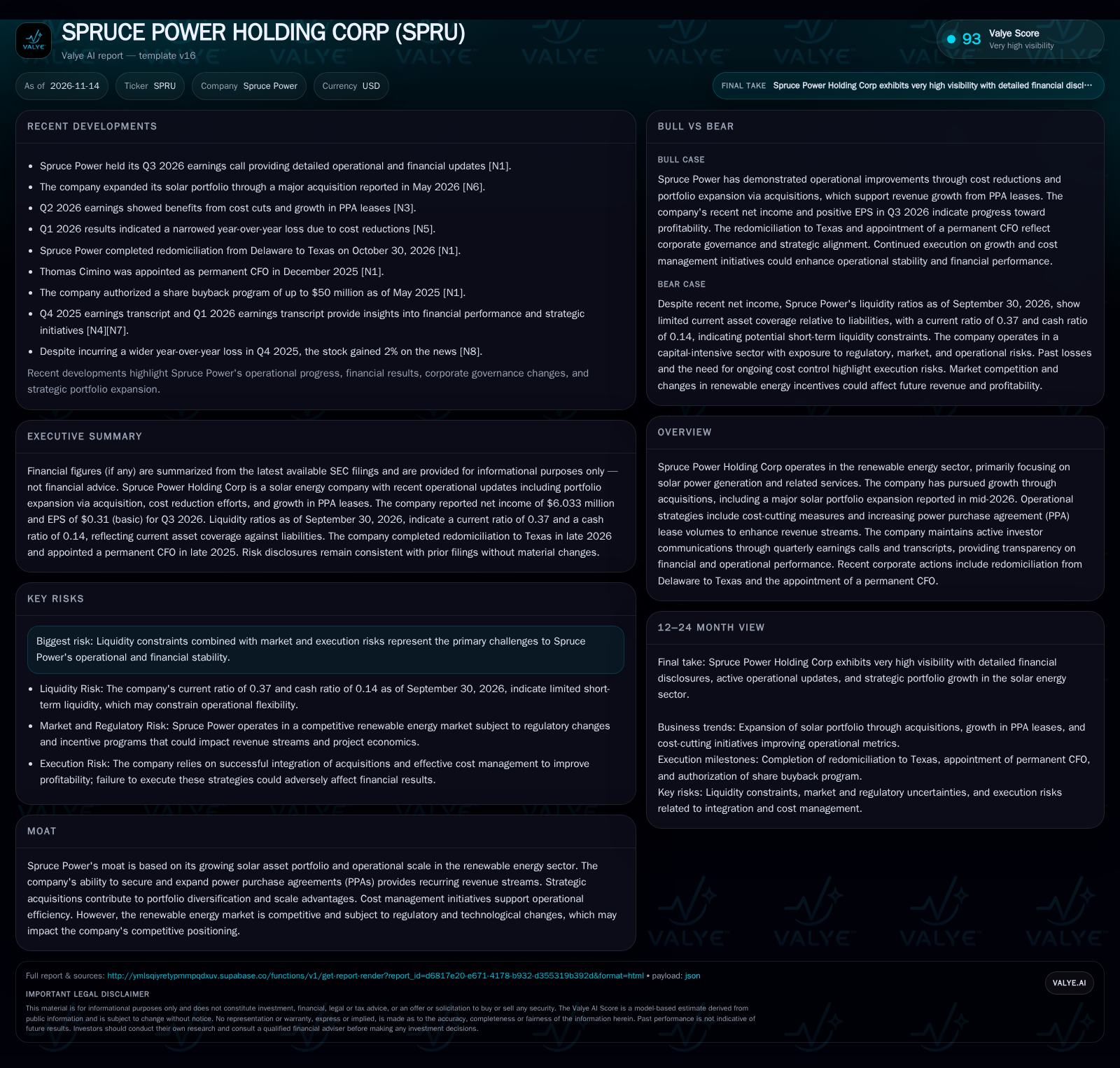
Spruce Power reported net income of $6.033 million for Q3 2026, with basic EPS of $0.31 and diluted EPS of $0.28 [S2]. This marks a shift from the prior pattern of losses and signals that recent operational changes—specifically cost-cutting and a larger PPA lease base—are producing positive bottom-line effects. In May 2026, the company completed a major solar portfolio acquisition, further increasing its exposure to recurring PPA revenue and the scale of its asset base [N6]. [S2]
The Mechanics of Solar PPA Revenue and the Challenge of Capital Efficiency
Spruce Power’s core business model is anchored in owning and operating distributed solar assets, monetized primarily through long-term power purchase agreements (PPAs) with residential and commercial customers. This structure typically yields recurring cash flows with predictable margins once assets are installed and operating. The economics are driven by the spread between contracted PPA rates and the combined costs of capital, operations, and asset maintenance. Scaling the portfolio through acquisition or organic origination can, in principle, deliver meaningful operating leverage as fixed corporate costs are spread over a larger revenue base.
However, the capital intensity of acquiring and maintaining solar assets imposes ongoing funding requirements. Each incremental asset typically demands upfront capital outlay, with returns realized over the multi-year life of the PPA. If Spruce Power can access low-cost capital or monetize assets efficiently, margin expansion and cash flow growth are plausible. The company reported a current ratio of 0.37 for the period. [S2] This dynamic makes access to external financing or asset recycling critical levers for the business model’s sustainability.
The timing and structure of capital deployment are critical to optimizing returns in the solar PPA model. Given the long-lived nature of solar assets and the extended duration of PPAs, upfront investment must be balanced against projected cash flow stability and discount rates that reflect both market interest rates and perceived project risk. If financing costs rise or asset performance deviates from expectations, the net present value of future cash flows can erode quickly, challenging the viability of expansion. Furthermore, the ability to recycle capital through asset sales or securitization depends on market appetite for renewable infrastructure, which can fluctuate with regulatory shifts and investor sentiment.
Scale, Asset Integration, and the Race for PPA Share in a Crowded Market
Spruce Power competes in a fragmented and competitive distributed solar landscape, where advantages can accrue to players with scale, cost discipline, and efficient capital sourcing. The company’s recent portfolio expansion suggests a bid for greater scale, which could confer negotiating leverage with vendors, better financing terms, and a broader geographic footprint. However, integration risk looms large—successfully absorbing acquired assets, harmonizing operations, and realizing targeted cost synergies are non-trivial tasks.
The market is also characterized by aggressive competition from both pure-play solar operators and diversified energy companies, many of whom have access to cheaper capital or proprietary origination channels. Customer switching costs in residential solar PPAs are moderate, as contracts are typically long-term but not always difficult to refinance or transfer. Regulatory incentives, such as investment tax credits or state-level renewable mandates, remain a key variable—any reduction in policy support could flatten growth or compress margins across the industry.
Geographic diversification within the portfolio can also influence competitive positioning and risk exposure. Markets with more favorable regulatory frameworks, higher solar irradiance, or stronger electricity demand growth can enhance asset utilization and contract pricing power. Conversely, concentration in regions facing policy uncertainty or grid constraints could heighten operational risk and limit growth potential. Efficient integration of acquired assets across diverse jurisdictions requires robust operational infrastructure and local expertise, which, if lacking, may delay synergy realization and increase costs. Thus, scale alone is insufficient without strategic alignment of asset location and operational capabilities.
Efficient Capital Deployment and Seamless Integration Unlock Lasting Value
If Spruce Power can successfully integrate its newly acquired portfolio and execute on further cost reductions, it could unlock significant operating leverage. Margin improvement would be driven by spreading fixed costs over a larger revenue base, while incremental growth in PPA leases would provide predictable, recurring revenue streams.
Additional signals would be successful refinancing of near-term liabilities on favorable terms, continued growth in PPA lease volumes, and improved asset-level performance metrics (if disclosed). Falsification would come from stalled integration, rising costs, or inability to access growth capital—manifesting in margin compression or renewed losses.
Incremental PPA Growth and Cost Controls Drive Gradual Progress
The most plausible path is that Spruce Power achieves moderate growth by carefully managing its existing portfolio, extracting gradual cost savings from integration, and selectively pursuing new PPA opportunities within its capital constraints. Recurring PPA revenue continues to underpin cash flow, but expansion is paced by available liquidity and the company’s ability to refinance or recycle assets. The business remains exposed to periodic working capital tightness and must maintain strict cost discipline to avoid slipping back into losses.
Confirmation of this scenario would come from stable or slightly improved quarterly earnings, slow but steady increases in PPA lease volumes, and management commentary focused on prudent growth and operational efficiency. Evidence to the contrary would be sharp deterioration in liquidity metrics, unexpected integration costs, or a reversal to net losses as acquisition benefits prove transitory.
Liquidity Constraints and Integration Challenges Undermine Momentum
If Spruce Power is unable to secure sufficient external financing or asset sales, near-term liquidity pressures could force a slowdown in operations, asset sales at unfavorable prices, or even raise going-concern questions. Integration difficulties—such as underperforming acquired assets, unforeseen maintenance costs, or inability to realize synergies—could erode margins and reverse recent profitability gains. In a worst-case scenario, tightening credit conditions or adverse policy shifts could further restrict access to capital and depress asset values.
This scenario would be confirmed by worsening current and cash ratios, negative operating cash flow, a return to net losses, or disclosures of covenant breaches and distressed asset sales. Early warning signs might include management guidance about capital needs, delays in PPA onboarding, or material write-downs of acquired assets.
What Could Shift Spruce Power’s Trajectory in the Next 12–18 Months
Quarterly trends in net income and operating cash flow—sustained profitability would signal successful integration and cost management.
Changes in current and cash ratios—improvement would indicate better liquidity management or access to new financing; deterioration could foreshadow operational stress.
Growth in PPA lease volumes—expansion here would confirm continued demand and effective portfolio scaling.
Evidence of successful integration of acquired assets—if disclosed, metrics on asset performance, cost synergies, or operational disruptions would help test acquisition execution.
Announcements of new financing arrangements, asset sales, or tax equity partnerships, which could alleviate liquidity constraints or fund growth.
Management commentary or disclosures around regulatory changes, incentive program adjustments, or shifts in competitive dynamics.
Asset-level performance data (if disclosed), such as delinquency rates, maintenance costs, or contract cancellations, to assess underlying portfolio health.
Disclaimer: This is research-only, informational analysis and not investment advice. It may include AI-generated interpretation and general industry context. Always verify important details using primary sources.

Comments