
Highview Merger Corp.: SPAC Structure, Execution Levers, and the Stakes of the Business Combination Window
Highview Merger Corp. enters the critical phase of its SPAC lifecycle, with $230 million in trust and a mandate to acquire a middle-market company. The coming quarters will test its management’s ability to secure a compelling target, navigate dilution and financing complexities, and deliver value before the liquidation clock runs out.
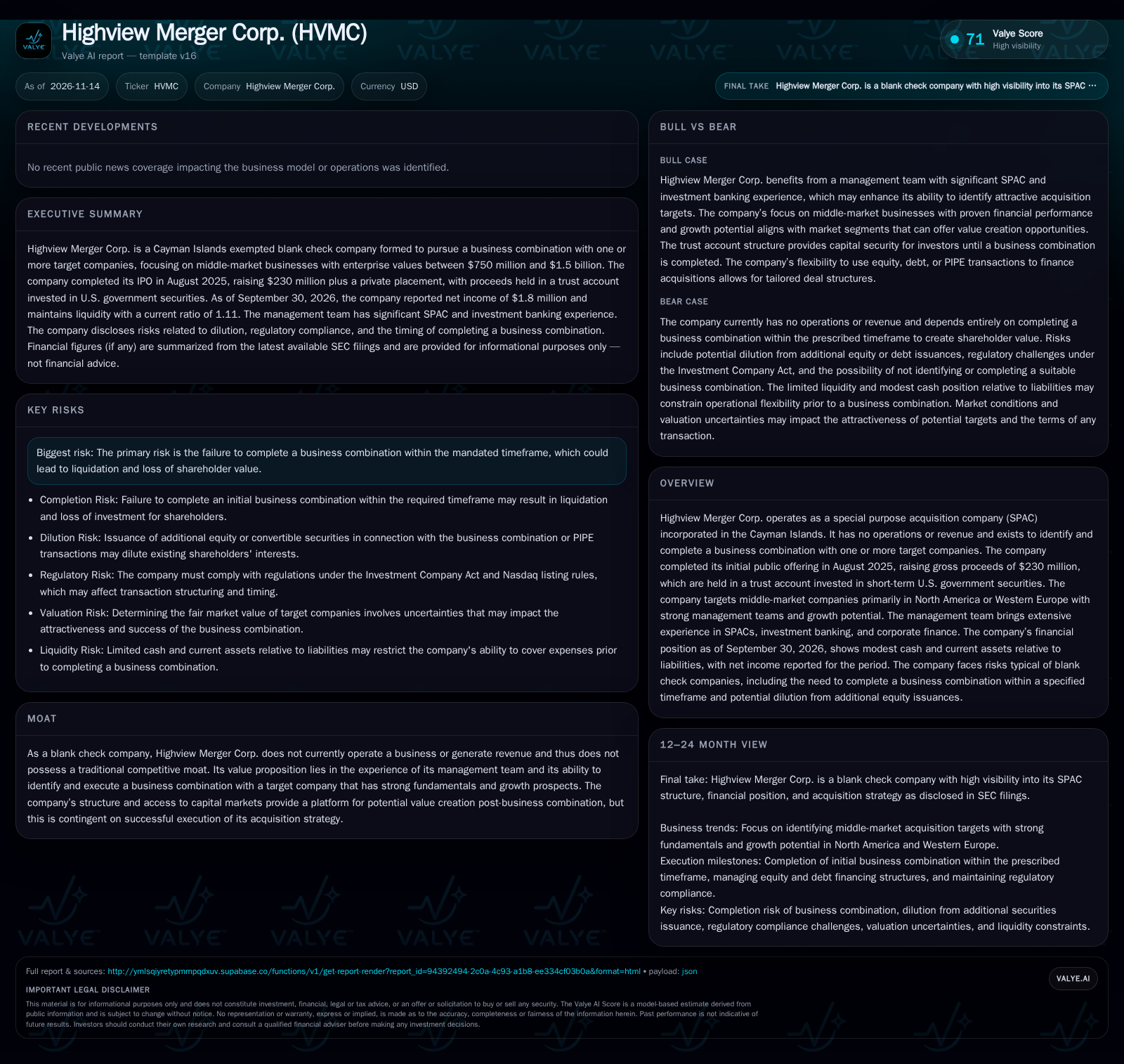
Highview Merger Corp. is a blank check company with $230 million in trust, seeking a business combination with a $750 million to $1.5 billion+ enterprise in North America or Western Europe. Execution on deal sourcing, structuring, and shareholder value creation are key to the outcome. [S1] [S2]
Highview Merger Corp. typifies the high-stakes world of blank check companies, having raised $230 million in an August 2025 IPO with a singular mission: to identify and merge with a promising middle-market business. With no operating activities or revenue, the company’s fate rests on management’s ability to find, negotiate, and close a transformative deal before its SPAC window closes. As the trust account sits idle, the coming quarters will determine whether Highview can convert its financial and structural resources into a successful business combination—or risk a value-eroding liquidation.
IPO Proceeds in Trust and the Countdown to a Business Combination
Highview Merger Corp. completed its $230 million IPO in August 2025, with all proceeds—including an additional $6.6 million from a private placement—held in a trust account invested in U.S. government securities, as required by its SPAC structure [S1]. As of September 30, 2026, the company had not commenced operations or generated revenue, and reported $427,598 in cash and a current ratio of 1.11 [S2]. The company’s mandate is to acquire a business with an enterprise value between $750 million and $1.5 billion or more, focusing on North American or Western European targets with strong management and growth prospects [S1]. The most material fact is that Highview remains a pre-deal SPAC: its entire value proposition and risk profile hinge on identifying and executing a business combination before the deadline, or else returning the trust proceeds to shareholders.
SPAC Economics: How Value Is Created—or Lost—Through the Deal Process
Highview Merger Corp.'s business model is structurally simple but economically complex. Until a business combination closes, the company earns only nominal interest income on trust assets and incurs expenses related to deal sourcing and administration [S1] [S2]. The real economics are triggered by the acquisition: the trust account (and any PIPE or debt financing) is used to fund the purchase, with Highview typically acquiring all or a majority of the target’s equity. Revenue, cash flow, and profitability then depend entirely on the target’s business and post-merger performance.
Critical levers include the price paid for the target relative to its earnings potential, the structure and cost of any additional capital raised (especially PIPEs or debt), and the dilution imposed on existing shareholders through share issuance or warrant exercises. The SPAC’s fixed operating costs are low, but the transaction itself can introduce significant variable costs—legal, advisory, and incentive fees—plus ongoing public company expenses post-merger. If the acquired business demonstrates strong operating leverage and cash generation, there is potential for significant value creation; if not, dilution and misaligned incentives can erode returns. The upfront capital structure, deal terms, and the quality of the target’s underlying economics are thus central to the ultimate outcome.
Deal Sourcing in a Crowded SPAC Market: Where Highview Could Stand Out—or Be Squeezed
Highview’s competitive positioning is defined less by traditional market share and more by its ability to source and close an attractive deal ahead of rival SPACs and direct private equity buyers. The company’s management team brings significant SPAC and investment banking experience, potentially giving it an edge in deal structuring and negotiation [S1]. However, the SPAC landscape remains crowded, with many blank check companies chasing a finite pool of quality targets—especially in the $750 million to $1.5 billion range.
Private equity, strategic buyers, and other SPACs represent direct competition, often with flexible capital and established reputations. Highview’s value proposition to targets may hinge on its ability to offer public market access, speed, and certainty of closure. Counterforces include target companies’ skepticism about SPAC dilution, regulatory scrutiny, and shifting market sentiment toward de-SPAC transactions. Ultimately, success depends on sourcing proprietary or under-the-radar opportunities, aligning incentives, and demonstrating execution certainty in a highly competitive environment.
Transformational Acquisition: How Highview Could Deliver Outsized Value
The favorable scenario for Highview is a successful merger with a high-quality, growth-oriented company at a reasonable valuation. The ideal target would have an established track record, strong management, and clear public comparables, enabling investor confidence and post-merger stock support [S1]. The causal chain: Highview leverages its management’s deal experience to source a proprietary opportunity, negotiates attractive terms, and closes the deal with minimal dilution and a compelling equity story. The post-merger company executes on its growth plan, delivers earnings expansion, and benefits from public market multiples.
Confirmation of this scenario would include a definitive merger agreement with a target exhibiting robust historical financials, positive investor reception to the deal terms (as indicated by low redemption rates and PIPE participation), and post-close operational momentum. Falsification would be signaled by failure to secure a high-quality target, excessive dilution, or an adverse investor reaction to the announced transaction.
Execution Realities: The Likely Middle Outcome for Highview’s SPAC Journey
The most plausible scenario is that Highview identifies a credible but not best-in-class target, negotiates a deal that requires meaningful dilution (via equity or PIPEs), and completes the merger near the end of its SPAC window. The merged company may have a solid operating base but faces the typical post-SPAC challenges: integration, public company costs, and pressure to meet growth expectations.
Evidence supporting this path would be an announced deal with a target in the stated size and geography range, moderate redemption rates, and the use of additional equity or debt to complete the transaction. Falsification could occur if Highview is unable to announce or close a deal before the deadline, or if the acquired company struggles to deliver on its public market narrative.
The Liquidation Clock: What Happens if No Deal Materializes
The adverse scenario is straightforward: Highview fails to secure or close a business combination within the mandated timeframe, triggering liquidation and the return of trust proceeds to shareholders (minus permitted expenses) [S1] [S2]. In this case, public shareholders recoup their investment (with nominal interest), but sponsors lose their at-risk capital and warrants, and any value creation opportunity is lost.
Confirmation would come from the absence of a merger agreement as the deadline approaches, regulatory or market headwinds preventing deal closure, or high shareholder redemptions making a deal unviable. The risk is heightened by competitive deal-making, market volatility, and the finite pool of attractive targets. Falsification would require the announcement of a credible, binding merger agreement with a clear pathway to closure.
Milestones That Will Define Highview’s SPAC Outcome
Announcement of a definitive merger agreement with a target company, including target industry, size, and financial profile.
Redemption rates by public shareholders upon deal announcement and completion—if disclosed—indicating investor confidence.
PIPE financing participation and terms, if any, which would signal external investor validation and the cost of incremental capital.
Dilution impact from equity or warrant exercises and the resulting pro forma ownership structure post-merger.
Regulatory developments affecting SPAC or de-SPAC processes, including any changes to the Investment Company Act treatment.
Target company’s post-merger revenue, EBITDA, and growth trajectory—would help test the ultimate value creation thesis.
Progress toward the SPAC’s mandated business combination deadline, and any extensions or amendments to the original terms.
Disclaimer: This is research-only, informational analysis and not investment advice. It may include AI-generated interpretation and general industry context. Always verify important details using primary sources.

Comments