
PLUS THERAPEUTICS: Navigating Innovation, Financial Strain, and the Race for CNS-Targeted Nanomedicine
PLUS THERAPEUTICS is advancing proprietary radiotherapeutics and diagnostics for central nervous system (CNS) diseases, but faces urgent financial constraints, regulatory complexity, and the relentless pace of biopharma innovation.
PLUS THERAPEUTICS develops nanomedicine-based radiotherapeutics and diagnostics, including the CNSide platform, targeting CNS diseases. Despite patent protections and ongoing innovation, the company faces acute liquidity pressure—current liabilities exceed current assets as of Q3 2026—and must continuously adapt to rapid industry evolution and regulatory scrutiny. The trajectory hinges on translating R&D into durable revenue before financial strain or shareholder dilution becomes critical. [S1] [S2]
PLUS THERAPEUTICS, INC. is betting on the promise of targeted radiotherapeutics and diagnostics for CNS diseases, leveraging its CNSide platform and proprietary rhenium-based candidates. While the company’s intellectual property portfolio and innovation pipeline could carve out a niche in the evolving landscape of nanomedicine, the business is under acute short-term financial strain: as of Q3 2026, current liabilities substantially exceed current assets, and net losses continue. Whether PLUS can parlay its scientific assets into commercial momentum—or will be forced into dilutive financings or strategic pivots—remains the central question.
Liquidity Stress and Platform Ambition Define PLUS’s Near-Term Reality
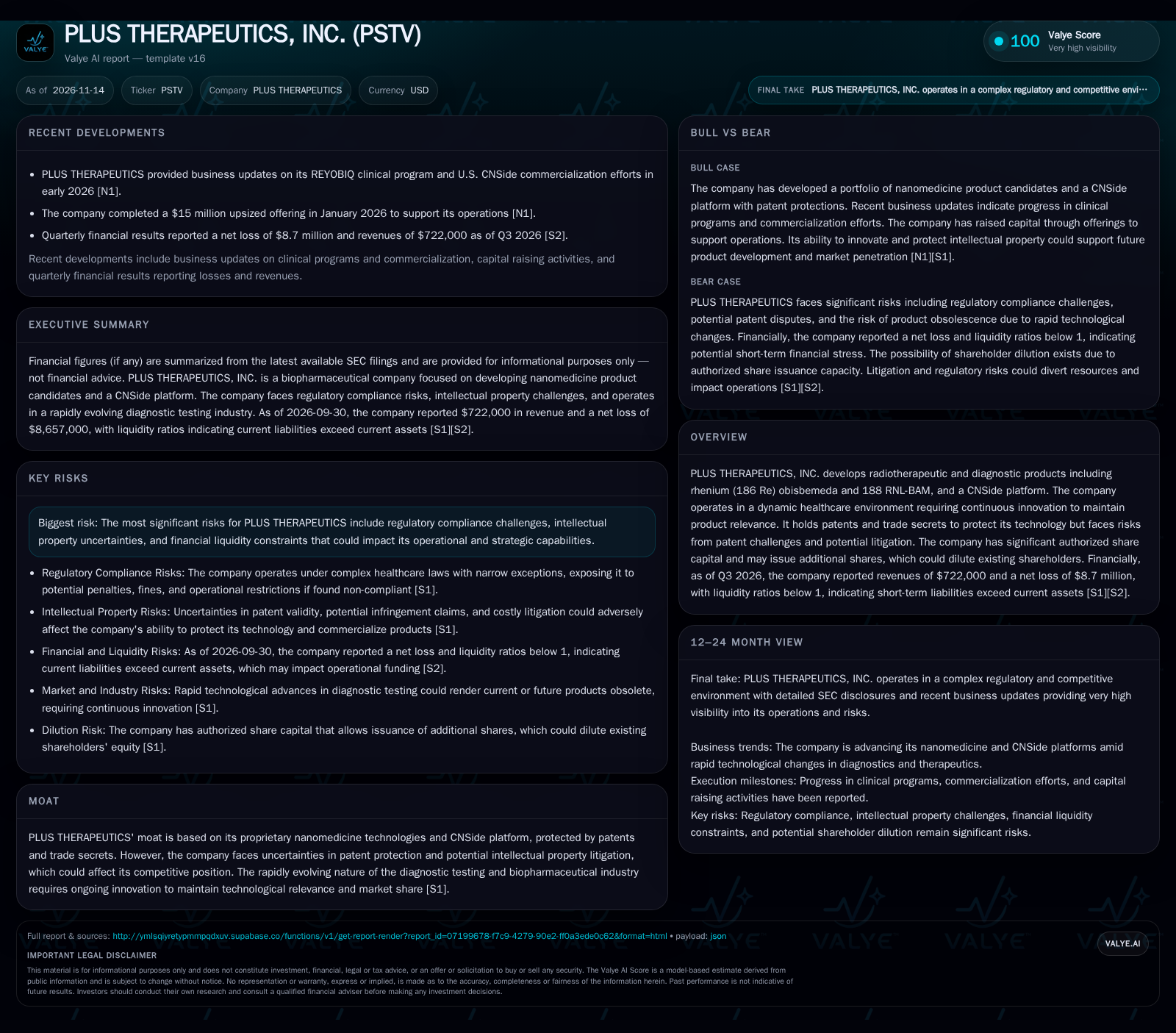
PLUS THERAPEUTICS reported $722,000 in revenue and a net loss of $8.7 million for Q3 2026, with current assets of $8.1 million and current liabilities of $13.1 million. The current ratio of 0.61 and cash ratio of 0.37 mean that short-term obligations outstrip liquid resources, signaling immediate financial pressure. The company’s product portfolio centers on rhenium-based radiotherapeutics and the CNSide platform, protected by patents and trade secrets, with a strategic focus on diseases of the central nervous system. These facts underscore a business at the intersection of innovative promise and pressing financial constraints. [S1] [S2]
The liquidity stress faced by PLUS THERAPEUTICS also reflects broader structural challenges inherent in developing CNS-targeted nanomedicines. CNS diseases often require prolonged clinical trials due to complex pathophysiology and stringent safety requirements, extending the timeline before potential revenue generation. This elongation of the development cycle intensifies the need for sustained capital, making the company vulnerable to funding gaps. Moreover, the niche nature of CNS indications can limit the immediate market size, necessitating a carefully calibrated balance between R&D investment and market entry speed to avoid exhausting resources prematurely.
How Commercialization Could Unlock or Undermine PLUS’s Model
PLUS THERAPEUTICS’s economics hinge on successfully bringing its radiotherapeutic and diagnostic candidates to market, particularly for high unmet-need CNS indications where pricing can be favorable. In biopharma, successful clinical and regulatory milestones typically unlock value through out-licensing, partnerships, or direct commercialization—each with different capital requirements and margin profiles. The company’s patent protections could, in theory, enable premium pricing and temporary insulation from generic competition, but only if products reach market and are reimbursed.
Fixed costs associated with R&D, regulatory compliance, and intellectual property enforcement are high, while variable costs—once a drug is approved—can be modest relative to price in rare or complex diseases. However, absent meaningful product revenue, these upfront investments drive persistent operating losses. PLUS’s current liquidity profile suggests it may need to raise capital—potentially through equity, which would dilute existing holders—or secure non-dilutive funding (e.g., grants, partnerships) to extend runway. The economics will turn only if clinical assets achieve approval and adoption before financial pressures force suboptimal strategic moves.
Commercial success in the CNS radiotherapeutics space depends heavily on reimbursement dynamics, which are influenced by the demonstration of clear clinical benefit and cost-effectiveness relative to existing standards of care. If PLUS’s candidates can establish superior efficacy or safety profiles, payers may be willing to could support premium pricing, but this is contingent on robust health economics and outcomes research. Additionally, the scalability of manufacturing radiotherapeutics, which often involve complex isotope production and handling, could impact gross margins and supply reliability. Strategic partnerships with specialized manufacturers or contract organizations might mitigate these operational risks but at the cost of margin dilution.
Innovation Edge Versus Industry Headwinds: Where PLUS Sits in the Biopharma Race
PLUS THERAPEUTICS competes in the crowded and rapidly evolving field of CNS-targeted therapeutics and diagnostics. Competitors range from large, well-funded pharmaceutical companies to other emerging biotechs pursuing radiotherapeutics, nanomedicine, and CNS disease solutions. The company’s position relies on a combination of proprietary chemistry (rhenium-based agents), targeted delivery (CNSide platform), and intellectual property. However, biopharma moats are notoriously leaky: patent challenges, scientific advances elsewhere, and the introduction of new modalities (e.g., antibody-drug conjugates, gene therapies) can quickly erode any edge.
Switching costs in this space are typically low for payers and providers once a superior therapy is approved, so the sustainability of PLUS’s position depends on ongoing innovation, successful clinical differentiation, and the ability to either partner with or outpace larger players. The threat of litigation over intellectual property and the risk of competitors leapfrogging with disruptive platforms are persistent counterforces.
The competitive environment for CNS-targeted nanomedicine is characterized by rapid scientific advances that can render existing platforms obsolete or less attractive. PLUS’s reliance on rhenium-based agents and the CNSide delivery system requires continuous innovation to maintain differentiation. This includes iterative improvements in targeting specificity, biodistribution, and minimizing off-target effects. Additionally, regulatory pathways for novel radiotherapeutics can be uncertain, and competitors with more established clinical data or broader pipelines might secure faster approvals or payer acceptance. The company’s ability to anticipate and respond to these dynamics through agile R&D and strategic collaborations will be critical to sustaining its competitive position.
A Path to Value Creation: Clinical Progress and Strategic Partnerships
If PLUS THERAPEUTICS can demonstrate compelling clinical data for its rhenium-based radiotherapeutics—particularly in CNS indications with high unmet need—it could attract strategic partners or acquirers, or even achieve regulatory approval and commercial launch. This would validate the technology, potentially enable premium pricing, and provide non-dilutive funding via upfront payments, milestones, or royalties. Evidence confirming this scenario would include successful completion of pivotal clinical trials, partnership announcements with larger pharmaceutical companies, or regulatory submissions/approvals.
A falsification would be stalled or negative trial results, lack of partnering interest, or continued capital raises at increasingly dilutive terms without corresponding progress in the clinic or market.
Most Likely Outcome: Incremental Progress Amid Financial Constraints
The most plausible path for PLUS THERAPEUTICS is a period of incremental clinical progress, punctuated by ongoing funding challenges. The company may advance its lead assets through further trials and generate positive early-stage data, but will likely require additional capital to bridge to later-stage development or commercialization. This could take the form of equity issuance (increasing dilution), smaller-scale partnerships, or grants, but with no guarantee of near-term revenue inflection.
Confirmation of this middle path would be regular yet modest clinical updates, continued net losses, and periodic capital raises—without transformative licensing deals or late-stage trial readouts. A deviation could occur if the company secures a major partnership or experiences a clinical setback that forces a strategic re-evaluation.
Financial Strain Forces Dilution or Strategic Retreat
In the adverse scenario, PLUS’s liquidity pressures intensify before meaningful clinical or commercial milestones are hit. The company is forced to issue substantial equity at depressed valuations, sharply diluting existing shareholders. Alternatively, inability to secure funding could force asset sales, program discontinuations, or even insolvency. Regulatory or IP setbacks could accelerate this decline by undercutting the perceived value of the pipeline.
Evidence confirming this outcome would include large, dilutive financings with minimal strategic benefit, significant program cuts, IP litigation losses, or going-concern warnings in SEC filings. Falsification would require clear signs of non-dilutive funding, clinical breakthroughs, or stabilization of the balance sheet.
Signals That Will Shape PLUS THERAPEUTICS’ Strategic Trajectory
Updates on the pace, results, and regulatory status of clinical trials for rhenium (186 Re) obisbemeda, 188 RNL-BAM, and the CNSide platform.
Announcements of new strategic partnerships, licensing deals, or non-dilutive funding arrangements.
Trends in operating cash burn and the timing/terms of capital raises, including any large-scale equity issuance.
Evidence of progress or setbacks in patent litigation, IP challenges, or regulatory compliance matters.
Revenue growth attributable to new product adoption, if disclosed, rather than one-time or non-core sources.
Changes in management’s risk disclosures regarding going-concern status or ability to fund operations for the next 12 months.
Clinical or regulatory developments in competing CNS radiotherapeutic or nanomedicine platforms that could impact the company’s competitive landscape.
If disclosed, customer or partner retention rates and the terms of commercial agreements would help test the durability of any achieved traction.
Disclaimer: This is research-only, informational analysis and not investment advice. It may include AI-generated interpretation and general industry context. Always verify important details using primary sources.

Comments